
Many years ago, I had done a post of credits songs: songs that appear at the beginning of a film, playing as the credits roll. Not just music, not just a verse or two, but a full-fledged song, often (as in the case of Garjat barsat saawan aayo re or Rangeen bahaaron se hai gulzaar Chinatown, to give just two examples) songs that were there only through the credits; they didn’t appear otherwise in the film.
Some readers suggested it might be interesting to find songs that did the opposite. Songs that ended a film, but were complete in themselves. Not (as is common in a lot of films) a verse or a refrain from an-already-heard song that is reprised at the end. Not like the hit love song of which the refrain is played again while the happy couple, now married, go off into the sunset.
No. These are songs which appear only at the end of the film. Not necessarily at the climax: Yeh mahalon yeh takhton yeh taajon ki duniya comes near the end, but there are several scenes beyond that. But songs which actually end the film.
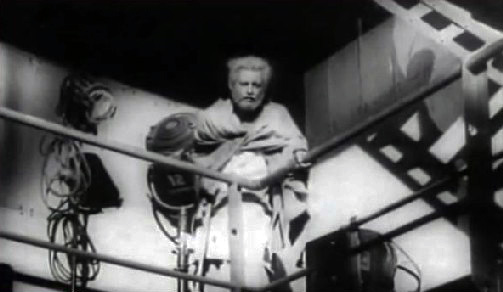
Because such songs seem to be actually few and far between, I have given myself some leeway: these are songs which end the film, or have no more than two minutes of the film remaining after the song ends.
As always, these are all from pre-1970s Hindi films that I’ve seen, and are in no particular order.
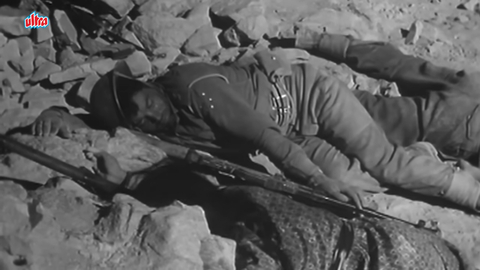
1. Kar chale hum fida jaan-o-tan saathiyon (Haqeeqat, 1964): This was the song that first came to my mind when I began compiling this post. At the end of the most hard-hitting, grittily real Hindi war film comes this patriotic song that is both a tribute to the nation as well as to the immortal soldiers who lay down their lives for it. Interspersed with the scenes of the dead across the battlefield are the scenes of those they leave behind: the mourning family and friends and sweethearts, the colleagues who have somehow survived, even the Republic Day parade that celebrates the armed forces.
An iconic song.
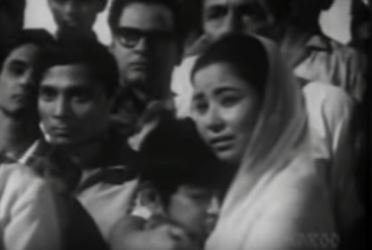
2. Meri aawaaz suno pyaar ka raaz suno (Naunihaal, 1967): Another song following a death, and also, in its way, a song celebrating a life lived for the country: Pandit Jawaharlal Nehru, to meet whom this film’s young protagonist has journeyed all this way, has passed away. Real-life footage of the cavalcade leading through teeming thousands across Delhi’s streets form most of this song, with only a few shots here and there of the film’s characters. A beautiful paean to the stature of Chacha Nehru, the affection with which countless Indians regarded him.
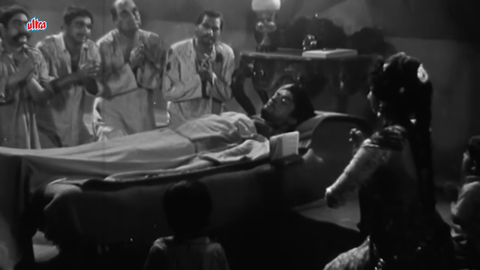
3. Ae maalik tere bande hum (Do Aankhen Baarah Haath, 1957): One more song for the dead and the dying, and then we’ll move on to happier (or at least different) themes. This is one of two songs in this list which is a version of a song that appears earlier in the film: V Shantaram’s character sings Ae maalik tere bande hum in his attempt to reform the criminals he’s taken charge of. At the end of the film, the woman who’s fallen in love with him offers comfort (and homage) to him by sitting by his deathbed and singing the same song back to him. Not just a single verse, not just a few bars, but the entire song.
This, also, is a song followed by a bit of dialogue (no more than two minutes) before The End comes on. Here, a senior police officer arrives to announce that the prison sentences of the convicts have been cut short: and the now ex-convicts, though they have the option to now go their way, decide unanimously that they must honour the man who turned their lives around.
4. Chal ri sajni ab kya soche (Bambai ka Babu, 1960): There is something very dramatic about a song ending a film, which is why most of the songs in this list focus on films that end with a death. Here is another dramatic, sad (from one point of view) end to a film: a parting of ways for two people who are deeply in love but can never be together. Dev Anand’s character, a fugitive who’s reformed thanks to the love and affection he’s received in a faraway village, has ended up falling in love with the sister of the man he’s impersonating. Even though she eventually discovers his real identity and reciprocates, to the rest of the family, he will remain the long-lost son, the man they don’t know killed their real son.
A poignant song, and one of my favourite Mukesh songs. This one does have some dialogue near the end, but the music and humming recommences right after that.

5. Mere saajan hain us paar (Bandini, 1963): One of the most haunting songs in SD Burman’s unmistakable voice, Mere saajan hain us paar is—like Chal ri sajni ab kya soche—a woman’s thoughts expressed in a song sung by a male. Nutan’s character, off to marry the kindly doctor (Dharmendra) to whom she is affianced, waits for the steamer on which she is to travel. A man at a nearby teashop starts singing, and even as the woman moves about, restlessly, she spots the man she once loved. Still loves. Broken, frail, needing help even to walk—but the sight of him, combined with the despairing words of the song—gives her the impetus she needs to decide what she must do.
What a beautiful song this is.
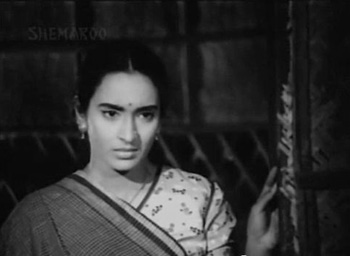
6. Jaago Mohan pyaare (Jaagte Raho, 1956): Through the space of one long, harrowing, extremely eventful night, a thirsty villager (Raj Kapoor) in the big, bad city of Calcutta has chased a sip of water. He has encountered hypocrisy, corruption, evil on different levels. Finally (and symbolically) when the dawn comes, he washes up at a temple, where a jogan (Nargis) gives him water to drink. The entire sequence plays out as a background song, while Nargis goes about her morning work and worship, as the city comes awake, as a literal—and metaphorical—dawn arrives.

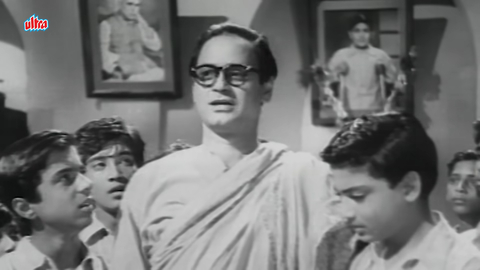
7. Hum laaye hain toofan se kishti nikaalke (Jagriti, 1954): If Do Aankhen Baarah Haath was a story of an idealistic jailor trying to reform a bunch of hardened criminals, Jagriti told the tale of a teacher who takes it upon himself to show the way to a group of jaded schoolboys, long neglected and subjected to teachers who are lackadaisical at best, tyrannical at worst. One of the plus points of Jagriti (and it had several, including a stellar performance by Abhi Bhattacharya) was its music, composed by Hemant Kumar. The film ended with this song, when the teacher is finally bidding farewell to the boys he’s nurtured all these months.
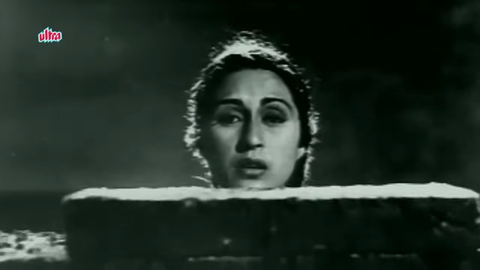
8. O door ke musaafir (Udan Khatola, 1955): Another song that ends a film, and also heralds the end of a life. Unlike Meri aawaaz suno, O door ke musaafir does not sing of a gentle going into the night, a long life well-lived: this is a dramatic death, a death that is imminent and therefore perhaps the more painful for the one who is left behind. Nimmi’s character, a tribal princess, must save her tribe from the wrath of their deity—by sacrificing herself. All her tribe gathers around to witness her death, but at the forefront is the outsider, the foreigner who has fallen in love with her (Dilip Kumar), and it is he who sings this song of desperation, begging the doomed ‘traveller’ to take him along as well.

9. Yeh zindagi usi ki hai (Anarkali, 1953): Even as she is bricked up for daring to fall in love with the Crown Prince Salim, Anarkali sings a song of farewell, very much akin to O door ke musaafir, although this song is from the opposite point of view: this is the song of the one who is dying, leaving behind the one they love. Yeh zindagi usi ki hai has two versions, a happy one (when Anarkali and Salim are vowing eternal love, joyous in their relationship) and this one, when she sees the end of all her hopes and dreams, and can only think of still vowing her devotion to the man she loves.
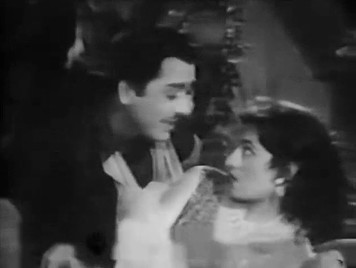
10. Dil par yeh kaisa tune khanjar maara re (Police, 1958): And, to end the list, a very unusual song. Pretty much all the songs in this list have a dramatic, often sad, context. A death; a separation; the light at the end of the tunnel: all classically impactful ways of ending a story. But Police, a fairly amusing, entertaining thriller, had a surprising end to it. Just when all ends have been neatly tied, the criminal has received his due punishment and justice has been served, the two lovers have been united—he decides to sing a song to his lady love. Not even just a verse or so from a previously-sung song (as in Sagaai or umpteen other films) but a full-fledged, new song. Composed by Hemant and sung by him, I love this one: so peppy and infectious.
Do you have any other songs to add to this list? Please share!
 Dustedoff
This is such a lovely collection! Thank you so much for this post …
LikeLiked by 1 person
Thank you so much! I am glad you enjoyed this one.
LikeLike
What a wonderful idea for a post, dear Madhu!
The first few songs that came to my mind are mere sajan hai us par, jago mohan pyaare and ye zindagi usiki hai. I adore all of them. All other songs in your list were unknown to me or I didn’t know that they were end-of-the-film songs. Dil par tune kaise came as a big surprise.
If I am not mistaken the title song of Dil Ek Mandir (1963) is a song which fits your list, but I can’t say that it is one of my favourite songs. I think another song also concerned with Rajendra Kumar’s death is aman ka farishta kahan jaa raha hai from Aman (1967). It is also a song which would fit here.
LikeLiked by 1 person
Thank you, Harvey, I’m glad you enjoyed this post. The Amar song had occurred to me also (mostly because it is similar in tone and picturisation to Meri aawaaz suno), but given that I am not a fan of Rajendra Kumar, and I don’t like the film (or the song, actually!) I decided to skip it. Dil ek mandir is a better song, but TBH, I’d forgotten that it ended the film. In any case, even if I’d remembered, I don’t think I’d have included it – it’s so morose. :-(
LikeLike
I am not a big fan of either of the songs I suggested. They were simply the ones that came to mind. The Aman song, in particular, stayed in my memory because Naseeruddin Shah writes about it in detail in his autobiography, as it marked his first appearance on celluloid. I have never been able to spot him though.
LikeLiked by 1 person
Wow! I had no idea Naseeruddin Shah appeared in that song. He was born in 1950, so he must have been in his late teens then. I must watch the song and try to see if I can find him.
LikeLike
I did read that autobiography, and it is very well written. It is probably among the best I have read in over the last 15+ years, related to Bollywood (Dev’s, Yusuf’s, Raj’s, Shotgun’s, Vijay Anand’s, Hema Malini’s, Asha Parekh’s, Om Puri’s, Rajesh Khanna’s, Rishi Kapoor’s … Some of them were, of course, biographies).
As always, I look for humorous anecdotes (which sometimes may not be so “phunny”, depending on personal point of view; especially the star’s :))
LikeLiked by 1 person
Thank you for sharing those anecdotes! Delightful. :-)
LikeLike
As I was reading your film-credits songs list, I came across my comment that you should make an “end of the film song”-list and had suggested piyaa tune kyaa kiyaa from Zindagi Zindagi (1972). I had completely forgotten about it.
LikeLike
I had not actually realized you were the one who suggested this post, Harvey – all I remembered was that someone had suggested it, and that I’d thought it a good idea. And I had of course forgotten Piya tune kya kiya.
LikeLike
As you see I had forgotten too.
LikeLiked by 1 person
The first movie that came to my mind is DIL EK MANDIR HAI.
LikeLiked by 1 person
Yes, classic example!
LikeLike
I should have written as DIL EK MANDIR.
LikeLiked by 1 person
Wow, what a great theme. Two songs that came to my mind were Jeena yahan marna yahan from Mera Naam Joker (1970), and Tere mere milan ki ye raina from Abhimaan (1973).
LikeLiked by 1 person
Thank you for these two! Yes, both very good additions to the list.
LikeLike
What a lovely theme, Madhu, and such a difficult one! Hats off to you for finding ten songs (and good ones, at that!) The first song that came to mind when I saw the title of the post was Jaago Mohan pyaare jaago… Can’t think of any such songs from this period, unfortunately (which makes your list even more precious).
LikeLiked by 1 person
I am glad you liked this, Anu. It’s interesting that so many of these are actually good songs. Other ones which nearly made the cut but did have a bit of dialogue after the song were Dekhi zamaane ki yaar (which of course gets a nod in the beginning of this post, with that screenshot…) and Aa ab laut chalein.
LikeLike
A very interesting list, and a lovely selection of songs, Madhuji.
All of these songs are integral to the theme of the movie, and in a way they are the summation of the story.
I think it was Bhappi Lahiri who introduced the random song at the end that has no connection with the story, in the movie Aap Ki Khatir in this song – https://youtu.be/rSgElpACL7Y?si=0OXh4ZM0l_yzEcJc.
There have been many movies in recent years that did the same thing –
Regards,
Uday
LikeLiked by 1 person
Thank you, Udayji, for both the appreciation as well as the additions to the list. Now, of course, plenty of films end with a song, which plays out against end credits. One film which I watched recently and liked (and loved the end song!) was Sitaare Zameen Par; the end song is Shubh mangalam.
LikeLike
Wow, what an interesting theme – while I knew all the songs, I had not quite associated them with being the last song except “Jaago mohan pyaare”. Absolutely superb. Thanks for sharing this.
LikeLiked by 1 person
So glad you enjoyed this! Thank you.
LikeLike
Madhu ji,
Nice list! I had done a similar post called Outro Songs last year – https://anitamultitasker.wordpress.com/2025/02/14/outro-songs/. I can see that your list is somewhat different from mine.
Anita
LikeLiked by 1 person
I had a vague recollection that you had done a similar list, but I deliberately didn’t go searching for it, so that I wouldn’t get even inadvertently influenced. :-) I am glad that we actually have just a couple of songs in common.
LikeLike
What a Lovely list of songs Madhuji.
Can’t think of songs to add at the moment.
There was thd sad version of Papa Kehte Hain from QSQT at the end of thd movie, though it wasn’t a full fledged song.
Then there was Din Jo suhane hain from Main Hoon Na.
:-)
LikeLiked by 1 person
I had forgotten Din jo suhaane hain, even though I’ve watched Main Hoon Na. But I remember the sad version of Papa kehte hain – yes, not a full-fledged song.
Thank you for reading, Anupji. I’m glad you enjoyed this list.
LikeLike
Re: Din jo sunahe hain.
There’s a distinction there. If the song has to continue or the film narrative, this one doesn’t qualify. As it’s more of a credits song. The entire crew of the film finds itself introduced to the audience with this song.
So if the song has to be a part of storyline, Main Hoon Na song may not qualify.
LikeLiked by 1 person
That’s okay. That was a newish sort of trend in Hindi cinema (like credits songs at the end are) which did not happen in old cinema, so that still qualifies.
LikeLike
Madhu,
Nice idea for a post. I think your Bandini song Mere saajan hain us paar needs some correction in the write-up. She was at Manihari Ghat which has a Railway Station on one side, and steamer Ghat on the other. She was waiting for the train which would take her to her future with her new lover escorted by the jail warden, “Main bandini piya ki“; and Ashok Kumar is waiting on the other side for the steamer. He is suffering from some incurable disease but insists to spend his last days in his village.
His helper narrates the sad story of Dada who suffered so much for the country. The Party asked him to marry the SP’s sister who would help them in state secrets. He protested that he was already married and can’t marry twice. That SP’s sister turned out to be a psychiatric patient. Dada used to say that she committed suicide. Five minutes of this narration revealed to her that what she considered as betrayal was a supreme sacrifice.
At that time that atmospheric song comes, Main bandini (Dharmendra) piya ki, main sangini hun saajan (Ashok Kumar) ki. Mera kheenchti hai aanchal, manmeet teri her pukaar. You would recall the jail warder shouts for her when the train comes, Kalyani tumhein idhar jana hai. She dashes for the steamer, Main ja rahin hun jahan mujhe jana chahiye. One of the best endings ever in films – one side train station to take her to Dharmendra, but she chooses to go to the steamer for her saajan to tend to him in his last stages.
Sorry for the long write-up.
AK
LikeLiked by 1 person
Thank you for that explanation, AK. It’s obviously been far too long since I last watched Bandini! Your beautifully-described scene made for a very evocative remembering.
LikeLike
Chalre sazni ab keys soche is my favourite. It is a must in the list.
Faruk Kader
Consultant Hydraulic Engineer
B.E. (Civil Engg.), M.E. (Environmental Engg.) MIEAust, CPEng. (3140666), NPER
LikeLiked by 1 person
Wonderful post. For me the first song that comes to my mind is this – 70+ year old bubby song from Albela –
LikeLiked by 1 person
I had completely forgotten that Shola jo bhadke was an end song! Thank you so much for this – it’s a favourite of mine too.
LikeLike
Really interesting post and I have been racking my brains .. I wonder if this would qualify : https://youtu.be/ZluzucN7XGs?si=zOeQCbjrfvyERiti ?
I watched the movie Ek Saal in a not-so-good resolution youtube video and I wonder if it was in that version that the song appeared at the very end and some bit of the movie was cut out instead, who knows. Not sure the movie is very well known either.
LikeLiked by 1 person
I had watched Ek Saal many years ago (and reviewed it, here) but now I don’t remember whether Ulajh gaye do naina dekho appears anywhere else in the film. I wouldn’t say this qualifies, really, because it’s not even a full verse, let alone an entire song.
LikeLike
Ohh my God, yeh zindagi usi ki hai gotta be my favourite one. I am back to this blog after so long. such a wholesome post, thankyou madhuji
LikeLiked by 1 person
I am so glad you enjoyed this post! Thank you. :-)
LikeLike
nice topic and a unique one.
LikeLiked by 1 person
Thank you!
LikeLike