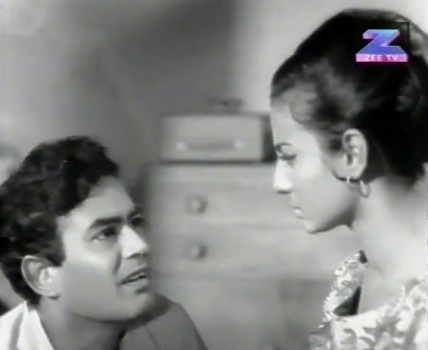
This week’s film came about after several false starts. A new blog reader and I have been waxing eloquent about our shared love for Sanjeev Kumar, not just one of Hindi cinema’s finest actors, but also, in his younger days (as far as I am concerned), also exceptionally dishy. After some false starts—Husn aur Ishq, Gunehgaar, Insaan aur Shaitaan—I ended up watching Priya, one of several films in which Sanjeev Kumar co-starred with Tanuja.
Author Archives: dustedoff
Macario (1960)
Can a blessing turn out to be a curse? Can it be that the one thing you have yearned for—to the extent that it now seems an impossible dream—is suddenly given to you, and you realize it was not what you wanted, after all? Is there really any truth in the adage about being careful what you wish for, because it may come true?
Ten of my favourite philosophical songs
This post has been in the pipeline for a while. I had been thinking about compiling a list of philosophical songs from classic Hindi cinema, and blog reader Kamini Dey’s request for a post with that theme served to spur me on. I got distracted midway, and decided to do a cynical songs post, but here it is, finally: a list of ten philosophical songs from old Hindi cinema that I especially like.
Pesh Hai: The Muslim Social—Random Thoughts
Including some recommendations, and some warnings.
This post was sparked off by a comment, by blog reader and fellow blogger Ava, on my review of the Sunil Dutt-Meena Kumari starrer, Ghazal. Like me, Ava ‘adores’ Muslim socials, and in her comment, suggested that I make a list of ten of my favourite Muslim socials. A great suggestion, I thought. And then thought some more. Were there ten Muslim socials I loved to bits? Were there some which were fabulous when it came to certain aspects, and horrendous on other counts? Were there some, perhaps, that I wouldn’t watch again (except possibly at gunpoint)?
All that thinking, I decided, had to be shared. Also in the hope that it might elicit some responses from those reading this blog post—please do comment, share your thoughts, and feel free to disagree. With the tameez and tehzeeb one would expect in a Muslim social.
Noorjehan (1967)
Give me a period film, and I’m willing to give it a shot. If it happens to be set in Mughal India, so much the better. If the cast features people like Meena Kumari, Pradeep Kumar, Rehman, Veena, Lalita Pawar and Nighar Sultana: well, there’s hope that the acting will be passable. And when I realize that the music composer is Roshan: then I’m certainly on for it.
Noorjehan, of course (though Richard would probably question that ‘of course’) is about the noblewoman who married the fourth of the Great Mughals, Jahangir. Born in May 1577 and named Mehrunissa, she was the daughter of a man who rose to great prominence in the Mughal court: Itmad-ud-Daulah (‘Pillar of the State’) was the title given to him, and the marriage of Mehrunissa to Jahangir made of Mehrunissa a powerful woman, too. Initially given the title Noormahal (‘Light of the Palace’) by her doting husband, she was subsequently given the title of Noorjehan (‘Light of the World’) and went on to become probably the most influential of imperial consorts in the Mughal dynasty, a wealthy woman in her own right, as well as a woman who exercised a good deal of power from beyond the purdah.
Ten of my favourite cynical songs
I know that sounds a little paradoxical—cynicism and something favourite? But that’s what this post is all about: songs that are cynical, but songs, too, that I like. Like a lot, in some cases.
A few weeks back, blog reader Kamini Dey made a request: a post on philosophical songs. I had been planning that anyway, so decided I should speed up my research on that post. And midway through compiling my shortlist of philosophical songs, I realized that several of the songs I’d put under that head were actually songs of cynicism (which, I suppose, is a kind of philosophy, after all: a philosophy of not expecting anything good from the world). I remembered then that another blog reader, Vinay Hegde, had long ago suggested a song list of cynical songs.
So here it is (sorry, Kamini: I get sidetracked easily, and these songs really include some of my absolute favourites). Ten songs that speak of the singer’s cynicism, his or her belief that the world is not a nice place. At times the bitterness boils forth in a fierce and/or despairing rejection of the entire world; at other times, it is cloaked with satire or a sort of bitter humour. Perhaps even smiles. But the cynicism is there, if you only pay attention to the lyrics.
Ranikhet: Of Mountains and the Military
Ranikhet, tucked away in the mountains of Uttarakhand, is actually named for a queen: Rani Padmini, the consort of a local king named Raja Sukherdev. Padmini visited this area and liked it so much that she decided to make it … Continue reading
Fahrenheit 451 (1966)
I’ve just finished reading what’s considered to be the finest work by one of science fiction’s greatest writers: Ray Bradbury’s Fahrenheit 451. Set in a dystopian future where literature is outlawed, this is a classic novel of tyranny, insecurity, and yet defiance and hope. In 1966, more than a decade after Bradbury wrote his novel, Francois Truffaut adapted it for the screen.
Hamlet (1954)
Today, April 23, 2016, marks the 400th death anniversary of one of English literature’s greatest writers, a man who had a huge hand in making English what it is today. Though William Shakespeare’s date of birth is unknown, he died on this day, nearly 52 years after he was baptized. In less than half a century, he created a corpus of work that has endured—and continues to spawn adaptations by the dozen in popular culture—ever since.
Poonam ki Raat (1965)
One style of mystery story popular in the early 60s (though there was the odd film even earlier, like Mahal) was the one where the suspense includes a seemingly supernatural element. A woman in white, singing a ghostly song of eternal yearning as she wanders half-seen (or unseen) through the gloom. Woh Kaun Thi?, Yeh Raat Phir Na Aayegi, Bees Saal Baad, Gumnaam, Raaz: all of them used this trope to the hilt.
As did this relatively lesser-known film [and you’ll probably realize, by the end of this post, why it’s little-known]. Poonam ki Raat was made by actor/writer/director Kishore Sahu, who played an important role in this film, the star of which was Manoj Kumar, quite a veteran of these suspense thrillers.