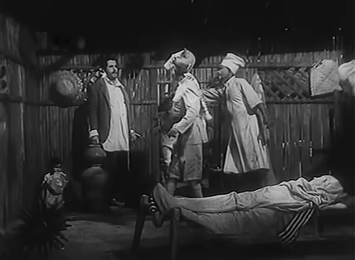
Chaar Darvesh (1964)

YouTube suggested this film to me, and for a few days, I was torn. Should I watch it (Feroz Khan is not a favourite of mine, though I don’t find him as irritating as some others), or should I not? Sayeeda Khan, after all, is someone I’ve wanted to watch, mostly because I was intrigued—she was married to film director/producer Brij Sadanah, and was murdered by him on their son’s eleventh birthday party (Sadanah also shot and killed their daughter, before committing suicide). Yes, macabre (not to mention tragic), but that’s how it is.

Eventually, it was the music—by the very talented but vastly underrated GS Kohli—that tipped the scales in favour of my watching Chaar Darvesh. Kohli, who did a lot of work as assistant to OP Nayyar (and it shows, in the rhythms and styles of much of his work), composed music on his own for several B-grade films, of which among the best-known are Shikari (1963; easily his magnum opus, with one great song after another) and Chaar Darvesh. Even if just for the music, I wanted to watch this film.

The story is set in some fictitious fantasy kingdom somewhere in the Middle East. At a shrine, three bearded darveshes, clad in flowing robes, have gathered to pray for boons. One is seeking a treasure [that sounds a little shallow, for a darvesh]; another is searching for his sweetheart, who’s gone missing.

These three men have learnt, though, that their wishes will only be granted once they have been joined by a fourth darvesh… who, thank heavens, arrives soon after. This is Qamar (Feroz Khan in blackface), and he proceeds to tell them his tale of woe and to explain how he happens to have turned so black.

Continue reading

Jaal (1967)

I had first watched this film many, many years ago, probably as a young teen. It had been aired on Doordarshan, back in the good old days when our family used to watch pretty much every film that was shown (including some seriously grotty ones like Fauji).

I remembered little of Jaal: Mala Sinha and Biswajeet, yes; and that it was a suspense thriller set in a spooky mansion beside the sea. That was all.

While I don’t like Biswajeet, and the music of Jaal (by Laxmikant-Pyarelal) is forgettable enough to not want to watch it for the songs, I decided I should give this one another try. At least find out what it’s about.

The story begins on a stormy night at sea. A small boat is tossed about on the waves, and we catch glimpses of the lone man on board: Sunder Singh (Sujit Kumar) as he tries to control his vessel. In the distance can be seen (like the boat and the waves, looking patently artificial) a lighthouse. Sunder, however, cannot make it safely to shore; his boat crashes against the rocks and explodes in a great burst of fire.

Continue reading

The Treasure of the Sierra Madre (1948)

This is one film I’ve known of for a long time, but have always had conflicting views on whether I wanted to watch it or not. On the one hand, I usually enjoy Westerns (more the escapist adventure kind, I will admit; but also, increasingly, those which go just beyond that). On the other hand, Humphrey Bogart is not one of my favourite actors. Then, again: I knew that this film (unlike another ‘seeking-gold-in-the-West’ film I love, McKenna’s Gold) was more gritty, more real. So Bogart—whom I do acknowledge as a good actor—might have done well in it.

The only way to find out, I guessed, would be to watch it for myself.

The story begins in a small Mexican town, Tampico, where a broke American, Fred Dobbs (Bogart) is wandering about, trying to make ends meet. Dobbs seems to have no set idea in mind of what he wants to do: he doesn’t seem to make any attempts to get a job, and all his energies are directed towards relatively prosperous-looking fellow-Americans who might be able to spare him some money to buy a meal.

Continue reading

Ten of my favourite ‘multiple version’ songs: solo/duet (or more)

Many years back, I’d begun doing a series of posts on multiple version songs in old Hindi cinema. Songs that seem to have struck their composers/film directors as so impactful that they needed to be repeated, in different scenarios, sometimes in different moods and even with different singers, singing differing lyrics. I did two of those posts, then something cropped up (I don’t remember what) and the project got abandoned.

But I’ve got back to this now, and here’s a third post on multiple version songs. My earlier posts focused on solos: two-version songs sung by a male singer and a female singer; and the same song, sung by the same singer but in two versions.

This time, I’m focusing on songs that appear at least twice in a film, but at least once in the form of a solo and the other time as a duet (or more: one of the songs in this list has three singers).

Continue reading

Aasmaan Mahal (1965)

Blog reader Raunakjoy, commenting on Himalaya ki God Mein (which won the Filmfare Award for Best Film, outdoing films like Waqt and Haqeeqat), remarked that there were, besides these contenders for the award, also lesser-known but equally—if not more—meritorious films, like Aasmaan Mahal.

I had to admit I had never even heard of Aasmaan Mahal before, let alone watched it. Directed by Khwaja Ahmed Abbas, this film—as I discovered from a cursory look at Google search results—appears in the Limca Book of Records as one of the first Hindi films to not use sets for shooting. Also, the film won Prithviraj Kapoor an honourable mention at Karlovy Vary for his portrayal of an ageing and impoverished nawab trying desperately to hold on to the tatters of his family’s once-substantial prestige.

Continue reading

A two-film Tapan Sinha article

… not on this blog, but here, on Learning and Creativity’s Silhouette e-magazine.

Highly acclaimed director Tapan Sinha was born on 2nd October, 1924, in Kolkata, and at the height of his career, was considered one of a quartet of top Bengali directors, along with Satyajit Ray, Mrinal Sen, and Ritwik Ghatak. He was to make some very fine Hindi films too (including Ek Doctor ki Maut and Sagina—the latter a remake of his own Bengali work, Sagina Mahato), but it was in the realm of Bengali cinema that Tapan Sinha made a special mark, with poignant, insightful films like Kabuliwala (which, by the way, Anu from Conversations Over Chai has written about, exquisitely, here).

Khaniker Atithi, made by Tapan Sinha in 1956, was remade by him 16 years later in Hindi as Zindagi Zindagi. The two films are basically the same story, but it’s the details that make all the difference. You get a glimpse of how Sinha’s mind worked, how he tailored his film to suit two different eras, two sets of audiences with probably very different expectations from cinema.

The editors at Silhouette had asked me to contribute a piece on any of Tapan Sinha’s films for their Tapan Sinha centenary celebrations, and I’m grateful to them for giving me this opportunity: I got to see two very interesting films, always a thing of joy.

Click here to read the article.  

Sapan Suhaane (1961)

Starring Balraj Sahni and Geeta Bali. With music by Salil Choudhary.

How could I—with a well-established reputation for watching films based on a single name I like among the crew and cast—pass up this one? Balraj Sahni is a favourite, as is Geeta Bali. And Salil Choudhary is one of those rare music directors for whom I’ll watch a film (even if I could just as well just listen to a playlist of the songs online).

These three were the reason I watched Sapan Suhaane, and I’ll admit that till more than midway through the film, I was congratulating myself on having stumbled on a hidden gem. Or, if not strictly a ‘gem’, at least a film that was watchable enough. After that…

But to start at the very beginning, when we are introduced to Shankar (Balraj Sahni) and his younger brother Dilip (Chandrashekhar). Shankar and Dilip are stepbrothers, but deeply devoted to each other. Shankar has given up his own comfort, his own prospects, in order to work so that he can finance Dilip’s studies.

Continue reading

The Good Soldier Shweik (1956)

Or, to give it its original Czech name, Dobrý voják Švejk.

I had stumbled across this film, highly rated as a satirical anti-war comedy set during World War I, and given that I enjoyed an earlier Czech comedy I’d seen (The Firemen’s Ball), I decided I should give this one a try as well.  The film is based on an unfinished novel by the Czech humorist Jaroslav Hašek, who intended this as a collection of vignettes and incidents centering round a World War I soldier. The novel, despite being incomplete, has since been translated into more than sixty languages, making it the most-translated Czech novel ever. It has been adapted for screen several times, including once in German, and more recently, in 2018, in English.

The film begins in Sarajevo in 1914 with a dramatic event: the assassination of Archduke Franz Ferdinand. There’s the gun firing, the troops parading down the street, the band playing as they march—and the archduke crumpling over in his carriage.

Continue reading

Tumse Achha Kaun Hai (1969)

Lalita Pawar plays an ageing and very wealthy woman who employs a man (played by Shammi Kapoor) to reform her granddaughters, who are getting too wild for her liking. The man, poor and in desperate need of money to pay for the treatment of an ailing family member, takes up the offer, even though it will require him to pretend to be someone he’s not. In the process, he ends up falling in love with one of the granddaughters—much to the annoyance of the indignant grandmother.

This was the gist of the story of Professor (1962), though with one qualification: Shammi Kapoor’s Preetam in that film is initially hired just as a tutor for the younger brothers of the granddaughters; it’s only a little later that he’s also given the task of tutoring the young women. It was, as I’ve said on more than one occasion—and of course in my review of the film—a delightfully entertaining film, romantic and fun and with absolutely fabulous music.

Seven years later, Shammi Kapoor acted in another film with a somewhat similar plot. Here, in Tumse Achha Kaun Hai, he is Ashok, a musician; and Lalita Pawar plays Sarojini Devi, the very wealthy woman who approaches him with a proposition: that he take on the task of setting to rights her granddaughters, all three of whom (she feels) are a disgrace to Sarojini Devi.

Continue reading

Ten of my Favourite Bathroom Singers

If ‘bathroom singer’ refers to ‘a mediocre or amateur singer’, then Hindi cinema belies that definition: because old Hindi films have plenty of instances of songs sung by people in bathrooms, while bathing, shaving, washing up, whatever—and all perfectly in tune. These bathroom singers are no bathroom singers at all.

If you don’t know what I’m talking about, here’s my list: ten songs that illustrate the point. Barring one song, all are from pre-1970s Hindi films that I’ve seen; the exception is a song from the cusp (1972), but I’ve included it because the film in question (Dil Daulat Duniya) always strikes me more—in tone, look, fashions, actors, etc—as a late 60s one.

The only other criterion I’ve kept in mind is that at least one verse is sung inside the bathroom.

Continue reading