Ten of my favourite Prem Dhawan songs

This post is a little late. It was the birth centenary of Hindi film lyricist, composer, and choreographer Prem Dhawan earlier this year (he was born on June 13, 1923, in Ambala), but what with one thing and another, I just couldn’t find the time to work on this post back then. Anyway, better late than never, I guess. And Prem Dhawan was one person I did want to write about on this blog, because he is one of those rare individuals who didn’t merely excel in one realm of the film industry; he was rather more of a polymath than most.

Continue reading

Bahaaron ki Manzil (1968)

What if you were to wake up one morning to find that your life had been switched with that of another? That the people closest to you were all dead, and that the people now claiming to be your friends and family were all strangers, or pretty much so?

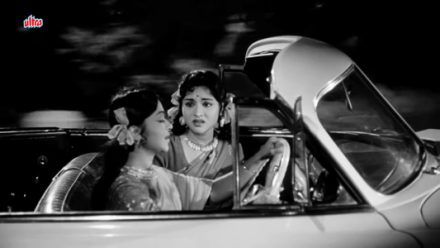
This is how Bahaaron ki Manzil begins: with Radha/Nanda (we don’t know who yet; Meena Kumari) waking up one morning. As she stirs, we can hear her mind: she’s happy, looking forward to her wedding—because today is her wedding day. When she gets up, though, she looks down at the tinselly sari she’s wearing, and is puzzled. She doesn’t have a sari like this. And there’s a wound on her forehead…

Continue reading

The Bad Seed (1956)

I am always intrigued by films that have children in important roles, films like The Search or The Four Hundred Blows, which call for children to really show off their acting skills. The Bad Seed is another for the list, and an unusual film, in that it has the child (Patty McCormack) in what might have been an unsettling experience for a child actor.

The Bad Seed begins in the home of Colonel Kenneth Penmark (William Hopper), who has been transferred to Washington, DC and is just about to leave. His farewell to his wife Christine (Nancy Kelly) and their eight-year-old daughter Rhoda (Patty McCormack) is touching: these three are obviously a loving, happy family. Rhoda, in particular, comes across as an affectionate child, adored by her father.

Continue reading

Kaala Bazaar (1960)

The first time I watched Kaala Bazaar was perhaps in my early teens: the film was being shown on Doordarshan, and given that back then I was very fond of Dev Anand, I watched it. I have very vague recollections of that viewing. What I do recall, vividly, is that I didn’t like that my hero was a criminal.

… which, as I came to realize later, was actually not so very uncommon a style for the characters Dev Anand played. Unlike the other major romantic hero of the time, Shammi Kapoor, Dev Anand didn’t just play characters who got up to ‘mischief’, so to say; his characters—from Tony in Jaal to Raju in Guide, from Chhagan in Roop ki Rani Choron ka Raja to Babu in Bambai ka Babu, plus others—were outright criminals: thieves, conmen, smugglers, men definitely on the wrong side of the law.

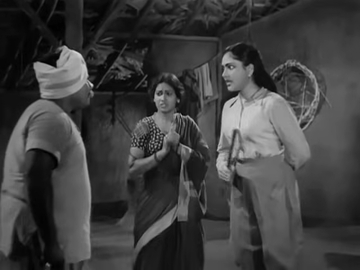
Like Raghubir ‘Raghu’ in Kaala Bazaar. Raghu is a bus conductor when the story begins, and within the space of a couple of minutes, his life takes an about-turn. A belligerent passenger is standing in the bus (which is against the rules), and when Raghu asks him to get off the bus, the man refuses. Both he and Raghu lose their tempers. Fists fly, and the next thing we know, Raghu is without a job.

Raghu’s mother (Leela Chitnis) is ill, and he has a sister (Nanda) and a young brother (?) as well; he cannot afford to be without a job. Desperate, Raghu flounders about, trying to find work. If not work, money.

Continue reading

Dev Anand: Ten Songs, Ten Voices

The very first Hindi film song I remember watching was a Dev Anand one. I was nine years old, and the film was CID. The film had already had a couple of songs (Boojh mera kya naav re, Leke pehla-pehla pyaar) that featured him, but when Aankhon hi aankhon mein ishaara ho gaya came on, it cast its spell on me. I was completely bowled over, and from then on, was a starry-eyed Dev Anand fan.

Over the years, as I’ve become older and wiser (more cynical?), the love for Dev Anand has been tempered somewhat. I don’t like the mannerisms, the exaggerated drawl and pout, the puff of hair, and the larger-than-himself persona he took on once he became a superstar. I find him a bit embarrassing in later films, from the 70s onward, where he’s trying desperately to appear much younger than he really was.

But, in his heyday, I think there was nobody to rival Dev Anand in the charisma department: nobody as suave, as charming, as watchable. And, as if that wasn’t all, his films always had great music. About 90% of my favourite songs as a teenager were from Dev Anand’s films. Munimji, CID, Nau Do Gyarah, Guide, Solvaan Saal, Kaala Paani, Kaala Bazaar, Baat ek Raat ki, Teen Deviyaan… one wonderfully entertaining film after another, one great song after another.

Continue reading

Lata Mangeshkar: Ten Composers, Ten Songs – Part 5

The first post in this series of song lists was posted as a tribute to Lata Mangeshkar when she passed away in early 2022. I had previously posted a song list featuring Lata in Ten Moods, so this time I wanted to be different: to showcase Lata’s work with different music directors. Naturally, given Lata’s oeuvre (even till just 1970, which is my self-imposed cut-off for this blog), that list, with just ten composers included, was far from enough. I ended up doing several more posts in the series, and every time, some reader or the other would comment: “What about so-and-so composer? How about this song?”

Continue reading

The Ladykillers (1955)

Long-time readers of this blog probably know by now that I have a soft spot for suspense films, heist films, comedies, and—where these genres sometimes meet—films about bumbling crooks. The funny heist film, so to say, where everything goes wrong. Some months back, when I watched Gambit (which I enjoyed very much), a subsequent search for funny heist films threw up another suggestion that I’d heard of before: The Ladykillers. Like Gambit, this too starred Herbert Lom, an actor I like, and because I was fresh from watching Gambit, I thought why not give this one a try too.

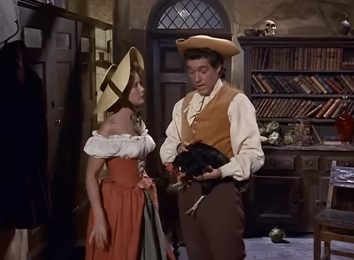
The Ladykillers begins with the lady in question: sweet, somewhat scatter-brained old lady Mrs Wilberforce (Katie Johnson), who emerges from her house at the end of a lane and walks down the street nearby. Everybody around seems to know and like Mrs Wilberforce: people greet her, and when she reaches her destination—the local police station—the cops are indulgent. Mrs Wilberforce has come to clarify that her friend, another elderly lady who had informed the police station about spotting a spaceship, was actually misinformed… Mrs Wilberforce’s explanation is detailed and apologetic, and her earnestness shines through bright and clear.

Continue reading

Raj Nartaki (1941)

Aka The Court Dancer.

When I was watching Amrapali some weeks back, I was reminded of another court dancer of Hindi cinema: Sadhona Bose’s character from this film, which claimed to be the first English language film to be made in India with an all-Indian cast and crew. I had made an attempt at watching Raj Nartaki a couple of years back, but I could not get into it, and abandoned it after a few minutes. I guess the concept of Indian actors speaking only English (and that back then) was sufficiently unusual to take time to get used to.

After Amrapali, though, I decided I had to give Raj Nartaki another try.

The film begins by laying the ground. This is the early 19th century, and the film is set in Manipur. Here, Prince Chandrakirti (Prithviraj Kapoor) is heir to the throne. He is also in love with the newly-appointed court dancer, the lovely Indrani (Sadhona Bose). When the story begins, Chandra (as Indrani affectionately addresses him) is at Indrani’s palace, where several of her fellow dancers are entertaining them.

Continue reading

Shailendra in Ten Moods

One of Hindi cinema’s leading lyricists, and a stalwart poet in his own right (I cannot resist wondering if that shouldn’t be “in his own left”, given Shailendra’s socialist leanings!), Shailendra was born on this day a hundred years ago. I have written about him before, in this post to mark an earlier one of his birthdays. But, since I like Shailendra’s poetry so much, I could not let his birth centenary pass without a post dedicated to him. A list of Shailendra’s songs, therefore, that are in ten different moods. And, so that this post isn’t a repeat, even in a small way, of my earlier Shailendra post, none of the songs here are from my earlier post.

Continue reading

Barjatri (1951)

Aka The Wedding Procession, though Hindi speakers will probably be able to relate to a more exact approximation of what barjatri means: baraati. The people who, at a wedding, accompany the bridegroom to the venue, invariably in great pomp and to be made much of. This delightfully funny film centres around a group of young men whose story begins just before all of them are to travel, as baraatis, for their friend’s wedding.

One of these is Ganesh ‘Gansha’ (Kali Bannerjee), who lives in his uncle’s home, and is unemployed. Uncle (?) has been pushing Ganesh to find a job, but Ganesh couldn’t be bothered. He would rather spend time sitting with his pals, chatting and smoking, all of them generally enjoying themselves.

Continue reading