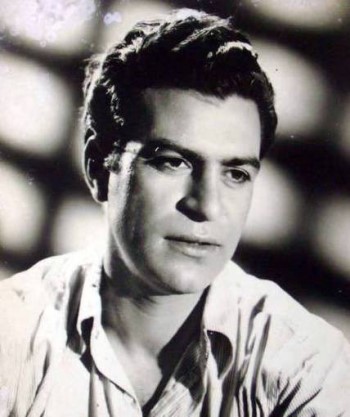
Chaar Darvesh (1964)

YouTube suggested this film to me, and for a few days, I was torn. Should I watch it (Feroz Khan is not a favourite of mine, though I don’t find him as irritating as some others), or should I not? Sayeeda Khan, after all, is someone I’ve wanted to watch, mostly because I was intrigued—she was married to film director/producer Brij Sadanah, and was murdered by him on their son’s eleventh birthday party (Sadanah also shot and killed their daughter, before committing suicide). Yes, macabre (not to mention tragic), but that’s how it is.

Eventually, it was the music—by the very talented but vastly underrated GS Kohli—that tipped the scales in favour of my watching Chaar Darvesh. Kohli, who did a lot of work as assistant to OP Nayyar (and it shows, in the rhythms and styles of much of his work), composed music on his own for several B-grade films, of which among the best-known are Shikari (1963; easily his magnum opus, with one great song after another) and Chaar Darvesh. Even if just for the music, I wanted to watch this film.

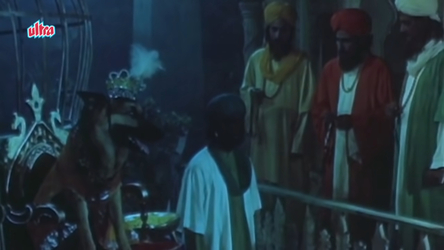
The story is set in some fictitious fantasy kingdom somewhere in the Middle East. At a shrine, three bearded darveshes, clad in flowing robes, have gathered to pray for boons. One is seeking a treasure [that sounds a little shallow, for a darvesh]; another is searching for his sweetheart, who’s gone missing.

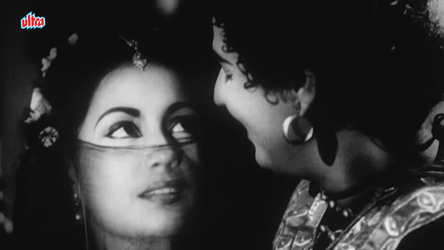
These three men have learnt, though, that their wishes will only be granted once they have been joined by a fourth darvesh… who, thank heavens, arrives soon after. This is Qamar (Feroz Khan in blackface), and he proceeds to tell them his tale of woe and to explain how he happens to have turned so black.
Continue reading

Aladdin aur Jaadui Chiraagh (1952)

Some weeks back, when I reviewed Police (1958), the thought that had stayed in my mind regarding Madhubala’s character—and her acting—in that film and otherwise, in the larger context of her career, was that she got sadly stereotyped. Too many people, film-makers most of all, ended up slotting her as the ravishingly beautiful woman who need only be cast for the fact that she could light up a screen like few others could. Her acting ability (which was actually very good) got overlooked far too often.

Something similar, though in a different way, happened to Meena Kumari. In Meena Kumari’s case, the ‘Tragedy Queen’ label got affixed fairly early in the actress’s career and branded her forever as the Main Chup Rahoongi type: the weepy, self-sacrificing, stoic Bhartiya naari. Despite films like Kohinoor, Azaad, Majhli Didi, Tamasha and Bandish, most people today associate Meena Kumari with ‘serious’ roles.

So, this film, which starred Meena Kumari in one of her lighter roles.

Continue reading

Zabak (1961)

Zabak is a film I’ve been wanting to watch for a while, mostly for Shyama. I like Shyama a lot, and as far as I know, this is one of the rare colour films in which she acted as a lead. Plus, given my penchant for raja-rani films, I thought this might be worth a try.

Zabak (Mahipal) is the son of a healer and hamaam owner named Hassan Shah Isfahani (?). Hassan Shah is much acclaimed as a man who knows his medicine, and everybody around, from the Haakim (the Lord) of Isfahan to the man in the street, comes to him for relief from a variety of ailments. Zabak is a happy-go-lucky sort, spending his time joking around town, and romancing Zainab (Shyama), the daughter of the Lord of Isfahan.

Continue reading

Do Dulhe (1955)

Today is the birth centenary of one of a handful of Hindi film actors who managed to cross from one type of role to another—again and again. Like Ajit, Pran, and Premnath (though not in the same league as them, when it came to success and popularity), Sajjan Lal Purohit—better known simply as Sajjan—appeared in leading roles in several of his early films (including, notably, in Saiyyaan, where he acted opposite Madhubala), then drifted into supporting roles (as Dev Anand’s sculptor friend in Paying Guest; as Mini’s father in Kabuliwala; and more), and eventually into villainous roles (in April Fool, Aankhen, Farz, etc).

Continue reading

Rani Rupmati (1959)

Considering this is a period film—a ‘raja-rani’ film, so to say—and it has some great music, I’ve not made much of an effort to watch it. I don’t mind Nirupa Roy in leading lady roles (she could look really pretty, and as long as she wasn’t playing the self-sacrificing and long suffering Sati Savitri, she was fine). But Bharat Bhushan isn’t my cup of tea. Along with Pradeep Kumar and Biswajeet, he is one of those actors whom I invariably see lip syncing to great songs, and wish the songs had been picturized on someone else.

But I finally decided it was high time I watched Rani Rupmati.

The story begins by introducing us to the town of Mandavgarh (now better known as Mandu), part of the kingdom of Malwa. Malwa is ruled by Pathans: its Sultan is Shujat Khan, whose elder son, Baazid Khan ‘Baaz Bahadur’ (Bharat Bhushan) seems to be an effeminate, music-loving hedonist who spends all his time doing riyaaz with his ustad.

Continue reading

Tumsa Nahin Dekha (1957)

If Rajkumar is the trademark ‘Shammi Kapoor at his peak’ film, then Tumsa Nahin Dekha is an equally – if not more – important film, because this is the one that made Shammi Kapoor into the icon he was by the mid-60s. Till Nasir Hussain got Shammi Kapoor to shave off his moustache and act as the devil-may-care hero of this film, Shammi was (as my father puts it), “Just another actor with a thin moustache and the usual roles. Nothing exceptional.” Tumsa Nahin Dekha gave him the opportunity to transform from the half-hearted, unexceptional sort-of-hero into a Shammi Kapoor who became almost an institution in himself.

Continue reading