Police (1958)

If you’ve been reading this blog some years, you probably know by now that I am a fan of Madhubala’s. I’ve watched most of her films (several of which I have not got around to reviewing on this blog), I’ve done lists of my favourite songs of hers, and I have waxed eloquent every now and then about how much I like her.

One of the things I dislike about much of the online (at least) raving about Madhubala is that the praise is invariably just about her beauty. How gorgeous, how exquisite. Yes, indeed; but Madhubala’s beauty, I think, often comes in the way of people appreciating what a good actress she was, too. Watch her performances in films like Mughal-e-Azam and Amar, for instance, and if you can look past her face, you will see how well she holds her own against heavyweight thespians like Dilip Kumar and Prithviraj Kapoor.

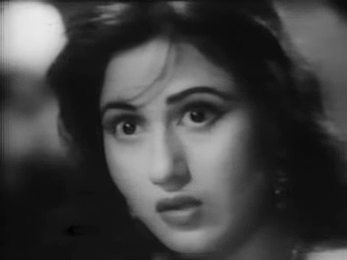
And she was a fantastic comedienne too. The madcap way she matches Kishore Kumar in Chalti ka Naam Gaadi, for example. Or her airhead character in Mr & Mrs 55. Interestingly, Madhubala is often compared to Marilyn Monroe, almost entirely on the basis of their beauty and popularity; but I think the two stars had one more thing in common: both could portray the ditzy beauty very well. This, in fact, is just the type of woman Manju, of Police, is: nutty, silly, a clown. But so endearing too (and, it goes without saying, so gorgeous).
Continue reading

Do Dooni Chaar (1968)

Mention Shakespeare and Hindi cinema, and most eyes light up. Vishal Bhardwaj’s tragedy trilogy—Omkara, Maqbool, and Haider—come immediately to mind for those who cannot think back further than the 1990s, if that. Those who belong to a certain generation (my own) will probably remember fondly the delightful comedy, Angoor, based on A Comedy of Errors.

Fewer, perhaps, will know that Hindi cinema’s tryst with Shakespeare is much older than Angoor. In 1928, a Hamlet adaptation called Khoon-e-Nahak was released; the same play was adapted for screen again in 1935, this time as Khoon ka Khoon, starring Sohrab Modi in the title role opposite Naseem Banu as Ophelia. In 1941, The Merchant of Venice was adapted as a film named Zaalim Saudagar. And in 1954, Kishore Sahu produced, directed and acted in Hamlet, an interesting and unusual film for Hindi audiences since it was a fairly faithful enactment of the play—down to the costumes, the names, etc.

Along with Hamlet (which seems to win hands down when it comes to popularity among Hindi film makers), another popular play for adaptation seems to be A Comedy of Errors. In 1969, it had been made (though with many departures from the original plot, and with no twin servants) as Gustakhi Maaf, with Tanuja in the double role, opposite Sanjeev Kumar. It’s interesting to note that while Sanjeev Kumar would go on to act in another adaptation of the play (Angoor), Tanuja had already acted in yet another version. Do Dooni Chaar, released in 1968 and quite clearly the inspiration for Angoor.

Continue reading

Ek Hi Raasta (1956)

BR Chopra is one director for whom I have a lot of respect: he was one of the most versatile film makers of his time, a man whose films could not easily be dumped together into one broad category. Look at the difference between Waqt and Sadhna, for instance: one stylish and glamorous, the first big multi-starrer in Hindi cinema; the other a low-key yet impactful film with an unusual female lead. Or Humraaz, a sleek suspense thriller, and—on the other hand—Dharamputra, a commentary on secularism and bigotry and several related ills which still plague India.

Whether he was conveying a message, highlighting a social evil, or simply making an entertaining film, BR Chopra was in a class by himself. His films invariably had excellent production values; the music could always be counted upon to be topnotch (and the fact that he often commissioned Sahir Ludhianvi as lyricist meant that it wasn’t just the music that was superb, it was also the words of the songs—some of Sahir’s best songs are for BR Chopra’s films).

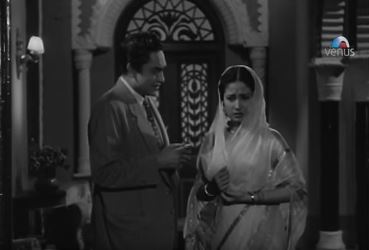
Which brings me to this film. Ek Hi Raasta was one of BR Chopra’s earlier films, and while it doesn’t have the impact of (say) Gumraah or Dhool ka Phool, it is still an interesting story.

Meena Kumari and Ashok Kumar in Ek Hi Raasta

Continue reading

Ferry (1954)

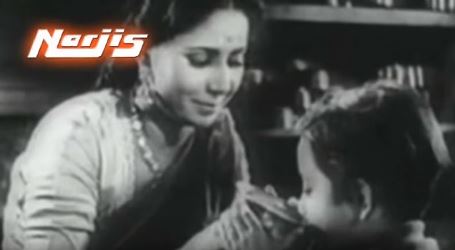
Earlier this year, commenting on a post, reader Shalini recommended Ferry to me. I admitted that I’d seen the film—years ago—on Doordarshan, and had liked it, though over the intervening years I’d forgotten what exactly it was all about. I did remember this much: that it featured a child, and that it was very different from the usual (mainly romantic or noir) films of Dev Anand that I’d seen till then. I decided it was time for a rewatch.

Geeta Bali and Babu in Ferry

Continue reading

Deep Jwele Jaai (1959)

It’s sad that, over the past year or so, barely a month has passed without my having to post a tribute to yet another film personality who’s passed on. Last month, with Eleanor Parker, Joan Fontaine and Peter O’Toole passing away within days of each other, I thought it couldn’t get worse. And I hoped that 2014 would be better.

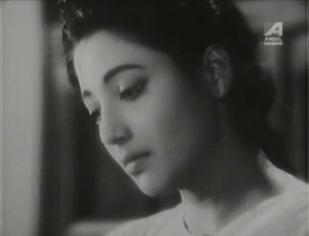
But, alas. We say goodbye to yet another luminary of the film world. This time, the beautiful and very talented (not to mention wildly popular) Suchitra Sen (April 6, 1931-January 17, 2014), who made a mark in Hindi cinema even in the few films she acted in (Bombai ka Babu, Devdas, Mamta and Aandhi being the best-known), but ruled Bengali cinema.

Suchitra Sen Continue reading