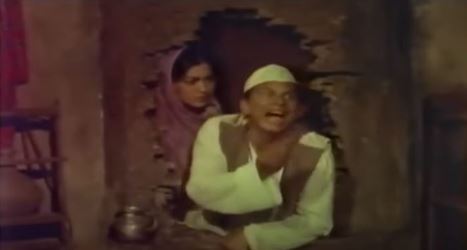
Aar-Paar (1954)

I saw this on the big screen, on August 10, 2025.

Given that getting to see a Hindi film as old as this on the big screen, as a proper commercial release (re-release, in this case), is a very rare treat, it needs to be put up front.

To mark the birth centenary of Guru Dutt, the National Films Division Corporation of India (NFDC) and the National Film Archive of India (NFAI) collaborated to restore and re-release several of Guru Dutt’s films. These were shown at PVR and Cinépolis cinema halls across India on August 8th through to 10th. Left to myself, I would happily have seen all the films that were being screened; but duty calls. August 9th was rakshabandhan, and we had family coming over for lunch. I was busy all through the previous day cleaning and cooking and generally preparing, and then again through half of the next day. But, once our guests had eaten, I scurried off cinema-wards to watch Sahib Biwi aur Ghulam. The following day, I managed to watch Aar-Paar.

Continue reading

Baaz (1953)

Today, July 9, 2025, marks the 100th birth anniversary of one of Hindi cinema’s best-known film directors. Born in Mysore on this day in 1925 as Vasant Kumar Shivshankar Padukone, Guru Dutt studied in Calcutta before joining Uday Shankar’s India Culture Centre (in Almora, present-day Uttarakhand) to train in dance. By the time he turned 19, he had moved to Pune, where he began working as a choreographer for Prabhat Studios. By the time Prabhat Studios folded up (in the early 1950s), Guru Dutt had formed a close friendship with Dev Anand, because of whom he received his first break as a director: in 1951, he directed Navketan’s Baazi, starring Dev Anand, Geeta Bali and Kalpana Karthik in a noir thriller that was to become a defining film for Navketan: edgy, stylish, dark, very urban.

Guru Dutt is today revered more for the hard-hitting, cynical cinema he made: films like Pyaasa, Sahib Bibi aur Ghulam and Kaagaz ke Phool hold up the mirror to a world that is selfish, cruel and opportunistic. These are bitter films, films that plumb the depths of human nature; films that—despite following most of the standard tropes of commercial Hindi cinema (a romance between the lead couple; a fair number of songs; a comic character invariably played by Johnny Walker)—were quite different from other Hindi films.

These, too, are the films for which Guru Dutt is mostly remembered today. Is that because over the decades, people have seen how the tragedy and turmoil of Guru Dutt’s personal life was probably reflected in films like these? Is there a voyeuristic tendency to try and spot the man behind the director?

But Guru Dutt also made other films, on other subjects. This one, for instance, an adventure/patriotic film set on the high seas, with Geeta Bali starring as the eponymous ‘Baaz’ (falcon), a woman who becomes a pirate to free her land of a colonial tyrant.

Continue reading

Jaal (1967)

I had first watched this film many, many years ago, probably as a young teen. It had been aired on Doordarshan, back in the good old days when our family used to watch pretty much every film that was shown (including some seriously grotty ones like Fauji).

I remembered little of Jaal: Mala Sinha and Biswajeet, yes; and that it was a suspense thriller set in a spooky mansion beside the sea. That was all.

While I don’t like Biswajeet, and the music of Jaal (by Laxmikant-Pyarelal) is forgettable enough to not want to watch it for the songs, I decided I should give this one another try. At least find out what it’s about.

The story begins on a stormy night at sea. A small boat is tossed about on the waves, and we catch glimpses of the lone man on board: Sunder Singh (Sujit Kumar) as he tries to control his vessel. In the distance can be seen (like the boat and the waves, looking patently artificial) a lighthouse. Sunder, however, cannot make it safely to shore; his boat crashes against the rocks and explodes in a great burst of fire.

Continue reading

Kaagaz ke Phool (1959)

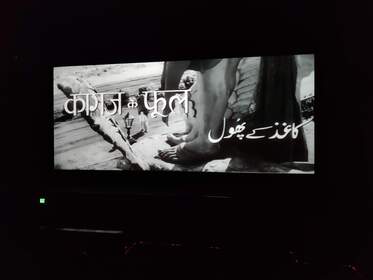
That first photo, because the space beyond the screen is so dark, may not be very obvious as regards context. But this is a photo from a full-sized film theatre, where I watched the re-released Kaagaz ke Phool on July 17th. The re-release was to mark the 65th anniversary of this film, a semi-autobiographical work that was a flop when it was first released, but has gained in popularity ever since. My niece had alerted me to the fact that PVR Inox would be showing Kaagaz ke Phool across its theatres, one show a day for a week, and I knew I couldn’t miss this one. If only for the fact that I get to see precious few old films on the big screen (Hum Dono was the last I saw).

I had thought I’d probably be one of a handful (ten, at the most?) of people in the theatre, because this, after all, is an old film; and this was an afternoon show on a weekday. But to my surprise, there were actually quite a few people, and—best of all—many of them were fairly young. Heartening.

But, to get to the film.

Continue reading

Paigham (1959)

This is a film that’s been on my radar for a while now. Dilip Kumar, Vyjyanthimala. A cast also boasting of Motilal and Johnny Walker. Some good songs. Paigham, I thought, might be worth a watch.

I will admit, though, that my heart sank a bit when I saw the opening credits and discovered that this is a Gemini Studios release. Like AVM, I now approach Gemini with trepidation: while their films often had great casts and excellent music, they were invariably just too melodramatic for my liking.

But I persevered.

Paigham begins by introducing us to Manju (Vyjyanthimala) who, along with her best friend Malti (B Saroja Devi), has just finished college: Manju at the top of her class, Malti at the bottom. Malti isn’t fazed by this; she’s a wealthy girl, her father Seth Sewakram (Motilal) a prosperous cotton mill-owner. Malti, in fact, has promised Manju that she will ask her father to give Manju (who’s done a course in shorthand and secretarial work) a job at the cotton mill, which is in a town named Rangpur.  

Continue reading

Night in London (1967)

In which Biswajeet’s character ends up facing a wall studded with red-hot spikes. You don’t just skewered to death, you get barbecued in the process.

Continue reading

Aandhiyaan (1951)

In 1951, fresh from the success of the Dev Anand-Geeta Bali-Kalpana Karthik starrer Baazi, Chetan Anand decided to make a film that would highlight the very interesting aspects of film-making he had been learning from studying the works of various European directors. ‘Based on a true incident that took place in Amritsar’, as the film’s credits read, the story of Aandhiyaan was written by Chetan Anand himself, along with Hameed Butt.

The film’s credits roll to an unusual sequence of shots: in each frame, one actor or the other is shown, battling the eponymous ‘aandhi’ or storm, though in this case literal rather than metaphorical.

The story is centred round a young and zealous lawyer named Ram Mohan Kapoor (Dev Anand). Ram lives upstairs from his munshi (Ratan Gaurang), whose daughter Rani (Nimmi) has long been in love with Ram, though she’s too shy to let him know that. When the story begins, Ram’s mother (Durga Khote) is due to arrive, and Ram is getting ready to go to fetch her from the station. Rani makes tea for him, and an excited Ram confides in her: he’s asked his mother to come because he wants her to fix a match for him. With a girl he likes a lot.

Continue reading

Naya Daur (1957)

Happy 100th birthday, Dilip Kumar!

It was on this day that Mohammad Yusuf Khan, who was to go on to become one of India’s most-loved and finest actors, was born in Peshawar’s Qissa Khwani Bazaar.

In a career spanning several decades, and some sixty-odd films, Dilip Kumar attained a status all his own. He was one of the first to win a Filmfare Award, and went on to win the most Best Actor Awards (until the record was equalled— though not yet surpassed). His scenes have been copied and re-done, his dialogues have become familiar to fans of cinema, his films and his acting closely dissected.

Continue reading

Aakhri Dao (1958)

This was one film where I had a tough time making up my mind: should I review it? Should I not? It’s not a great film, but it’s not absolutely abysmal either. And it has a luminously lovely Nutan, plus some superb songs (courtesy Madan Mohan and Majrooh Sultanpuri) to compensate for other drawbacks in the film. It’s also a film about a murder (as macabre as that may sound, always something that catches my attention).

If for nothing else, as an example of a film that could have been pretty good but ends up a damp squib, this, I decided, was worth reviewing.

The story centres round Raj Kumar Saxena ‘Raju’ (Shekhar), a mechanic who works in a garage, and lives in a tiny room above the garage along with his friend and colleague Popat (Johnny Walker). Popat has been having a chat with a wealthy customer, Muthuswami Chetiyar (Mirajkar) and is keen on getting Muthuswami to invest in a garage for Popat. The incentive Popat offers is a match for Muthuswami’s daughter: Raju, he says, will be a fine bridegroom. Because he guesses Muthuswami will not be eager to marry his daughter to a mechanic, Popat takes care not to let on that the groom he has in mind is that figure hunched over a car at the other end of the garage…

Continue reading