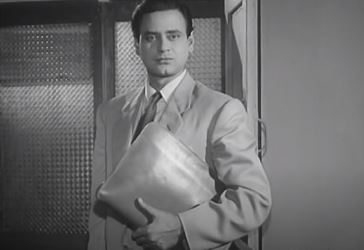
I have to admit I have never watched this film in all my years of watching and blogging about old Hindi cinema. Part of the reason is, I suppose, that this film—directed by Bimal Roy—somehow always tends to get sidelined in all the praise that’s showered on his better-known works: Do Bigha Zameen, Bandini, Devdas, Parakh, Sujata, Madhumati… then, too, there’s the fact that Kamini Kaushal has never been one of my favourite actresses. I’ve always found her a little affected, her diction and expressions too exaggeratedly innocent.
Continue readingTag Archives: Kammo
Howrah Bridge (1958)
Aaiye meherbaan baithiye jaan-e-jaan, and Mera naam Chin Chin Choo. Two great actresses, two iconic songs.
When I was doing the Helen tributes last month, I was reminded of Mera naam Chin Chin Choo all over again—and remembered, too, that I had never reviewed Howrah Bridge on this blog. It has also been many years since I last watched the film (before I launched Dusted Off), so I decided it was high time I revisited this.
Howrah Bridge begins very far from the bridge, and in fact from Kolkata: in Rangoon, where Prem Kumar (Ashok Kumar) finds his father (Brahm Bhardwaj) in a flap. Daddy is distraught because Prem’s elder brother Madan (Chaman Puri, in a cameo role) has run off from home, taking with him an invaluable family heirloom, a dragon which has been in the family for generations. We later discover that the dragon was crafted in China many centuries ago, and from there came to be owned by the king of Burma, after which it passed into the possession of Prem’s family.
Continue readingArpan (1957)
When I was going through Chetan Anand’s filmography last year (to commemorate his birth centenary), I stumbled across a Chetan Anand film in which he starred, besides directing it: a film, too, which immediately struck me as unusual, just given its length: a mere one hour. For a Hindi film, rare indeed. Though I didn’t watch Arpan back then, I bookmarked it and decided I’d watch it sometime later.
And it is an unusual film. Not just short, but also somewhat surreal in places. Hauntingly beautiful at times, outright odd at others.
Arpan is set, we are told, 2,500 years ago. A famine is ravaging the land, and people are starving left, right and centre. In this situation, the royalty, of course, is expected to set an example, and thus Princess Madhavi (Sheila Ramani) is going about, a large entourage with her, distributing food to her father’s subjects.
Continue readingApradhi Kaun (1957)
The world of Hindi cinema is peppered with names that anyone familiar with the industry (at least the industry of the 50s and 60s) can quickly slot into categories. Star. Villain. Comedian. Character actor. There are many, many names that automatically fall into (almost exclusively) one of these categories. Those that have shifted from one category to another—like Pran, for instance, once the quintessential villain but in later years the more interesting ‘good man’, or Ajit and Premnath, both initially hero and later villain—have again usually not done too many shifts.
Abhi Bhattacharya is one of those relatively rare individuals who seem to have appeared in a wide variety of roles, a wide variety of films. He was the idealistic school teacher of Jagriti, the ‘other man’ of Anuradha. The kind-hearted, principled example of the bhadralok in films like Amar Prem, and the straying older brother of Dev Anand in Love Marriage. He played Krishna and Arjun and Vishnu (the latter in a slew of mythologicals). He even played the villain, in the Vinod Khanna-Yogita Bali starrer, Memsaab.
This year marks the birth centenary of Abhi Bhattacharya (as far as I’ve been able to find out, he was born in 1921, though I’ve not been able to discover exactly when in 1921). To commemorate his career, I wanted to watch a Bhattacharya film, but a dilemma presented itself: which one? Hindi or Bengali? (since Bhattacharya had what seems to have been a very successful career in Bengali cinema as well). Eventually, I homed in on this film, a rare whodunit in Hindi cinema that’s pretty well made too.
Continue readingDil Tera Deewaana (1962)
Shammi Kapoor plays a wealthy man who pretends to be poor while far away from home. He falls in love with the only daughter of a poor blind man. Pran comes along and throws a spanner in the works.
Kashmir ki Kali? Yes, but also Dil Tera Deewaana.
It’s been a long while since I reviewed a Shammi Kapoor film, and considering he happens to be my favourite actor, I decided it was high time I revisited one of his films. I’d watched Dil Tera Deewaana many years back and remembered just the bare bones plot (besides the title song, which I don’t really care for). I did remember, though, that it was fairly entertaining as a film.
Chor Bazaar (1954)
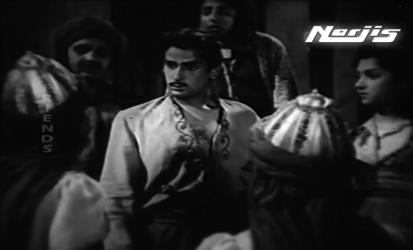
There were various reasons for my wanting to see this film. One was that it’s a historical (okay, faux historical, considering it’s set in some undefined supposedly Middle Eastern land named Sherqand). The other was that its music was scored by Sardar Malik, one of—in my opinion—Hindi cinema’s very underrated music directors. The main reason, however, was Shammi Kapoor. Though still in his moustached pre-Tumsa Nahin Dekha days, he is one of my favourite actors. So just about anything starring Shammi Kapoor is, for me, worth watching at least once.
Raj Hath (1956)
Despite my love for historicals and Madhubala, I was surprised when Ava mentioned this film on her blog. A historical (and a Sohrab Modi one, too), with Madhubala, and I’d never heard of it? Ava recommended it, so I decided to keep an eye out for it. Fortunately, I discovered Raj Hath on Youtube—therefore, this post. Ava, thank you. This was an enjoyable film.