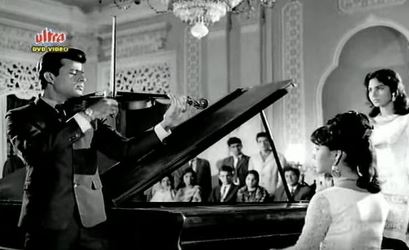
By which I mean two versions of the same duet.
This is part of an admittedly sporadic series of posts that focus on multiple versions of songs in old Hindi cinema. Composers and film directors have, again and again, homed in on songs that have staying power: songs that audiences wouldn’t mind listening to repeatedly in a film. Multiple version songs, as I’ve shown in previous posts of this type, take various forms. The type, for instance, where both a woman and a man sing the same song, but as solos. Or where a song is sung both as a duet and as a solo. Or, even, where the same singer (male or female) sings the same at two different points, but usually in two different moods.
And then there’s this: where a duet is repeated. Invariably, in two distinct moods. Given that the overwhelming number of duets in Hindi cinema tend to be romantic ones, there’s a certain predictability to the tones of these songs. One version is, more often than not, a happy version: two lovers celebrating their love and vowing eternal fidelity. The other version, just as often, is the complete opposite in tone. Things have fallen apart, fate (or disapproving parents, nasty relatives, lecherous villains, etc) have intervened and either sown the seed of suspicion, or used emotional blackmail to force one of the couple into giving up the other. There are also sorts of possibilities—and they lead, as below, to the old duet being again sung (often as an impossible duet, the estranged lovers physically too far apart to be really singing together).
Tag Archives: multiple version songs
Ten of my favourite ‘multiple version’ songs: solo/duet (or more)
Many years back, I’d begun doing a series of posts on multiple version songs in old Hindi cinema. Songs that seem to have struck their composers/film directors as so impactful that they needed to be repeated, in different scenarios, sometimes in different moods and even with different singers, singing differing lyrics. I did two of those posts, then something cropped up (I don’t remember what) and the project got abandoned.
But I’ve got back to this now, and here’s a third post on multiple version songs. My earlier posts focused on solos: two-version songs sung by a male singer and a female singer; and the same song, sung by the same singer but in two versions.
This time, I’m focusing on songs that appear at least twice in a film, but at least once in the form of a solo and the other time as a duet (or more: one of the songs in this list has three singers).
Continue readingTen of my favourite ‘multiple version songs: one voice, two solo versions
After last week’s post of multiple version songs featuring one male voice and one female voice singing the same song, I decided I should do another post of ‘multiple version’ songs. Also solos, and also (as in the previous post), songs which appear within the same film.
Usually, when one singer (invariably singing for one character) ends up singing two versions of the same song, it’s because the story has changed circumstances for the character. It could be—in most cases—that happy days have given way to sad; or ennui has made room for a sense of purpose. In some (relatively rare) cases, the same singer sings two different versions of the same song for two different characters.
Ten of my favourite ‘multiple version’ songs – male/female solo versions
There are times I’ve watched a film (like Daag, or Pyaar ka Mausam, or Taqdeer) and got the distinct feeling that the music director composed one especially good tune in the film, and that was a fact acknowledged by the film maker too, who decided to use that tune in different versions throughout the film. Therefore we have Ae mere dil kahin aur chal in several versions, and the same with Tum bin jaaoon kahaan or Jab-jab bahaar aayi aur phool muskuraaye. The tune, at least in essence is the same (the tempo may change); the singer(s) may be different, the actors who lip-sync to it may be different, and there may be other differences as well.
‘Multiple version’ songs can be of different types. The most common (from what I can tell; I haven’t researched this) is the differentiation of tone: the happy version/sad version scenario. One version of the song (usually the one that appears earlier in the film) is an upbeat, happy one; the other uses the same tune, but often different lyrics that reflect two different situations.
Then there are songs where different versions may be only sung by different playback singers—which might include (as in the case of Jab-jab bahaar aayi) one version sung as a solo, another as a duet or even by a trio. There are also versions (overlapping with regional language cinema) where the same tune is used in songs in films of different languages, for instance the Bengali song Ei raat tomaar aamaar (from Deep Jwele Jaai) appears as the lovely Yeh nayan dare-dare in the Hindi film Kohraa.
Those are versions for other, later song lists. For this post, I’m going to confine myself to one particular type of ‘multiple version’ song: the solo male singer/female singer song.