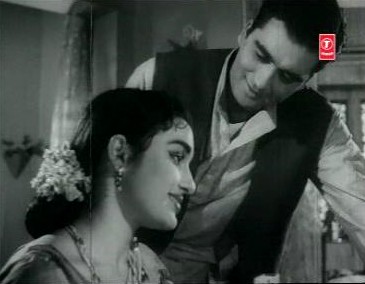
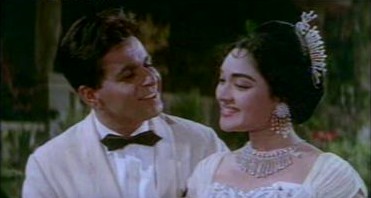
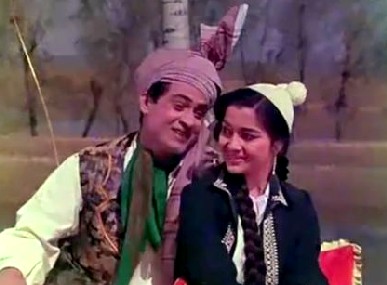
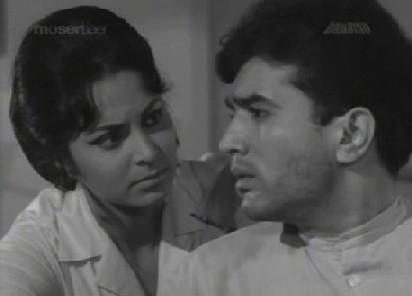
I first watched Khamoshi when I was a child (and too immature to really understand it). I last watched it as a teenager, more able to appreciate the film—which left a handful of clear, sharp images burnt into my memory: Dharmendra, looking out over a balcony and singing Tum pukaar lo; Dharmendra flinging a glass of water at Waheeda Rehman and then watching, half-bemused, half-shy, as she laughingly wipes her face against the front of his shirt. Waheeda Rehman, clinging to Rajesh Khanna but thinking of Dharmendra.
So, considering that this last week saw Dharmendra’s 74th birthday (on December 8th), and having read some very enjoyable posts by fellow bloggers: I decided it was time to re-view and review Khamoshi. It came as a bit of a surprise to realise that Dharmendra actually appears onscreen for just over 5 minutes (and that includes a song). The male lead is Rajesh Khanna. And the film belongs to Waheeda Rehman.
Tag Archives: Nasir Hussain
Sahib Bibi aur Ghulam (1962)
After all the lightheartedness of the past few posts, time to get back to serious stuff. I had three none-too-cheery films lined up: Khamoshi, Andaz, and this one. Sahib Bibi aur Ghulam had been popping up in some recent posts (one song was part of the daaru list, and a discussion on Jawahar Kaul—one of the leads in Dekh Kabira Roya—ended up with a general wondering of what role he played in Sahib Bibi aur Ghulam). So Sahib Bibi aur Ghulam it was, a rewatch of a memorable film with some fine performances and superb music.

Chhaya (1962)
Like Sujata, Chhaya is the story of a girl brought up in the house of someone she’s not related to. Like Sujata, it stars Sunil Dutt (and looking gorgeous, too!), and like Sujata, it’s got great music. Also like Sujata, it was directed by a Bengali director: Hrishikesh Mukherjee in this case.
That’s where the resemblance ends, because Mukherjee makes Chhaya a less poignant, less socially relevant film than Bimal Roy made of Sujata. Where Sujata focussed on the understated emotion of a family and a `daughter who’s not quite one’, Chhaya focuses on a mother who’s forced by circumstances to yield up her child to another.

Leader (1964)
Having spent most of my life avidly watching Hindi films—especially pre-80’s—I’m inclined to be indulgent. I don’t bat an eyelid when a heroine’s hairdo goes from stylish bob to flowing tresses from one scene to the next. I don’t wonder how an arch villain can defy the cops of an entire nation (occasionally, most of the world) and still fall before the combined efforts of the hero, his comic sidekick, and a faithful pooch. I forgive completely illogical turns and plot elements, ascribing them to artistic license. I mumble a puzzled “What the—!” or “How the—!” or even a “Why the—!” and move on.
Leader is one of those (thankfully rare) films that’s a “What/Why/How the—!” moment from beginning to end.

Do Bigha Zameen (1953)
Bimal Roy, Hrishikesh Mukherjee, Guru Dutt, Asit Sen: some of my favourite directors, and all men with a string of poignant, meaningful films to their credit. Not always very happy films, but films that step away from the usual masala of Hindi cinema. Films that, like the classic Do Bigha Zameen, are not about bewigged, gadget-toting gundas and their better-than-good (not to forget immensely strong) nemeses, but about common people with common problems.

Asli-Naqli (1962)
I tend to associate Hrishikesh Mukherjee with films that focus on the everyday lives of people like you and me (I’m assuming here that you aren’t a multimillionaire, a film star or something equally glamorous; I’m not, at any rate). Anupama, Anuradha, Anand, Satyakam—all of them amazing films whose protagonists are very real. Asli-Naqli is perhaps a little different, because it begins in the world of the spoilt young heir of a very rich man.

Phir Wohi Dil Laya Hoon (1963)
Someone once said that Nasir Hussain came to Bombay with one story in his briefcase, and created a series of blockbusters out of it. This is one of them, and a vastly entertaining film: total paisa vasool. You get your money’s worth.
The story’s similar to that of Dil Deke Dekho, Tumsa Nahin Dekha, and Jab Pyaar Kisise Hota Hai: a couple separates, and one of them raises their only child, a son. He grows up, meets his `other’ parent (who’s wealthy), and they don’t quite hit it off—but he does fall for that parent’s adopted daughter. To complicate matters, there’s a villain who pretends to be the long-lost son, whom the parent has been yearning for all these years.