
A couple of months back, my sister Swapna was invited to head a quiz team at a pub quiz (Jai Arjun Singh, who was also there, wrote about it here). Telling me about the quiz later, Swapna mentioned that there was one question that even Jai didn’t know. In Aarzoo, which place in Delhi does Rajendra Kumar’s character say he belongs to?
Nobody could answer that question. But the answer is Okhla Village.
… which sort of struck a chord with me, because till we shifted from Delhi to Noida, my husband and I had spent many years living very close to Okhla. And Noida, in case you weren’t aware of this, is actually an acronym for New Okhla Industrial Development Authority. Okhla follows us around. Or we refuse to really move away from Okhla.
This incident reminded me, though, that I have never reviewed Aarzoo on this blog, though I’ve watched the film at least twice. Time to amend that, I decided.
Newly-minted medical graduate Gopal (Rajendra Kumar) and his neighbour Ramesh (Feroze Khan) have been best friends since their childhood. Gopal’s younger sister Sarla (Nazima) and his widowed mother (Achla Sachdev) regard Ramesh pretty much the same as Gopal: a member of the family, a brother/son just as Gopal is.
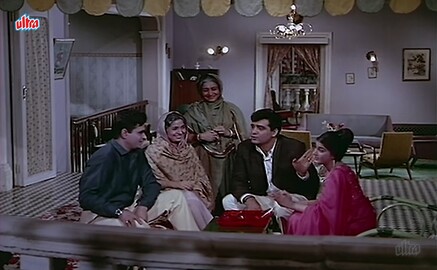
Now Ramesh tells Gopal that he has booked two tickets for them to go to Kashmir. A skiing championship is being held in Gulmarg; Gopal and Ramesh had competed the previous year and not fared well. This year, therefore, Ramesh has entered them under false names: Ramesh will be Haria from Haryana and Gopal will be Sarjoo from Okhla Village. [This makes no sense to me, especially since the assumed names are not combined with disguises].
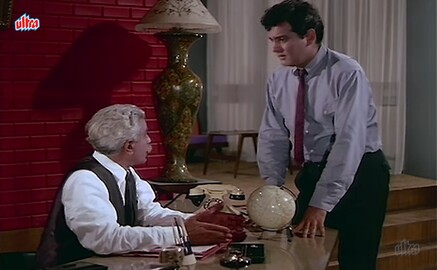
But Ramesh’s father (Brahm Bhardwaj) throws a spanner in the works. Ramesh, who helps him out in the business, has to complete some important work here in Delhi; he can’t go off to Kashmir now. Ramesh argues his case, but Dad is adamant. He finally says that Gopal can go on his own for now, and Ramesh can join him a week later. Ramesh has to be happy with that.
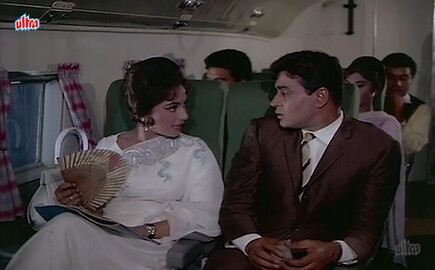
So Gopal goes to Kashmir… and, in the plane, finds himself seated to Usha (Sadhana), who studies in college in Delhi but lives in Srinagar with her father Diwan Kishan Kishore (Nazir Hussain)—though these details of her life are revealed only much later in the story. For now, all Gopal knows is that he is seated next to a pretty cantankerous female. Usha lets fly at him every opportunity she gets, and after a while, Gopal is so fed up, he moves to another seat.
In Srinagar, Gopal opts to stay at a houseboat owned and operated by the very annoying Mamdoo (Mehmood in one of his most irritating roles). Mamdoo, in between romancing Sabi (Malika, elder sister of Mumtaz) and singing a teeth-grittingly idiotic ditty, takes Gopal sightseeing. On the walk up to Shankaracharya Temple, Gopal runs into a familiar face.
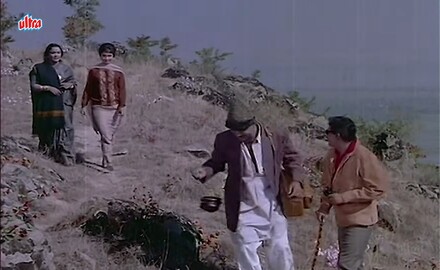
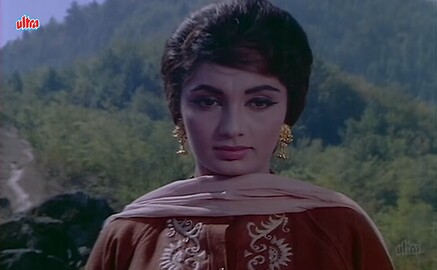
But, in an inexplicable turn-around, Usha is now all benign smiles. She is accompanied by her aunt (Praveen Paul), who along with her husband (Hari Shivdasani) had come to receive Usha at the airport. Gopal does not, right now, give Usha the time of day, but as it happens, Usha’s uncle and aunt are going to Gulmarg and want Usha to accompany them. She has discovered that Gopal is going to be competing in the skiing competition there, and that is enough to make Usha eager to go to Gulmarg. [From snapping his head off in the plane to now being all glassy-eyed and silly smiles: why?]
Much happens. In Gulmarg, Gopal (of course masquerading as Sarjoo) wins the skiing championship [how someone who lives in Delhi and doesn’t seem to be spending any time practising pulls off this feat—after having performed really badly the previous year—is beyond me]. Usha is ecstatic, as are her uncle and aunt.
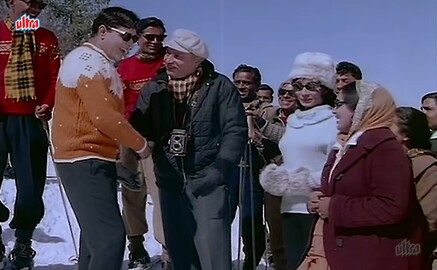
Also, Gopal and Usha bump into each other. She twists her ankle, and is mock-huffy when Gopal binds it up for her. To a remark of Gopal’s, she retorts that “It would be better to die than to be crippled” [Note]. Anyhow, they go on, he helping her onto a pony and then serenading her.
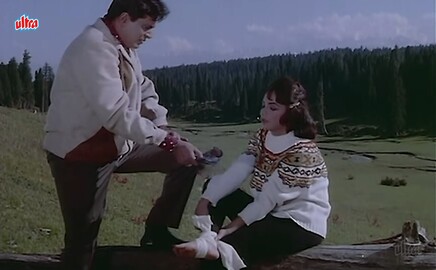
This is the start to the Usha-‘Sarjoo’ romance. They meet every day, they sing songs to each other. The moronic Mamdoo also gets to meet Usha when he rows them in his shikara. So much time they spend together, and Gopal doesn’t find two minutes to let the love of his life know who he really is. Not his real name, not his address, nothing.
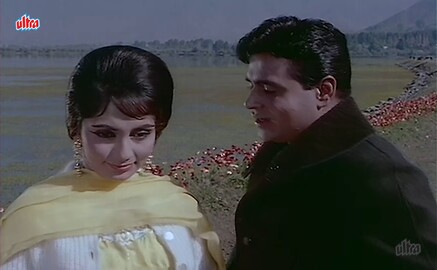
Then Usha falls ill with a fever, and Gopal, unable to stay away from her, persuades Mamdoo’s now-wife, Sabi, to help him out. Sabi, pretending to be a friend of Usha’s, turns up at Usha’s home, along with her ‘father’ (Gopal in disguise). Gopal spends time ‘treating’ Usha, sings a song in praise of her, makes much of her… all under the benevolent eye of her father, Diwan Sahib, who has no idea what is happening.
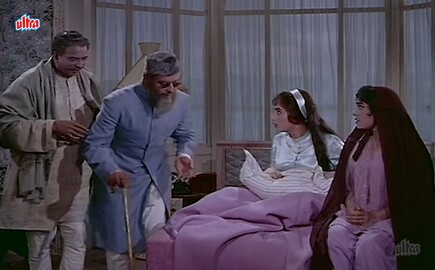
Unfortunately for Usha and Gopal, Diwan Sahib happens to overhear a quick word between ‘Salma’s Abbu’ and Usha. Gopal was supposed to return to Delhi, but hasn’t been able to get a ticket. The only ticket he has been able to book is for Pathankot, from where he will have to travel by road. The plane to Pathankot leaves early the next morning. Usha is sad, but Gopal assures her: they will be together again very soon.
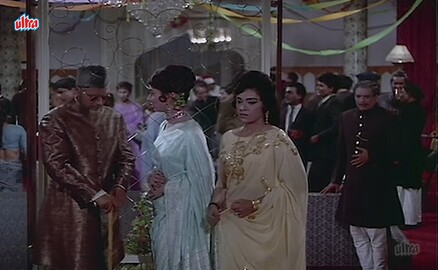
Diwan Sahib is horrified and heartbroken: his daughter, whom he’s always trusted so much, is carrying on an affair with some ne’er-do-well? [thankfully, he does not suspect Usha of actually having an affair with Salma’s old father]. He is so angry, in fact, that he locks Usha up in her room, and refuses to hear anything she might have to say.
The next morning, at the airport, Mamdoo has come to see Gopal off, and since there’s no sign of Usha, Gopal decides to write a note for her which Mamdoo can pass on. He only manages to write that his real name is not Sarjoo, when Usha [who has shown a bit of spirit and climbed down from the window of her room] arrives.
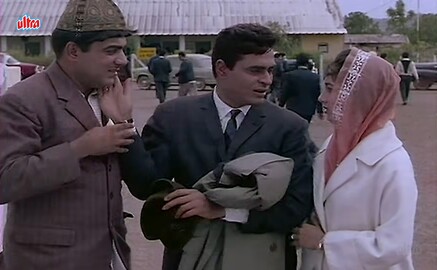
The plane is about to take off, so all Gopal has the time for is to reassure Usha (who tells him that Daddy knows all) that he will return within two days, and then he will talk to her father to ask for her hand in marriage. He runs off, leaving his half-written note in Usha’s hand.
When Usha gets home, there is a big scene. Daddy is frustrated and prone to use emotional blackmail, but Usha shows him she can blackmail like the best of ’em. If my mother were alive, she cries, she would understand my pain. This, of course, makes Daddy start bawling that he wishes God had taken him rather than her mother, and then both of them have a good cry and make up. So much so that Daddy agrees to come to the airport to receive ‘Sarjoo’ (since Gopal never did get around to writing his real name on his note, they still think of him as Sarjoo) when he arrives.
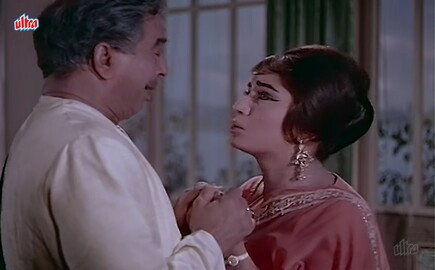
Meanwhile, other things have been happening in Delhi. Gopal has written to Ramesh, telling him about the girl he’s fallen in love with (though not giving her name, or anything else about her).
Also, Ramesh’s father has finally allowed Ramesh to leave for Kashmir—but with a caveat. Ramesh has to go and ‘see’ (with a view to marrying, naturally) a girl, the daughter of his father’s good friend. The girl’s photo has been sent for his perusal, and Ramesh is smitten at first glance.
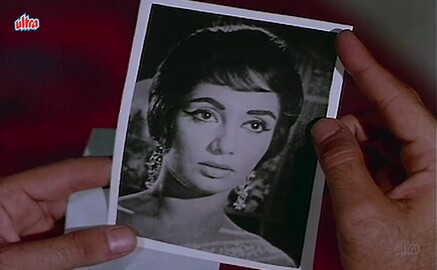
Of course.
Two men, in love with the same woman. Two men, furthermore, who are best friends.
Remember: Usha said “It would be better to die than to be crippled”.
Note that Gopal, whom Usha knows only as Sarjoo, has gone to Pathankot, and intends to go from there to Delhi by road. Note that this is a wealthy man; he won’t go by bus. He’ll take a cab. It’s a long way from Pathankot to Delhi, and a cab driver may sing to pass the time… and may get distracted.
This is not the first time I’ve watched Aarzoo, and I remembered a good chunk of it well enough to remember why I have not watched it more often.
What I liked about this film:
The songs. Shankar-Jaikishan’s music and Hasrat Jaipuri’s lyrics come together to create a stellar score. The songs, really, are what stand out: each of them is good. Jab ishq kahin ho jaata hai is probably the least of the songs, but the others are all top-notch: Ae nargis-e-mastaana, Aji roothkar ab kahaan jaaiyega (and its male version, Aji humse bachkar kahaan jaaiyega), Ae phoolon ki raani bahaaron ki mallika, Chhalke teri aankhon se sharaab aur zyada, and Bedardi baalma tujhko.
And, Sadhana. So pretty, and so gorgeously dressed (her costumes were designed by Bhanu Athaiya).
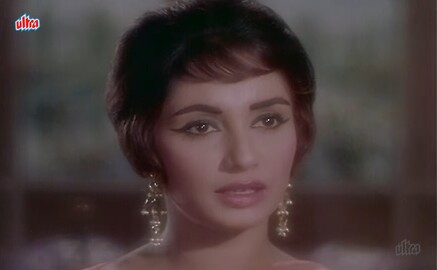
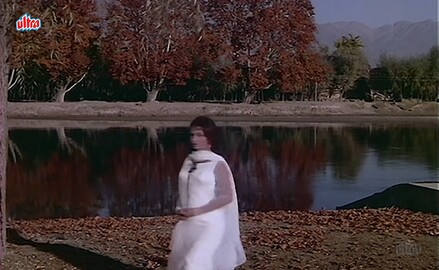
Lastly, Kashmir, which is lovely. Four of the songs showcase the beauty of Kashmir in the picturization, and one that especially stands out because of its unusualness is Bedardi baalma tujhko, filmed during autumn, with chinar leaves covering the ground and flaming red and gold in the background.
What I didn’t like:
Pretty much everything else.
Mehmood is at his most irritating here. Mamdoo is a halfwit, and he has this extremely annoying habit of adding ‘aandis’ to every other word. “Tum aandis, hum tumhe houseboat dikhaandis.” And so on and so forth. As if that’s not enough, he almost continuously sings a frightful ditty which goes “Ya Ilahi, mit na jaandis, dadr-e-dil” (note: not dard-e-dil). Also, he ends up as part of a thoroughly idiotic and pointless comic side plot involving Dhumal, who is Ramesh’s father’s munshi and for whose benefit (for no really good reason) Mamdoo dons drag.
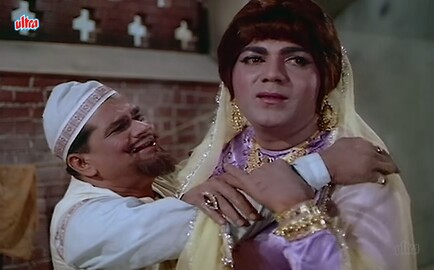
Ugh.
Then, the melodrama. I know that’s par for the course for many, many Hindi films. But Aarzoo takes the melodrama to stratospheric levels. Shortly after Gopal reaches Pathankot, an incident occurs after which there’s just people weeping and sobbing hysterically or screaming at each other. And Rajendra Kumar, always a one for high drama, is at his peak here. The crying, the insistence on self-sacrifice, the quivering lip…
And, the belief that a woman cannot possibly be considered an intelligent, mature person. The way Gopal insists on cutting Usha out of the decision about her own life made me see red. Usha does snap back briefly, but only very briefly. If I had been in her place, I would have been happy to say goodbye to a man who didn’t think I knew what was good for me, didn’t trust me, and didn’t credit me with the maturity to decide my own fate.
Honestly, unless you’re a fan of Rajendra Kumar, don’t even watch Aarzoo. The songs are available easily on YouTube; go watch them, instead.
And this was the same Ramanand Sagar who, just three years down the line, made the kitschy but utterly enjoyable Aankhen…


Nice review, Madhu ji.
I never watched the movie but it has been on my watchlist because of the songs.
You convinced me not to watch the movie😀.
To be honest I am not a fan of Rajendra Kumar. Of the songs, the one I really like is “ Chalke teri aankhon se”.
About Mehmood, it’s a pity he is frequently cast as the village idiot. I do think he can be a decent actor under a good director like Gurudutt or Bimal Roy.
Btw, I just posted “Songs of Hope” on my blog. Please check it out when you get a chance and let me know what you think.
Regards,
Uday
LikeLiked by 2 people
I agree re: Mehmood. He could actually be a very good actor (see Pyaasa, for instance); even as a comic actor, he needed the right sort of director to allow him to be funny without having to resort to sheer idiocy – I find him hilarious as Atma Ram in Pyaar Kiye Jaa, for example. It’s a shame that both he and Rajendranath got slotted as buffoons and ended up doing so many cringeworthy roles. :-(
LikeLiked by 1 person
Loved reading the review, dear Madhu!
I was laughing all through it. I should admit I never had the aarzoo to watch it and if someday a perverse thought should arise suggesting to watch the movie, atleast I am warned.
LikeLiked by 3 people
LoL, yes! Do consider yourself amply warned, and avoid this like the plague. :-D
LikeLike
I’m one of those who enjoyed the movie. I didn’t like the Mehmood bits, but my son who was then around 10 or so, let out hoots of laughter at all the Mehmood scenes, so I guess they did have some fans.
I like the songs too, which I remember, Harv, you didn’t like. After some cheekhna chillana, we do get a nice ending.
LikeLiked by 1 person
Ava, nice ending toh honi hi thi, when does Hindi cinema of that period not have a nice ending? :-D
I guess Mehmood did appeal to a certain sense of humour. I enjoyed his antics well enough when I was a child, but once I grew up a bit, I began to find him hugely irritating.
LikeLiked by 1 person
You are right Ava, I am not a big fan of the songs. I don’t dislike them, but more like umh…
But in face of general approval for the songs if not to say euphoria for them, I preferred not to mention it.
One song, which I like somewhat, bedardi balamaa tujh ko, is marred by an iconic object, which is highly hallowed (alliteration intended) in Kashmir and India. The reason is that in the city where I live there is a long avenue of the European Chinar Tree and in autumn the leaves come all falling down on to the bike lane, which makes riding a bicycle fast impossible there. In the very first year I got here, the fallen leaves got all entangled in the bicycle spikes leading to a mishap. Not only did I go down but took along 3-4 bike riders behind me too. But I do like the vast barren expanse at the beginning of the song, which I presume is filmed in Ladakh.
LikeLiked by 1 person
Great anecdote! Hindi movies are full of location misdirection, notable in films like An Evening in Paris, Barood and even Ek Dooje Ke liye which was filmed also in Vishakhapatnam but credited to Goa. Here’s an idea for Madhu, songs with location misdirection.
LikeLike
I have come across several songs which are obviously filmed in the Deccan somewhere but it’s ‘supposed’ to be Kashmir. :-) If I remember correctly, Hum Dil De Chuke Sanam was supposed to be set in Italy, but I believe it was all shot in Hungary.
LikeLiked by 1 person
I had forgotten about those first few shots at the beginning of the song. While it does look like Ladakh, I am not absolutely sure – pretty much wherever you go in Ladakh, there are the high mountains (not these low hills, as you see here) always in the backdrop… but it could be.
What an anecdote, by the way, Harvey! Uff.
LikeLiked by 1 person
I did watch Aarzoo on the big screen back in the mid-60s, when the only real attraction for us was the songs. There wasn’t much choice of entertainment then, so we often went just to enjoy the music and the stars, even if the story didn’t stay with us for long. At that age, we naturally remembered only what appealed to us most and the rest faded away. Looking back now, it’s clear the film survives mainly for its songs and not so much for its storytelling.
Thanks for the lovely review and for bringing this film back into focus for a new generation.
LikeLiked by 1 person
I am glad you liked this review. Thank you for reading.
My father too often voices the same opinion: that one went for the music and the stars; the story didn’t stay with one for long. In fact, I have lost count of the number of films for which I’ve heard my father say, “Oh, this had very good music!” – and when I asked him whether the film itself was any good, he invariably shrugs his shoulders and is quite non-committal.
LikeLike
Hi Dusted Off,
Until this post popped up in my email, I hadn’t realized you hadn’t reviewed Aarzoo since it was such a popular movie of its time.
I have to say are being was too kind with the review.
I have watched this movie at least a couple of times, and each time, barely managed to get through it.
Last I watched it was as recent as last summer, along with my father-in-law.
He wanted to watch this movie with the family because the songs remind him of the time he was getting deployed to Srinagar in mid-1965 when the 2nd Indo-Pak war was imminent.
These songs were all the rage at that time, and he remembers them like yesterday.
I watched the movie with him in bits and pieces, and barely managed to get through it.
I have to admit this is an extremely annoying movie.
As it is, I can barely stand Rajendra Kumar.
When combined with the annoying acting of Mehmood & Dhumal (which you correctly picked up on), the gisa-peeta plot and the over-dramatization, this movie is insufferable.
I can only stand Rajendra Kumar in movies where the music is truly exceptional such as Goonj Uthi Shehnai, but even in it, songs are Maine Peena Seekh Liya are so poorly acted.
Coming to the music, would it be awful if I were to admit that I don’t find the songs of Aarzoo too appealing?
I suppose at one time I must have, since I have an original soundtrack recording cassette in my collection, but not any more.
My mom tells me that the songs of Aarzoo were insanely popular at that time.
Like, so popular that our generation and later generations cannot even imagine.
The only thing that comes even remotely close is perhaps Hum Aapke Hain Koun and Dilwale Dulhania Le Jayenge.
But, apparently, we can’t imagine how popular the songs of Aarzoo were back then !
Anyway, I am going to admit I don’t like the songs of Aarzoo – they are too cheesy and too popular-y, if you know what I mean.
Except Bedardi Balma Tujhko – that song is sublime.
One of my favorites.
Rajendra Kumar was a hero made by Mohammed Rafi – he owes his whole career and popularity to Rafi.
However, when Rafi sang for Rajendra Kumar, especially in the 1960s era (such as Suraj, Sasural and Aarzoo), he put on an affected style that doesn’t quite sit right with me.
Maybe it was just a sign of the changing times.
I am sure vast majority of music lovers will disagree with me on this, LOL.
Overall, it was an iconic movie – establishing Mr. Jubilee Kumar at his zenith, and record-breaking musical success.
I agree with your final assessment – just watch the songs on You Tube and hard pass on the movie.
-Pratick
LikeLiked by 2 people
Thank you for being so honest! I will agree that there are far better scores in other films of the period (Jewel Thief, for example, or Kashmir ki Kali, or the fabulous Waqt) which I think fully deserve their popularity… but in the context of the film as a whole, I’d say the music is really one of the (very few) elements here which is worth it. Not much else in the film is enough reason to sit through it!
LikeLike
Thank you for this lovely review! I almost watched this film a few years ago – it was on Zee Classic – but one look at Rajendra Kumar’s reaction when he finds out his leg has been amputated was enough to wipe out all my enthusiasm. I hadn’t realised he was a medical student, though – his outlook on crippled people and autonomy (at least when it comes to Usha) is a rather concerning one for a medical professional to have.
“…how someone who lives in Delhi and doesn’t seem to be spending any time practising pulls off this feat—after having performed really badly the previous year—is beyond me…”
Knowing what we do of multi-talented gets-a-girl-out-of-his-league-with-zero-effort Gopal, he probably realised Ramesh was losing and sabotaged his own victory for his friend’s sake! Wouldn’t be the only time he did that…
LikeLiked by 1 person
You couldn’t be more right re: Gopal’s views, for a medical practitioner. One would have expected someone like him to be more accepting of his own disability…
Honestly, Hindi cinema has had the weirdest ideas about so many professions and what they embody. The general tendency seems to be to elevate everything (science, medicine, law enforcement) to a ‘noble calling’ without really paying attention to what the profession is actually about.
This somewhat tangential comment (my own, not yours) reminds me of this delightful long-ago post by the late Bollyviewer, which I’d enjoyed hugely when she’d posted it, long ago:
https://bollyviewer-oldisgold.blogspot.com/2008/12/filmi-professions-how-professional.html
LikeLiked by 1 person
That was so much fun to read! I hadn’t been aware that Bollyviewer was a scientist.
Completely agree regarding Hindi cinema’s proclivity for noble callings. I can’t speak for medicine, but having studied a bit of psychology, the way that the subject – particularly with respect to disorders – is represented in Hindi films is quite jarring (with perhaps the exception of the occasional Raat Aur Din and Khamoshi). Some people I’ve met whose knowledge of psychology and psychiatry is limited to Hindi films were surprised that a general feeling of “paagalpan” isn’t an actual diagnosis!
LikeLiked by 1 person
Oh, goodness, yes! The way mental illness is handled in Hindi cinema is best left undiscussed.
And the law, or law courts… or the police. Sometimes I get the impression that little or no research was ever done back then; film-makers just decided the plot needed so-and-so profession, and then, depending upon what rudimentary stuff they knew (or thought they knew) about it, they went ahead and did it. Not even a nod to veracity.
LikeLike
Your assessment of the movie is spot on Madhulikaji. I enjoyed the review and agree to every point put forth by you. You have written ‘Ramesh’ instead of ‘Gopal’ at certain places in your narration of the story. Please correct.
LikeLiked by 1 person
Thank you for drawing my attention to that faux pas, Jitendraji. Now corrected. I am glad you enjoyed this review, thank you for taking the time to read.
LikeLiked by 1 person
Thank you for this review, Madhu! I was in splits with your asides. What a dreary film this was, to be sure. Of course, Rajendra Kumar was never a favourite but he outdid himself with his quivering lip here.
p.s. Your ‘what you didn’t like’ section reminded me that I’d watched this film and reviewed it (here), so I went to see whether I’d liked it any better. We seem to have made the same observations regarding Sadhana’s prettiness, Mehmood’s horrible attempt at comedy and the melodrama. :) Though I was a bit more charitable than you in that I said it was a ‘decent enough watch’. (What was I thinking??)
LikeLiked by 1 person
I have just finished re-reading your review of the film, Anu. I didn’t have the time. I have too much work to finish, because I am travelling on work come Monday. I have a workshop to conduct, and stuff to prepare for that. And packing. And food to be cooked – some, at least – for family for when I’m gone. And much else. I have no time!
I clicked on the link, telling myself I would only glance through.
And then, I ended up reading it all through, and laughing all through. Such a delightful review! :-)
LikeLike
Now that’s a compliment, if ever there was one, Madhu! :) Thank you for taking the time to read the whole review again.
LikeLiked by 1 person
You do write wonderfully well, Anu. :-)
LikeLike
Anu, loved your review of the movie too. If not good, the movie atleast provided stuff for two good, hilarious reviews.
LikeLiked by 1 person
Thank you so much, Harvey. :) Good to have you visiting my blog again. We’ve missed you there.
LikeLike
I do visit it quite often, Anu dear, but the method of commenting on disqus seems to evade my intellect.
LikeLike
Sarju of Okhla How can Jai forget this dialogue 😉
LikeLiked by 1 person
:-D
LikeLike
Loved your review and was surprised that this film was not reviewed earlier.
I find Arzoo dreadful, but Sadhana sparkled—especially in the songs. The music was enjoyable, and her role, though limited, had some dimension. She refuses to sit quietly, searching for Rajendra Kumar (though why she overlooks the far more handsome Feroze Khan is beyond me). If the film were ever re-released, I’d recommend cutting Mehmood’s role altogether—it’s pure cringe.
What I liked more is somewhere in 1965, after release of this movie Sadhana (along with Rajendra Kumar) visited soldiers posted on J&K border. They crossed Nastachun pass en-route which was later renamed as Sadhana pass. It’s almost cinematic tribute to both her beauty & natural splendor.
LikeLike
Madhuji,
Arzoo is difficult to sit through. And I completely second your review!
Anita
LikeLiked by 1 person
Anitaji, glad you agree! :D
LikeLike