
Given that I am a fan of mid-1950s-early 1960s Dev Anand, and that this film also stars Vyjyanthimala (whom I like a lot), it should come as no surprise that I’ve had this film bookmarked for several years now. Somehow it kept getting ignored, until some weeks back, when I discovered that Amardeep was a remake of the 1956 Tamil film Amara Deepam (starring Shivaji Ganesan, Savitri, and Padmini). And that Amara Deepam was based on Random Harvest.
Now, Random Harvest is a film I’d watched and reviewed in the early years of this blog, and it’s a film I’ve never been quite able to forget: so emotionally charged, so romantic, so utterly beautiful.
I couldn’t wait to see what T Prakash Rao (who directed both Amara Deepam and Amardeep) would make of such a wonderful story.
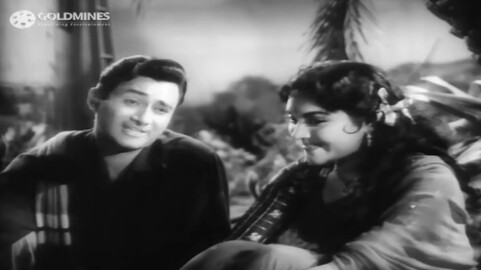
The film begins in the home of the very wealthy Aruna (Vyjyanthimala), who lives with her father (Bipin Gupta). When the story opens, Aruna’s father is talking to their servant (Shivraj) and telling him that he’s happy that Pran (Pran, of course) has come to stay with them. Pran’s father, who has died recently, had been his (Aruna’s father’s) best friend, and—like all bosom buddies in Hindi cinema—the two men had decided, during their respective offspring’s childhood, that they would be married to each other. He is now looking forward to Aruna and Pran getting married.
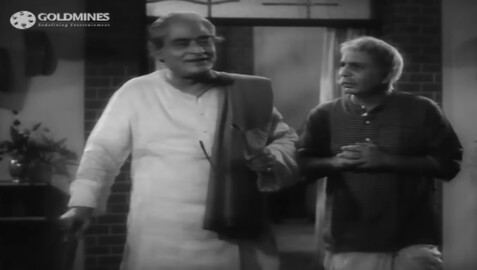
His hopes are about to be dashed, though, because Pran and Aruna do not hit it off. There is a tiff over a radio (Pran wants to sleep, Aruna is playing the radio so loud in the next room that he can’t, and she refuses to turn the volume down, and so Pran gets mad enough to bust her radio)… and Aruna goes weeping and complaining to her father. [TBH, I have little sympathy for her. I cannot sleep with music blaring at me, so Pran gets my vote here].
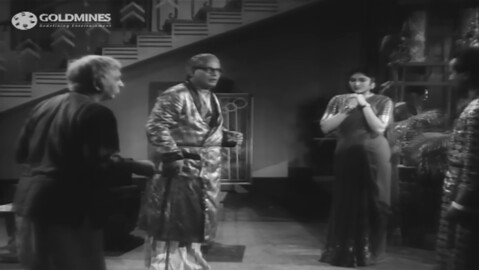
When Aruna’s father [about time?] tells her that she will be marrying Pran so she’d better kiss and make up with him, Aruna decides this cannot happen. That night she sneaks away from home. Better the mean streets than marrying a man who won’t let her play the radio at full volume.
Aruna washes up, finally, at the hut (actually a ramshackle old bus, its wheels gone) that a man named Ashok (Dev Anand) has repurposed into a home for himself. Ashok spends his days doing some perfunctory searching for a job, but otherwise singing and doing nothing much. When he returns from one of these days of idling around town, it’s to find Aruna fast asleep in his bed. Ashok is charmed and covers her up with his blanket; the next morning, when she wakes up, he offers her tea.
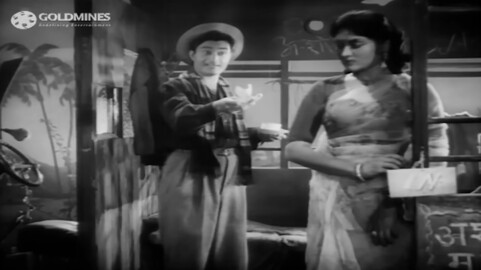
They get talking, and Ashok informs her that he has no-one in the world: his parents died when he was a child and he has been brought up in an orphanage [how an unemployed man with no generational wealth manages to be so well-dressed is of course one of those eternal questions of Hindi cinema]. When Ashok asks Aruna about her family, her home, she refuses to tell. Someday I will, she promises; but not now.

While Ashok and Aruna are [predictably] falling in love, Aruna’s father is getting increasingly distressed. Where has Aruna gone? He sends Pran off to find her, and Pran ends up spending entire days driving about town, trying to find the missing woman. When he gets back home, he suggests informing the police—but Aruna’s father shoots down that idea. Tell the police, and soon everybody will know, and their name will be mud. No; no police. Pran should continue to keep searching. Pran is understandably miffed. [I actually feel for Pran till now. Aruna and her father have been pretty high-handed in their dealings with him].

But—call it luck, call it persistence—Pran one day finally sees Aruna. He immediately grabs her and bundles her into his car. Ashok, seeing Aruna being abducted thus in broad daylight, comes running and tries to stop Pran, but cannot keep up [well, naturally. Why do people in Hindi films insist on trying to chase speeding cars on foot?]. Pran drives off. Ashok, still running along trying to catch up with the car, gets hit and falls down.
Aruna, in all the confusion, has not seen what has happened to Ashok. Pran takes her home, where there’s a tearful reunion with her father, who shortly after, kicks the bucket: so much happiness doesn’t suit him.
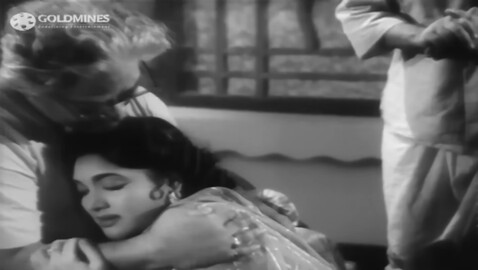
Ashok is taken to the hospital, where he comes to. But he has lost his memory; he doesn’t know who he is, what his name is, where he lives, anything.
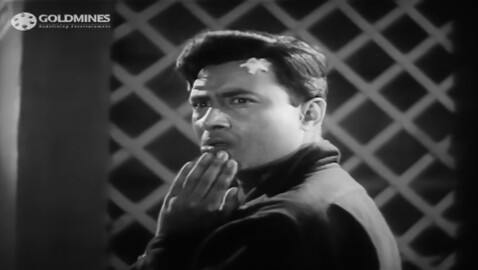
We are now introduced to a small group of people who depend on street performances to eke out a living. Rupa (Padmini), her sister Champa (Ragini) and their fellow artiste, known only as Ustad (Johnny Walker) dance, sing, do stunts etc on the streets. Their relationships are a little convoluted:
- Ustad is in love with Rupa, but Rupa is utterly unmoved.
- Champa is in love with Ustad, but he of course doesn’t give a hoot.
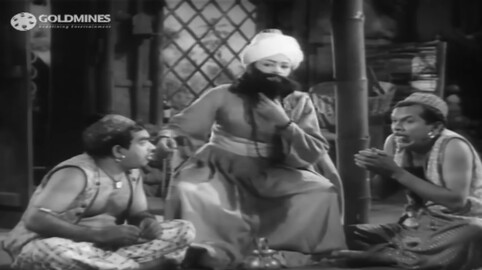
- Instead, Ustad keeps trying to find silly love-potion-like methods to have Rupa fall for him; this he does with the help of his friend Laali (Mukri). Laali is a wily character and tries to humour Ustad without really helping him.

It’s a [predictably] silly comic side plot, with Champa disguising herself as a sadhu peddling love philtres just so she can teach Ustad a lesson or two.
Into this muddle comes Ashok, who saves Rupa when she tumbles down from a tight-rope on which she’s walking. As is common when a woman falls and a man catches her before she hits the ground, Rupa falls headlong in love with Ashok.
Since Ashok has no idea who he is, where he lives, etc, he ends up staying with Rupa and her cohort. Rupa thus gets plenty of time to devote her energies to letting him know her feelings, and soon enough, Ashok is reciprocating. He has completely forgotten Aruna.
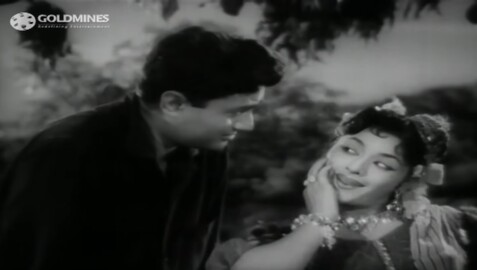
What of Aruna, then? [After all, Hindi cinema has long held that one’s first love is one’s true love, and that no matter what happens, one must circle back to him/her]. How do Aruna and Ashok find each other again? And what happens of the then-messy love triangle that has formed?
What I liked about this film:
C Ramachandra’s music (to lyrics by Rajendra Krishan). Two songs that are relatively popular, and which I liked, are the dual-version Dekh humein aawaaz na dena and Mere mann ka baanwra panchhi; but one song that I discovered and ended up enjoying a lot was the delightful Ab darr hai kiska pyaare: so much fun!
Then, the dances. With Padmini, Ragini and Vyjyanthimala in the film, this was a given. Vyjyanthimala gets to dance to only one song (Laagi apni nazariya kataar banke), but Padmini and Ragini get several dances between them, all worth watching.
What I didn’t like, and a comparison:
I watched Amardeep, after all, because it was supposedly based on Random Harvest. But other than the fact that the main male character loses his memory and falls for a woman other than the woman he initially loved, there is no similarity here. In Random Harvest, Ronald Colman’s character is a former soldier who’s lost his memory due to PTSD, and in that state, he falls in love with, marries, and has a child with Greer Garson’s character. Then, a car accident knocks him out while he’s away—and when he comes to, he’s recovered his memory of before the entire falling-in-love-and-marrying episode. It turns out he’s a very wealthy man, and once he returns to his property and family, it doesn’t take long for him to fall in love with another woman…
Which, as you can see, is not at all the same as Amardeep. There is no marriage here, and Ashok, at the beginning, has his memory intact. Also, the very believable, very poignant romance between the man and his first love (in Random Harvest) is replaced by a fairly shallow and hard-to-believe love (which is exactly what I also thought of the second romance) in Amardeep. Other plot elements too are very different; Amardeep, for instance, does not have the very interesting twist regarding the lead female character’s career arc after her husband (or, in Amardeep, lover) disappears from her life.
If one were to completely disregard the lack of resemblance to Random Harvest, this is an okay film. Not particularly good, but not simply horrible either. There are the songs and the dances, there are even some likeable cameos (Om Prakash and Anwar Hussain in a brief scene, Randhir in another). But there is a ho-hum quality to the film, which, all said and done, I found forgettable. And the extremely convenient coincidence at the end was the last straw.


Amardeep is one of a long list of Dev Anand movies that I watched mainly for the songs – in this case perhaps one song, “Dekh Humein Awaaz Ne Dena”.
I agree with you that this movie is nothing like Random Harvest, except for the amnesiac falling in love with two different women before and after amnesia. The comedy plot was insufferable, but that was par for the course for South Indian tear jerkers of that era.
I did not watch Amaradeepam, but I did watch a Telugu movie called “Pavitra Bandham” (1971), which was loosely based on Amardeep (and so indirectly Random Harvest). It starred Nageswara Rao, Vanisri and Kanchana. Unlike Amardeep, however, in Pavitra Bandham the hero gets back with the girl he married while under amnesia, because after all, marriage is a “holy bond”.
Regards,
Uday
LikeLike
If I could be given a rupee for every film that I’ve watched for just one song (and the film itself turns out pretty rubbish)… I would have earned myself a pretty penny. So many films! (And talking of Dev Anand: I remember watching Joshila for Kiska rasta dekha. And wishing I hadn’t).
So in Pavitra Bandham, he actually does marry the second woman? That is definitely a departure from both Random Harvest (where the pavitra bandhan is honoured, I guess, in that he had married his first love) and from Amardeep.
LikeLike
Good reviews Madhulikaji. Thoroughly enjoyed it. I fail to understand the need for comic side plot in the old Indian movies. In many movies, I found it as insufferable, making the movie difficult to sit through.
LikeLiked by 1 person
Glad you liked the review, Jitendraji. Thank you for reading. And yes, comic side plots in old Hindi cinema were rarely interesting, and even more rarely contributed anything to the film. More often than not, they were really insufferable, as you have so rightly pointed out.
LikeLiked by 1 person
Thanks for the review, dear Madhu. Ever since I heard the songs, I have been wondering what the plot of this movie might be, what with Dev cavorting once with Vyjayanthimala and then dancing around with Padmini.
The movie it seems is quite disappointing if one expects Random Harvest, but otherwise seems to be the usual run-of-the-mill fare of what one would expect from that era. But what I am curious about is, if Pran gets to play only the search and rescue team or does he get the opportunity for downright villainy? Otherwise that would be such a waste of Pran.
LikeLiked by 1 person
Thank you for reading, Harvey. And yes, Pran is actually wasted here. He does get a bit more villainous (he ends up running the factory Aruna’s father used to own, and then he gets all nasty about workers’ rights etc). A very lukewarm sort of villainy, to be honest: not like the sort of memorable villains Pran played in so many other films.
LikeLike
Random Harvest had a much better remake in the Bengali film Harano Sur (1957). Uttam Kumar – Suchitra Sen, with a lovely song by Geeta Dutt. Ajoy Kar directed the film after returning from Bombay post his work with Hemen Gupta. Check it out, this one has subtitles, though the print quality in not something I would like
https://www.youtube.com/watch?v=YHdlpZ9rLNI
LikeLiked by 1 person
Thank you for this, Anirudha. I did know that it had been remade as Harano Sur, but when I’d looked for a subtitled version some time back, I hadn’t found one (or perhaps I didn’t persevere long enough in my search). I have bookmarked this, will try to watch sometime. Coincidentally, I am watching a Bengali adaptation of an English play these days: Chupi Chupi Aashey, based (and pretty faithfully, too) on The Mousetrap.
LikeLike
Oh, Premendra Mitra. His main legacy is in literature. Very famous. One of his characters was named ” Ghana-da” (the da used as a mark of respect in Bengal as you would know, but this bloke could invent the weirdest tales like how he prevented a world war just because of a mosquito or something, etc). Very well written and extremely popular among among teens and middle aged Bongs of my time and earlier, not sure about the current generation.
Somehow, his cinema did not carry that kind of flair. I have the collection of his screenplays. It was published in the form of a book.
You would find his reference in my S D Burman book.
LikeLiked by 1 person
I had only heard of him as a director, not a writer. I see now that some of his stories have been translated into English – will try and see if I can find the time to read!
I finished watching Chupi Chupi Aashey last night. Good, but not fantastic. I will post a review sometime.
LikeLike
Like Harvey, I’ve often wondered about the story of Amardeep, but never got around to watching it. I’m rather glad that you have given me a reason to not watch! :) I loved your rhetorical questions in the review, but you must admit that having a well-dressed hero/heroine, despite their financial background, was a plus in those films. After all, as Shalini is wont to say, ‘Pretty people doing pretty things’ is often the only reason to watch certain films!
LikeLike
Yes, ‘pretty people doing pretty things’ – and, I will add to that, ‘singing pretty songs’ is the biggest reason to watch most of these films! And in Amar Deep‘s case, at least, if you’ve seen the songs, you’ve seen the best part of the film.
LikeLike