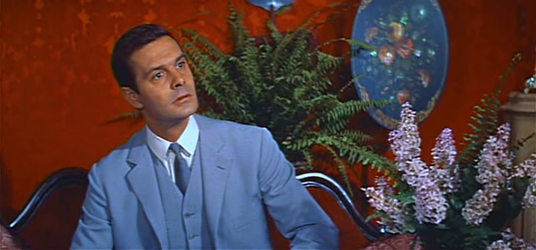
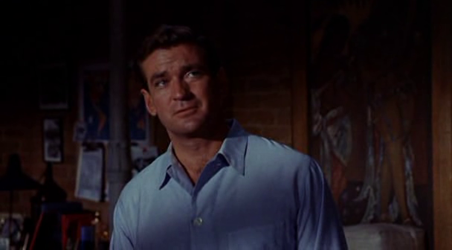
This is a somewhat belated tribute, to yet another star of the silver screen. Aussie actor Rod Taylor (January 11, 1930 – January 7, 2015) arrived in Hollywood in the 1950s, and though he never achieved the fame of fellow countrymen like Errol Flynn (and, much later, Hugh Jackman, Nicole Kidman, Russell Crowe, etc), he did star in several big films, including Hitchcock’s The Birds, The Time Machine, Young Cassidy, 36 Hours (and, his last outing, Inglourious Basterds, in which he played Winston Churchill).
Author Archives: dustedoff
Parivaar (1956)
Serendipity isn’t something I encounter too frequently while watching Hindi cinema. More often than not, it’s the other way round: I watch a film because I liked the cast, or because the story sounds appealing, or (and this happens with appalling frequency) because the music is wonderful. That I should watch a film about which I know next to nothing—on a whim, so to say—and find that it’s not just watchable but actually quite enjoyable is something to be grateful about. Which is why this review. Seriously speaking, I hadn’t expected much of Parivaar (the name itself conjures up one of those extremely melodramatic social dramas AVM used to specialise in).
Worse, I had my memories (I wish I could rid myself of them) of having watched the utterly execrable Nanda-Jeetendra starrer Parivaar, one of the worst films from the 60s I’ve ever wasted three hours upon. But, back to this Parivaar, which brought a smile of pleased anticipation to my face as soon as the credits began to roll. Directed by Asit Sen and produced by Bimal Roy, Parivaar is set completely within the large haveli of the Choudhary brothers, where all of them, with the exception of one brother, live as a joint family. Over the first hour or so of the film, we are introduced to these men, their families, and their servants.
Continue reading
Begumpuri Masjid, and a bit about the Tughlaqs
A few weeks back, I’d decided to begin a series of articles on some of the more interesting medieval mosques of Delhi. I began with an introduction to mosque architecture, then wrote a piece on one of the most striking … Continue reading
Why I love the comforts of old Hindi cinema
There’s this delightful, irreverent new literary journal called AntiSerious. Which, as its name suggests, is all about not being serious. Not being serious about politics, society and its morals, the economy, literature, or whatever. When AntiSerious were starting up, they asked me if I’d like to contribute an article. They left the choice of subject matter to me, and I (gleefully, with a whoop of joy you could’ve heard in Chinchpokli) picked old Hindi cinema. (Yes, well. What did you expect?)
What emerged was this, a brief (really, compared to the usual length of my posts) essay on what it is I like about old Hindi cinema. What makes the 50s and 60s the cinematic equivalent of comfort food for me.
Click here to read on:
http://www.antiserious.com/2015/01/20/love-comforts-old-hindi-cinema/
… or, because AntiSerious has shown a tendency to inexplicably vanish, here is the entire article:
Jaan-pehchaan ho, Jeena aasaan ho
Some years back, a smart, snazzy music-and-DVD store opened in a mall I used to frequent. I couldn’t resist the temptation to go check out the DVDs on display.
I’m quietly flipping through the titles when a bright-eyed and earnest staffer appears.
‘Can I help you, ma’am?’
Quick smile. ‘Uh, no, thanks. Just looking—’
‘Which movie, ma’am?’
I heave a sigh. And here I was hoping I’d be left alone in what I know will be almost certain disappointment. But perhaps not? This is a big store. There are lots of DVDs. Hope springs eternal. ‘Prem Patra?’ I venture. ‘1962. Or Boyfriend? 1961, Shammi Kapoor.’
There’s a moment of bewilderment, of deer in the headlights, of what the eff did you just say. The smile comes back on in a jiffy, but it’s wavering at the edges now. ‘I’ll look, ma’am.’ Then, just as he’s turning to go, ‘Anything else, ma’am?’
I could say Mother India or Guide, which they’ll probably have, but I’ve seen both, and like neither. ‘Jab Pyaar Kisise Hota Hai,’ I say.
He comes back five minutes later, just as I’ve come to the conclusion that he cannot have found any of the films I wanted. But—hallelujah!—he actually does have one DVD in his hand. Jab Pyaar Kisise Hota Hai, sure enough. Not the 1961 Dev Anand-Asha Parekh film I’d wanted, but some frightful Salman Khan one from the 1990s. I shudder and run away.
Yup. I’m that eccentric who doesn’t think the 1980s are ‘classic’ (they couldn’t be, even a century from now). I’m the one who dwells in the past, who’s totally fascinated by old cinema. And when I say ‘old’, I mean anything that ends at about 1970. ‘Why this fascination with that period?’ ask friends.
Till now, my usual response has been to rave about the music, to wax eloquent about the subtlety and sensitivity of Bimal Roy films; about Madhubala’s gorgeousness and Shammi Kapoor’s handsomeness. I shut up when people get that glazed look over the eyes.
Time to come up with a more comprehensive answer. Why, after all, this fascination?
The conclusion: several factors. There is the eye candy. The fabulous music. Lots of brilliantly scripted films, from crime thrillers like Teesri Manzil and CID to dramas like Pyaasa and Parakh.
But what really makes the films of the 50s and 60s so very endearing to me, is that they’re the cinematic equivalent of comfort food. They give me a warm and fuzzy feeling, and invariably leave me thinking – even if it’s a film I’m watching for the first time – that this is an old friend, familiar and likeable and with no nasty surprises lying in wait.
Perhaps I should illustrate that with some examples.
Let’s say you’re watching an old Hindi film. Chances are you’ll sooner or later come across a baby (usually the heir to a throne, a zamindari or at least an eye-poppingly immense fortune). If someone, within the first half-hour of the film, gives the child a tattoo, has him/her photographed, teaches him/her a unique song, or gives him/her a distinctive piece of jewellery (a taaveez, preferably), you can bet the child will be lost, to be brought up by passing strangers who disappear with the kid for the next 15 or 20 years (never 14, never 19: always a round figure).
You also can assume that the child:
(a) will grow up unaware of his or her heritage;
(b) in the course of his/her perambulations through life, will meet, again and again, people who (unknown to this person or them) are actually a long-lost parent or sibling or (if the child, before being lost, was old enough to have a childhood sweetheart) said sweetheart.
(c) will have instant chemistry with the people in question; and the chemistry will be appropriate to the actual relationship. A long-lost brother and sister, meeting each other as strangers will feel only fraternal, not romantic. If, on the other hand, they’re unrelated and were once childhood sweethearts (or promised to each other by interfering parents), then the chemistry will be romantic.
Similarly, a long-lost parent will evoke deep affection and respect, and make the long-lost offspring imagine that Ma or Pitaji would have been just like this. Ditto for the old lady or gentleman (who will be white-haired and doddering, even when probably not more than 50): they will always feel a maternal or paternal fondness for the young stranger.
Talking about long-lost mothers, you can be sure that if Nirupa Roy plays a filmi mum, she’ll misplace a child sometime, somehow. In the odd film here or there, she might deliberately do a switcheroo with her baby – but for its welfare. More usual, though, a storm, train wreck, fair (not necessarily the Kumbh; even a busy village fair will suffice) or black-hearted goons will be responsible. Many years later, she – now keeping body and soul together by stitching clothes – will be reunited with her offspring. (Note: if Leela Chitnis plays mum, she’ll have also contracted some fell disease in the meantime).
Lost-and-found isn’t essential for some smart predictions to be possible, though. For instance, if someone close to the hero or heroine – sibling, best friend, romantic interest, or the protagonist himself/herself – is an upholder of the law (preferably a lawyer, but a cop will do), you know what’s coming: murder, with the hero or heroine being accused.
It’s the same with medicine. If an important character is a doctor, you can be pretty sure someone is going to get mighty sick. Always, also, the disease they’ll contract – or the accidental injury they’ll receive – will be in keeping with the doc’s specialisation. An ophthalmologist will have someone dear go blind, rather than suffer a stroke or have a heart attack.
Then there’s the delicious comfort of film romance. Barring the one-off film where an unmarried heroine gets pregnant (and – a minor digression – invariably after just one spell of indiscretion, on a rainy night) – you can be sure everything will be very chaste. These are films you could take your kiddies to watch without wondering if there’ll be embarrassing snogging. There’s nothing remotely embarrassing (though possibly misleading, for the young) about two dahlias bobbing together.
And, if you want to perpetuate the illusion that romantic love’s for keeps, Hindi cinema manages brilliantly. If two people fall in love, that love weathers all storms: villains (both the Pran/Prem Chopra type, and the disapproving patriarch); accidents; war; misunderstandings; forced marriages to other people – but the lovers will come together eventually. If the odds are stacked too high against them in this life, they’ll be united in the next, with pastel-tinted mist swirling about as they float dreamily off, singing their song in echoing voices.
Not that every film has all of this. There are aberrations, films without piano songs at parties. Or films like the songless Kanoon or Ittefaq. Or Dhool ka Phool, in which two lovers are audacious enough to fall in love with other people after having a child out of wedlock. Or Haqeeqat, where just about everybody dies (it is a war film, but when has that ever stopped Hindi cinema?). Or – no, wait. I’ve run out of examples.
I admit it: I like things to follow set patterns. I like to be able to guess what’s going to happen, and am very smug about being proved right. I love the comfort of stories playing out the way they should in a perfect, innocent, sweet world where right always triumphs, no matter in how implausible or improbable a way.
In other words, I love the world of old Hindi cinema.
Armaan (1966)
Comments on blog posts here tend to go off on tangents. I don’t have a problem with that (in fact, I often contribute)—and, best of all, sometimes these completely tangential comments give me ideas for other posts. The other day, commenting on my C Ramachandra post, Harini had remarked that Asha Bhonsle’s voice in Aa dil se dil mila le sounded a lot like Noorjehan’s. That reminded me of the lone Pakistani film I’d seen till then, the wonderful Dupatta (which starred Noorjehan). And I decided it was time to watch another Pakistani film. After all, Lollywood did share a lot in common with Bollywood in the early years, didn’t it?
Home Delivery Food Review: Sangeeta Anand
Edited to add: Sadly, Ms Anand passed away in March 2015. This review, therefore, is now more a tribute than anything else. While I am passionately fond of food, and can cook a decent enough meal (or so possibly biased people … Continue reading
Ten of my favourite C Ramachandra songs
…specifically, songs which he composed, not just songs he sang (since C Ramachandra also lent his voice to some of his best songs).
Chitalkar Ramachandra was born 97 years ago—on January 12, 1918, in the town of Puntamba in Maharashtra. Although he’d studied music, it was as an actor that C Ramachandra joined the film industry—he debuted in a lead role in a film called Nagananda. This didn’t continue for long, though; he eventually shifted to composing songs, first for Tamil cinema, and then for Hindi. And he came like a breath of fresh air to Hindi film music: in a period dominated by classical tunes composed by the likes of Naushad, Anil Biswas and Pankaj Mullick, C Ramachandra had the guts to bring in music with distinctly Western rhythms, what with hits like Aana meri jaan Sunday ke Sunday and Mere piya gaye Rangoon. And he was brilliantly versatile: as the following selection will (hopefully) show, he could compose just about everything from peppy club songs to lullabies to ghazals (if one can expect a particular style of music for a ghazal) and lilting love songs.
Kakushi-toride no san-akunin (1958)
Known in English as The Hidden Fortress, though the literal translation is The Three Villains of the Hidden Fortress. One of Akira Kurosawa’s finest samurai films.
I’ve made it a blog tradition that, every year on my birthday, I review a film featuring someone who shares the same birthdate as me, January 8. So, over the years, I’ve reviewed films starring Nanda, Fearless Nadia, Elvis Presley and José Ferrer, among others. This year, I decided it was time for a change. Two changes, actually. For one, the film I’m reviewing is neither in English nor in Hindi: it’s Japanese. And, the person who shares my birthday in this case—Japanese actor Susumu Fujita—isn’t one of the leads. In fact, he doesn’t even appear in the film till the second half. But he is there in The Hidden Fortress, and he’s a good actor. Plus, even though his role here is fairly small, it’s a critical one. Enough reason.
Qila-e-Kohna: The Mosque in the Old Fort
A good way to begin a new year? Launch a series of articles on some of my favourite medieval mosques in Delhi! As is probably obvious from my article on mosque architecture, I find old mosques fascinating (well, old any … Continue reading
Gustakhi Maaf (1969)
Happy New Year!
The other day, someone mentioned that after Omkara, Maqbool and Haider—based respectively on Othello, MacBeth and Hamlet—Vishal Bhardwaj was going to be making a trio of films based on Shakespeare’s comedies. The thought came into my head: had any Hindi film maker remade a Shakespearean comedy before? The very next moment, the answer popped up. Of course: Angoor. And (my brain was beginning to work overtime by now), another film based on A Comedy of Errors and also starring Sanjeev Kumar: Gustakhi Maaf.
I hadn’t heard of Gustakhi Maaf until a few years back, when I happened to find (and subsequently buy) a delightful lobby card featuring Sanjeev Kumar in this film. I went looking for the film, discovered that it was based on A Comedy of Errors and that it starred the ever-bubbly Tanuja—but I couldn’t get hold of the film anywhere. Until Harini (over at bagsbooksandmore) pointed me to it. So here goes: review #1 of 2015, of a fun, frothy film.