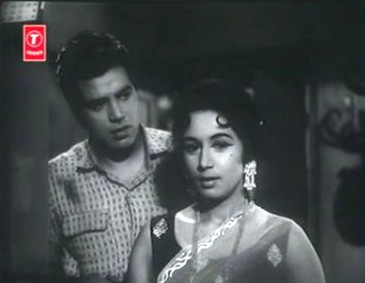
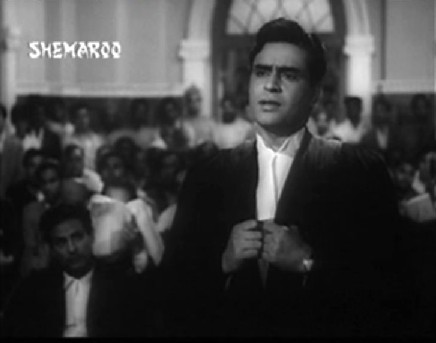
Akashdeep (1965)

Once upon a time, there was a writer.

No: it wasn’t Dharmendra, and it certainly wasn’t Nanda (old Hindi cinema, at least, doesn’t seem to believe women capable of writing anything more complex than a love letter, if that).
This writer was someone quite different, and one day (I’m guessing) decided that it was time to show the world what he was capable of. So, with a producer and a director, the writer went into action, and what resulted was Akashdeep. Looking at the film, I’m assuming this was somewhat of a collaborative effort. A “how about this?” and a “don’t you think it would be a good idea—?” sort of film.

Continue reading

The Naked Jungle (1954)

One person who’s figured very consistently on my blog statistics for the past year is the gorgeous Eleanor Parker. Any day, all I need to do is click my blog stats link, and I’ll see that among the top hits for my blog is ‘eleanor parker’ or ‘eleanor parker actress’. So, considering it’s her 88th birthday today, it seemed the perfect time to review a film that starred Ms Parker.
Eleanor Parker was born on June 26th, 1922. The ‘Woman of a Thousand Faces’ (so called because of her amazing versatility), she got three Oscar nominations, but is usually remembered mainly for her role as the beautiful Baroness in The Sound of Music. Ms Parker did, however, act in a host of other films—and in very varying roles, too. This, as the mail order bride of a plantation owner in South America, is just one of them.

Continue reading

Ek Thi Ladki (1949)

Harvey’s recent post on Mr Sampat sparked off a brief discussion on one of Hindi cinema’s finest character actors, Motilal. Since Motilal was known—at least in the 50’s and 60’s—as a character actor, it seemed appropriate to review a film in which he’s the hero. Not that Ek Thi Ladki (‘There was a girl’) really allows much scope for a hero. True to its name, it centres around its heroine, the spunky and vivacious Meena Shorey. But Motilal is a very likeable leading man; I S Johar, in his debut, is a deliciously crooked crook; and one of my favourite vamps—Kuldeep Kaur—is in it too.

Continue reading

Ten of my favourite Hemant songs

My maternal grandfather used to work in the Gramophone Company of India. Mummy grew up in a house full of LPs, and a lot of those—including dozens of albums from Hindi films of the 50’s and 60’s—ended up in our house. I grew up listening to music; but for a long time, I couldn’t tell one singer from another. The first singer whose voice I learnt to identify (I must have been about 11 or 12 at the time, I think) was Hemant.
Hemant Kumar Mukherjee was born on June 16, 1920, and went on to become one of Hindi cinema’s great music directors—and a singer with a very distinctive voice, rich and deep and sonorous.

So, as a birthday anniversary tribute: my ten favourite Hemant songs. These are all from the 50’s and 60’s, from films that I’ve seen, and in no particular order. Frankly, each song is a masterpiece in itself.

Continue reading

Kanoon (1960)

9 years before he made the superb suspense thriller Ittefaq, B R Chopra produced and directed this film. It too starred Nanda (though not in as pivotal a role as in Ittefaq). It too didn’t have a single song—though it did have a ballet performance. And, like Ittefaq, it hinged on a murder.
But Kanoon wasn’t by any means a precursor to Ittefaq. Ittefaq is mainstream murder mystery; Kanoon straddles with consummate skill the line between crime detection and social issues. It’s an excellent, unusual and gripping film that merits viewing.

Continue reading

The Inn of the Sixth Happiness (1958)

The Chinese wish each other five happinesses: wealth, longevity, good health, virtue, and a peaceful death in old age. The sixth happiness one must decide for oneself.

Richard’s recent post on Dr Kotnis ki Amar Kahani reminded me of this film, because the two films share a lot in common. Like Dr Kotnis ki Amar Kahani, The Inn of the Sixth Happiness is based on a real life story—in this case, that of the Englishwoman Gladys Aylward (1902-70), who in 1930 went off to China to ‘serve’ the people there. Like Dr Kotnis, she too fell in love with a Chinese national, and is even today, 40 years after her death, regarded as something of a national heroine.

The Inn of the Sixth Happiness, while not completely true to the story of Gladys Aylward (artistic license makes films sell!), is accurate enough in the basics. It tells, with sensitivity and feeling, the story of a brave woman’s determination to go halfway across the world—to a land of which she didn’t even know the language—simply in order to follow her dream.

Continue reading

Agni Pariksha (1954)

Or Ogni Porikkha, if you want to be phonetically correct.

Over the last twenty-odd years, I’ve heard countless Bengalis rave about Uttam Kumar and Suchitra Sen as the ultimate onscreen romantic couple. I’ve seen both of them act (separately) in a few (admittedly Hindi) films, and have been very impressed.
So, finally: an Uttam Kumar-Suchitra Sen film, and one that was a big hit too. Agni Pariksha: ‘trial by fire’.

Continue reading

Announcing the Johnny Walker Songs Compilation DVD

How many actors have had films named for them? How many appear in the lyrics of songs? And how many, without being lead actors, manage to invariably feature in at least one song in every film they’ve acted in?

Continue reading

Thoroughly Modern Millie (1967)

One of my biggest failings when it comes to cinema viewing is the naive belief that an actor or actress whom I’ve seen and appreciated for the first time will necessarily be fantastic in all their subsequent films that I watch. Thus, having watched The Sound of Music—and raved over every single element of it, especially Julie Andrews—I began searching out other films that starred Julie Andrews, in the childish hope that they’d all be as fabulous as The Sound of Music.
Alas, no. This one, for instance, made only two years after the von Trapp saga, is nowhere close to as endearing. Julie is superb as the 20’s flapper girl Millie Dillmount, trying her best to be hard-heartedly modern, but the film is a bit of a drag.

Continue reading

Jewel Thief (1967)

This is one of those films that have a very interesting—and unexpected—twist that can come totally as a bolt out of the blue if you’re watching it for the first time. Subsequent watchings, no matter how far apart, tend to dilute the suspense a good deal because (unless you have a really frightful memory) you know what’s coming. And somehow, unlike films like Teesri Manzil or Mera Saaya or Woh Kaun Thi?, Jewel Thief lacks other elements that could encourage repeated viewings.

Continue reading