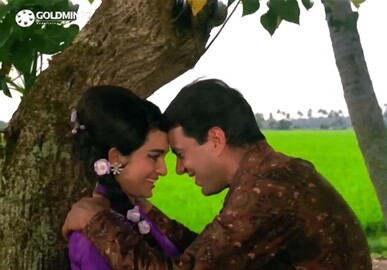
Aaye Din Bahaar Ke (1966)

(Coincidentally enough, I watched Aaye Din Bahaar Ke some weeks back, just after I’d posted my review of Phool aur Patthar. Back then I’d not known that we would be mourning the passing of Dharmendra so soon after. Consider this a tribute).

When I watched Phool aur Patthar some weeks back, I was reminded of the many fairly entertaining films Dharmendra worked in through the mid- and late-1960s. Not all of them were good (some, like Chandan ka Palna, were terrible), but quite a lot of them had at least good songs, a fair deal of entertainment value, and an undeniably handsome male lead to make them worth at least a one-time watch. Some of these (like Aankhen, arguably my favourite Dharmendra film) I’ve reviewed already; there are several others.

Here’s one. I last watched Aaye Din Bahaar Ke perhaps about 20-odd years ago, and actually remembered a fair bit of it. That I didn’t mind watching it again, even though the film is far from perfect, says a lot for it.

The story begins in Darjeeling, where Ravi (Dharmendra) lives with his widowed mother (Sulochana Latkar). Ravi is devoted to his mother: so much so that when Ma is doing her pooja, he tells her, “You may worship your gods, but I will worship only you.” She has devoted her life to looking after Ravi, educating him, etc, which is why this somewhat OTT sentiment.

Continue reading

Himalaya ki God Mein (1965)

I realized the other day that there are umpteen well-known old films that I have seen but have never got around to reviewing on this blog—invariably because I had watched them before I started Dustedoff, and because there were so many ‘new’ old films to watch and write about, I never got around to rewatching stuff. It’s time to amend that, and revisit some films that perhaps should be talked about.

To begin with, Himalaya ki God Mein. Directed by Vijay Bhatt, Himalaya ki God Mein beat Haqeeqat and Waqt to win the Filmfare Best Film Award, and was a superhit. I had watched this donkey’s years ago, when it was telecast on Doordarshan. I remembered almost nothing of it except the fact that Manoj Kumar played a city doctor who relocated to the mountains to treat villagers and ended up falling in love with a village girl played by Mala Sinha. That was it. Time for a rewatch, I decided.

The film begins at night, on an aeroplane where Dr Sunil (Manoj Kumar) and his fiancée, also a doctor, Neeta (Shashikala) are travelling. Another passenger on the plane suddenly clutches his chest; Sunil examines him, diagnoses a heart problem, and asks that the plane land immediately.

Continue reading

Yaadein (1964)

In its category for Fewest actors in a narrative film, the Guinness Book of World Records begins the list with this:

“Excluding monologues, the only narrative films with a single cast member have been Yaadein (India, 1964), written, directed and produced by Sunil Dutt (India), who was also its only actor….”

(Only two other films are listed in this category; one is the 2002 French-American production Lettre; the other is the 2004 Kannada film Shanthi).

I have known about Yaadein for a long time now; it was aired on Doordarshan when I was a child, and I remember my parents watching it. I wasn’t allowed, because this is one of those rare Hindi films from that era which had an A certificate. I do recall, though, my parents telling me that it was a unique film, with only Sunil Dutt in it.

Continue reading

Night in London (1967)

In which Biswajeet’s character ends up facing a wall studded with red-hot spikes. You don’t just skewered to death, you get barbecued in the process.

Continue reading

Kati Patang (1970)

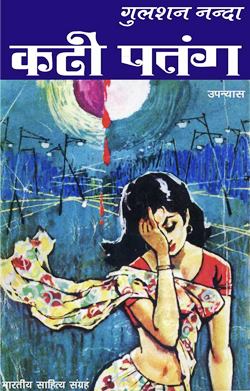
Our recent trip to Nainital prompted me (actually, even before we left on our trip) to read Gulshan Nanda’s novel Kati Patang. Gulshan Nanda, for those who may be unfamiliar with his work, wasn’t just a hugely successful writer of Hindi social-romantic popular fiction, but also a script writer for Hindi cinema: he wrote the scripts (many of them based on his own novels) of blockbusters like Saawan ki Ghata, Khilona, Kati Patang, and Jheel ke Us Paar. This insightful article about Nanda’s writing, as well as its adaptation to the big screen, is worth a read.

Continue reading