Chitralekha (1964)

I have decided it’s high time I began rewatching some of the old Hindi films I last saw when in my teens (or, in some cases, even before that). Back then, all our film viewing used to happen on India’s sole television channel, Doordarshan, which would telecast Hindi films every weekend, and sometimes in between as well. Most of the films were old classics, and I have fond memories of first viewings of films which became firm favourites almost from the get-go: Junglee, Teesri Manzil, Nau Do Gyarah, Dekh Kabira Roya, Woh Kaun Thi?, Mera Saaya

There were also films that I watched (we watched everything, there was such a paucity of options for entertainment) but which I ended up not liking. Or, as in the case of Chitralekha, not really understanding. I guess this was a simple case of being too young, too immature, to grasp the niceties of a film that wasn’t the standard masala entertainer.

About time, I thought, I saw this one again.

Kidar Sharma, who directed Chitralekha, had already made this film (based on a novel by Bhagwati Charan Verma) earlier as well. The 1941 Chitralekha starred Mehtab (who of course later married Sohrab Modi) and the juiciest bit of information about the film is that it featured a bathing scene (Cineplot used to have an article about this, an excerpt from Kidar Sharma’s autobiography, but since Cineplot now seems to be sadly defunct, that’s gone). Kidar Sharma did say, from what I recall of his autobiography, that the original Chitralekha was far superior to the 1964 remake.

But the 1941 film is, I think, gone—or at least not available for viewing online, though there are songs and stills galore. I may as well watch the 1964 Chitralekha, I decided, since that was the one I had hazy recollections of watching as a child.

The story is set in Pataliputra during the heyday of the Gupta Empire. Aryaratan Samant Beejgupt (Pradeep Kumar), a high nobleman, has just returned to Pataliputra after a sojourn elsewhere. Beejgupt’s arrival in the city is greeted with anticipation: his fiancée Yashodhara (Shobhna) is shyly hopeful that this time he will marry her.

Continue reading

Howrah Bridge (1958)

Aaiye meherbaan baithiye jaan-e-jaan, and Mera naam Chin Chin Choo. Two great actresses, two iconic songs.

When I was doing the Helen tributes last month, I was reminded of Mera naam Chin Chin Choo all over again—and remembered, too, that I had never reviewed Howrah Bridge on this blog. It has also been many years since I last watched the film (before I launched Dusted Off), so I decided it was high time I revisited this.

Howrah Bridge begins very far from the bridge, and in fact from Kolkata: in Rangoon, where Prem Kumar (Ashok Kumar) finds his father (Brahm Bhardwaj) in a flap. Daddy is distraught because Prem’s elder brother Madan (Chaman Puri, in a cameo role) has run off from home, taking with him an invaluable family heirloom, a dragon which has been in the family for generations. We later discover that the dragon was crafted in China many centuries ago, and from there came to be owned by the king of Burma, after which it passed into the possession of Prem’s family.

Continue reading

Aadhi Raat ke Baad (1965)

I dithered over this film for a long time after I’d finished watching it. Should I review it? Should I not? It wasn’t a great film, but it wasn’t terrible, either. It wasn’t as if a review was needed to warn potential viewers off it. Or vice-versa, to alert people to a film they must see.

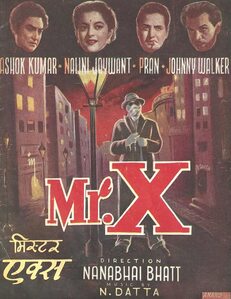
Eventually, I decided that at least a brief review was in order, because this film had an interesting connect to another film I’ve wanted to watch for a while: Mr X.

In 1957, Nanabhai Bhatt had directed a science fiction film (borrowing from HG Wells’s novel The Invisible Man) that starred Ashok Kumar and Nalini Jaywant. According to this web page on Mike Barnum’s blog, the film is about a man who ingests a drug that makes him invisible; he uses this invisibility to go on a Robin Hood-esque spree, helping the poor by robbing the rich. The cops, baffled by the invisible man, dub him Mr X.

I’ve long wanted to watch Mr X, mostly because it features one of my favourite N Dutta songs, Laal-laal gaal. The film isn’t available online, at least, or even on DVD, from what I can tell; perhaps there are carefully guarded prints deep in some archive…

Continue reading

Kangan (1959)

In which Iftekhar, playing against type, acts the part of a lecherous villain. And Chitragupta, composing against type, proves he was no one-trick pony.

But, to begin at the beginning (and Kangan gets into action right at the start, not dilly-dallying about with incidental stuff). Karuna (Nirupa Roy) is about to get married, and her widowed father (?) is giving her his blessings and wishing her mother were still around. Just then, Kamla (Purnima) comes in; she is not just Karuna’s bridegroom’s sister, but also a good friend of Karuna’s. Karuna’s father leaves the two women together and goes off.

Continue reading

Chalti ka Naam Gaadi (1958)

In response to that unwarranted comment about me ‘wasting my time watching silly Indian films’, I’ve done something (reviewed Bhabhi ki Chudiyaan and Devi) to uphold my contention that all Indian films are not silly. Now it’s time to look at Indian films which are silly, but where the silliness is intelligent, and deliberate.

What, after all, is wrong with silliness, or with humour? For me, the stuffy idea that humour is somehow low is very irritating. Some humour may be unpalatable to certain people (I, for one, find nothing humorous about sexist or racist jokes, or toilet humour), but humour can be sophisticated, it can be the result of a great intelligence.

As, I think, comes through in this delightful film about three brothers, all motor mechanics, who run a garage.

Brijmohan Sharma ‘Bade Bhaiya’ (Ashok Kumar), as he’s known, is the eldest of the three, and he rules with an iron fist in an iron gauntlet.  Bade Bhaiya is a hard taskmaster, and lords it over Jagmohan ‘Jaggu’ (Anoop Kumar) and Manmohan ‘Manu’ (Kishore Kumar), as also their apprentice Maujiya (Mohan Choti). One important aspect of Bade Bhaiya’s personality is his aversion to women: he sees red even when Maujiya hangs up a calendar with a painting of a woman on it.

Continue reading

Jeevan Naiyya (1936)

While I knew of this film, I hadn’t paid enough attention to it until I read Nabendu Ghosh’s Dadamoni: The Life and Times of Ashok Kumar. Jeevan Naiyya, produced by Himanshu Rai and directed by Franz Osten (at a time when there were several European, especially German, technical experts in the Hindi film industry) is not a landmark film in itself, but simply viewed as Ashok Kumar’s first film, this is worth a watch.

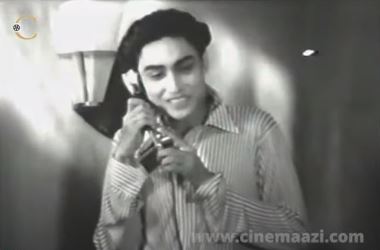
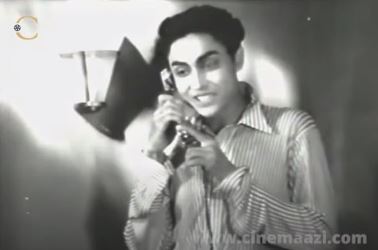
The story begins bang in the middle of things. Ranjit (Ashok Kumar) and Lata (Devika Rani) are engaged to be married, and the film begins with a telephone conversation in which they’re cooing sweetly inane nothings to each other. Ranjit’s boisterous friends barge in on this conversation and break it up, but it’s obvious that these two are very much in love with each other, and looking forward to being married.

Continue reading

Book Review: Nabendu Ghosh’s Dadamoni: The Life and Times of Ashok Kumar

The 1936 Hindi film Jeevan Naiyya begins with a telephone conversation. An engaged couple, very much in love with each other, whispers sweet nothings on the phone. It’s all a bit awkward, and the young man in particular comes across as distinctly uncomfortable with all this koochie-kooing. This is not quite the mellifluous, effortless romance of a Jalte hain jiske liye, but it is, in its own way, a landmark scene. Because this is the very first onscreen appearance of a young actor who went on to become one of Hindi cinema’s biggest stars: Ashok Kumar Ganguly, better known simply as Ashok Kumar.

Continue reading

Sadhu aur Shaitan (1968)

Cinema looking at itself is not an uncommon feature; there have been several notable films, both in India (Kaagaz ke Phool, Sone ki Chidiya) as well as abroad (Cinema Paradiso, 8½, The Bad and the Beautiful, etc), which are about cinema and film-making. But this film, relatively obscure, really should be part of the annals, simply because of its sheer devotion to Hindi cinema. Not because it’s about film-making, not because there is even (as in Solvaan Saal), a single scene on the sets of a film. But because it celebrates Hindi cinema in so many ways, on so many levels.

Sadhu aur Shaitan begins by introducing us to the eponymous ‘sadhu’ of the story: Sadhuram (Om Prakash), a widower who lives with his two children Ganesh (Master Shahid) and Munni (Baby Fauzia), and the maid Ramdeyi (Dulari) who looks after home and the children. Sadhuram is a somewhat excessively ‘good and righteous’ man, the living image of piety (all a little over the top as far as I’m concerned, but at least he isn’t stuffy about his righteousness).

Continue reading

Sitaaron Se Aage (1958)

When I was reading Balaji Vitthal and Anirudha Bhattacharjee’s The Prince Musician, I came across a mention of this film, which I had never heard of. But the songs listed as being part of Sitaaron Se Aage were familiar to me, and both leads—Ashok Kumar and Vyjyanthimala—are among my favourites. Recently, reading HQ Chowdhury’s Incomparable Sachin Dev Burman, I was reminded again of Sitaaron Se Aage, and decided it was high time I watched it.

And what a showcase of SD Burman’s music this film is—right from the start. It begins with Sambhalke yeh duniya hai nagar hoshiyaaron ka, with Lattu (Johnny Walker) and his cronies, the pickpockets Bajjarbattu and Nikhattu, going about relieving passersby of their belongings. The three end up outside a theatre, where the superstar actor Rajesh (Ashok Kumar) has just completed yet another highly-acclaimed performance.

Continue reading

Tamasha (1952)

When you are as devoted to the pursuit of old Hindi cinema as I am—and you assiduously discuss old cinema with other like-minded souls—you keep getting recommendations. Some recommendations I take with a certain amount of leeway automatically assigned, since I know that the recommender has his or her own biases that are likely to be reflected in the film in question. Others I tend to blindly follow, because over time, I’ve realized that these are people who pretty much share my own ideas of what comprises watchable cinema.

One of these is Anu, who blogs at Conversations over Chai. We have our differences (Raj Kapoor is one), but by and large, Anu and I tend to agree about cinema. So when Anu, chatting with me during my trip in August to meet her, recommended Tamasha, I immediately made a note of it. After all, Dev Anand, Meena Kumari, Ashok Kumar, Kishore Kumar—and a comedy? That certainly sounded like something I wanted to watch.

Continue reading