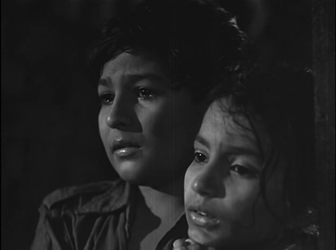
Kundan (1955)

Some days ago, in this delightful post about chai in Hindi cinema, I came across a mention of Kundan. Aao hamaare hotal mein chai peeyoji garam-garam sounded so interesting that I bookmarked the film without even really checking to see what it was all about (though the cast, barring Nimmi—whom I often find very irritating—appealed to me). Then, just a couple of days later, Anu posted this wonderful tribute to Sohrab Modi, in which she listed Kundan as one of her favourite ten films directed by Modi. Adapted from Victor Hugo’s classic Les Miserables.

That sealed it. I had read Les Miserables a couple of years ago, and had been blown away by it: by the depth and width of it, the characterization, the sheer scope of it all. And now, it looked as if the universe was pushing me towards Kundan. I had to watch this one.

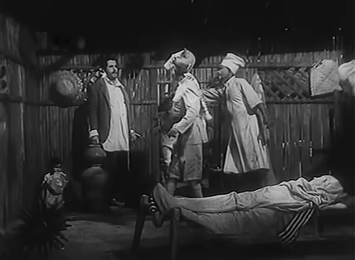
The story gets off to a flying start. Kundan (Sohrab Modi) is a very poor man who lives with his very ill sister and her little daughter Radha. Unable to earn [it’s not clear why, given that he looks able-bodied enough], a desperate Kundan finally steals a loaf of bread from a bakery and runs home to give it to Radha. Since he’s made no attempt to commit this theft in secrecy, the alarm has been raised and Kundan is arrested even as Radha is eating the loaf.
Continue reading

Kaagaz ke Phool (1959)

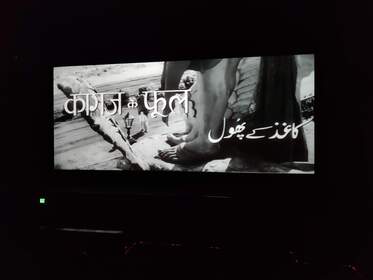
That first photo, because the space beyond the screen is so dark, may not be very obvious as regards context. But this is a photo from a full-sized film theatre, where I watched the re-released Kaagaz ke Phool on July 17th. The re-release was to mark the 65th anniversary of this film, a semi-autobiographical work that was a flop when it was first released, but has gained in popularity ever since. My niece had alerted me to the fact that PVR Inox would be showing Kaagaz ke Phool across its theatres, one show a day for a week, and I knew I couldn’t miss this one. If only for the fact that I get to see precious few old films on the big screen (Hum Dono was the last I saw).

I had thought I’d probably be one of a handful (ten, at the most?) of people in the theatre, because this, after all, is an old film; and this was an afternoon show on a weekday. But to my surprise, there were actually quite a few people, and—best of all—many of them were fairly young. Heartening.

But, to get to the film.

Continue reading

Do Phool (1958)

I have watched hundreds of Hindi films. Many of these I’ve reviewed here on this blog, and for many of those, I’ve had readers mention that so-and-so film was actually a remake of so-and-so Hollywood film, or was inspired from this novel or that play. In some, of course, I’ve been able to spot a source immediately: the grand mansion being run as a hotel by its manager who then forces the owner to pretend to be a guest is lifted from Come September and used—without any credit for the original idea—in both Kashmir ki Kali and Mere Sanam. Adalat is a remake of Madame X; Aradhana of To Each His Own; Gumnaam of And Then There Were None… all uncredited. And umpteen others.

This is something I find very irritating. The amount of work that goes into coming up with a good plot is substantial, and if you’re acknowledging that by thinking it worthy of being copied, then you should certainly think it worthy enough to pay for. But by calmly hogging all the credit and assuming that Indian audiences won’t cotton on to this plagiarism, and Hollywood (or foreign writers), too far from the world of Hindi cinema, will be oblivious.

Anyway, that’s a long, convoluted and messy topic, which I should probably leave for later. For now, the reason why all of that came to my mind: because this film does give credit where it’s due. Not, unfortunately, to the writer of the book (Johanna Spyri), but at least to the book itself.

Continue reading

Boot Polish (1954)

When I reviewed Les Quatre Cents Coups a couple of weeks back, I was mentally riffling through the list of good films with child protagonists that I’d seen. I couldn’t, sadly, think of many. There were some—The Night of the Hunter, Bhai-Bahen, Bandish, Do Kaliyaan, for instance—in which children played an important part. But these were either not really films about children, or they were films about stylized children: little adults, really, or oversized toddlers.

Then I saw Kaphal – Wild Berries, made by blog reader, fellow blogger and film maker Batul Mukhtiar (aka Banno), and thought: yes, this is what a good film about children should be like. (Here, on my website, is a review of Kaphal). I also remembered, then, that Banno had once recommended a film about children.  The Raj Kapoor production, Boot Polish, which she’d reviewed on her blog, and which I’d never got around to watching. If someone who could make such a lovely film about children could recommend a film, that film would be worth watching.

So here we are. And, thank you, Banno.

Rattan Kumar and Naaz in Boot Polish Continue reading

Bhai Bahen (1959)

My sister and I were discussing, with much fondness, my father’s love for classic Hindi cinema. When my parents bought a DVD player, I offered to look out for old films that I could buy for them. “Any particular favourites you’d like me to buy you?” I asked. Papa’s list included Sangdil, Daag, Anari, Ratan, Andaaz, Albela, Sone ki Chidiya and a bunch of other films—all of them selected mainly because they had superb music.

And I am very much my Papa’s daughter. It takes just one good song for me to rent a film (I may not go so far as to buy it, though). I’ve done it with Akashdeep, and I’ve done it again with Bhai Bahen. Here, fortunately, I was a little luckier. Even though the best thing about it is the lovely Saare jahaan se achha, Bhai Bahen is, overall, an interesting and rather offbeat little film.

Continue reading