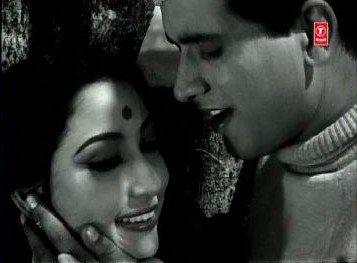
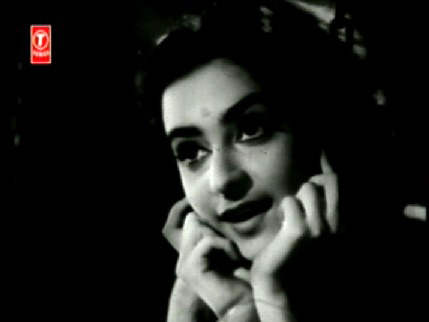
Bhabhi (1957)

I made such a mistake doing a Westward the Women post for International Women’s Day. Granted, it’s a good film, and highly recommended—but does it really teach a woman anything substantial? Knowing how to harness a mule or drive a wagon isn’t all there is to life. So here’s compensation: a film replete with lessons for women (and men, too). There are do’s and don’ts for just about any situation in life, including—though never stated—filmmaking.

Pandari Bai in Bhabhi

Continue reading

Love in Simla (1960)

Memsaab reviewed Love in Simla a while back. I am, on purpose, not reading it again, just to make sure I don’t end up subconsciously lifting phrases and ideas (though my excuse can always be that imitation is the sincerest of flattery!) I can’t hope to write as delightfully as memsaab does, but for what it’s worth, here’s my two cents.

Love in Simla is the quintessential Cinderella story: the fairy godmother helps turn the ugly duckling into a swan so she can steal Prince Charming from the clutches of the evil stepsister. Of course, this being Bollywood, the swan has a heart of gold and can’t bring herself to harm even the evil stepsister.

Sadhana in Love in Simla

Continue reading

Shikar (1968)

After all the melodrama of the recent Hindi films I’ve been watching, I decided it was time to sit back and enjoy one of my favourite genres: the thriller. And a thriller the way only the Bollywood of the 1950’s and 60’s could manage: with lots of romance thrown in, a gorgeously vampish Helen, hummable songs, a comic side plot starring none other than the inimitable Johnny Walker—and, interestingly enough, a supporting actor who manages to steal the limelight from the hero.

Dharmendra and Sanjeev Kumar in Shikar

Continue reading

Hum Dono (1961)

After Usne Kaha Tha, it’s time for yet another Nanda film (though Sadhana plays an equally, if not more important role in it). And a coincidence: this one too is against the backdrop of World War II. But that’s where the resemblance ends. Hum Dono is a very different story, more mainstream than Usne Kaha Tha, yet equally enjoyable—and with superb music by the underrated Jaidev.

Dev Anand and Sadhana in Hum Dono

Continue reading

Shaadi (1962)

Shaadi isn’t one of the better films I’ve seen in recent times. In fact, it had some definitely irritating moments, and it called for more suspension of disbelief than is generally expected in Hindi films. On the other hand, it had quite a cast: Saira Banu, Manoj Kumar, Dharmendra, Indrani Mukherjee, Balraj Sahni, Om Prakash, Manorama, and others. Even more interestingly, it was Saira Banu’s second film and one of Dharmendra’s first few films. Overall bearable, especially since I didn’t have anything better to do.

Saira Banu in Shaadi

Continue reading

Beti (1969)

There are some things I have very little patience with while I’m watching a film. Weepiness, for instance. Precocious children for another. Endless bhajans (unless the bhajan in question happens to be of the calibre of Allah tero naam or Man tadpat hari darshan). Mindless self-sacrificing which can’t possibly benefit anyone.
And much more. Beti, unfortunately, has all of these in ample doses. I saw it primarily because I like the lead pair (Nanda is an old favourite, and I haven’t given up on Sanjay Khan, despite the lamentable Ek Phool Do Maali). And when a film lists Rajendranath, Shyama and Asit Sen in its cast, one can hope for lots of entertainment.

Or so I thought.

Sanjay Khan and Nanda in Beti

Continue reading

Love in Tokyo (1966)

Love in Tokyo was before my time, but I can well imagine what its trailer should’ve been:

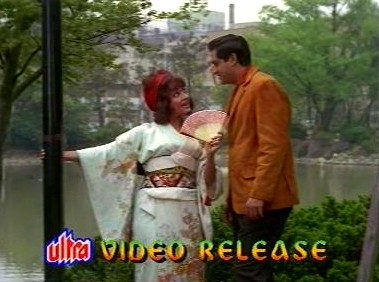
Japanese gardens! Asha Parekh in a kimono! Joy Mukherji in a wet shirt! Mehmood as a geisha! Mehmood as an Arab doctor! Mehmood as a nawab! Mehmood as Asit Sen!

And so on and so forth. It probably would’ve mentioned a few other attractions: Pran as a lecherous villain (so what’s new?), Lalita Pawar as a tyrannical matriarch with a soft heart (ditto), surprise revelations, a gold digger without a conscience, and a comic side plot without a shred of sense in it.
In spite of all that lunacy, though, this is an entertaining film with a certain mad charm about it.

Asha Parekh and Joy Mukherji in Love in Tokyo

Continue reading

Ten of my favourite Madhubala songs

The Hallmark Group recently introduced a limited edition of gold-plated silver ingots representing 25 historic stamps of India. Issued under the authority of India Post, it’s called the Pride of India Collection. The stamps replicated run the gamut of concepts, events and people dear to India: Rabindranath Tagore, kathakali, the Taj Mahal, cricket—and more. And with Bollywood so close to the hearts of so many millions of Indians, there had to be a film star featured: and they couldn’t have chosen better.

Pride of India Collection - Madhubala ingot

[Personally, I think the stamp (released in March 2008) does Madhubala justice; the ingot doesn’t. She looks as if, as P G Wodehouse would put it, she’d been bingeing on starchy foods. The eyes are puffy; the smile is off; and she has a double chin. No, I wouldn’t pay Rs 6,000 for this.]

Continue reading

Ek Phool Do Maali (1969)

A very frank admission: I am not intellectual. I cannot summon up the brainpower to analyse a film and go deep into the philosophy of it—which is why arty films are completely lost on me. I never, after seeing a film, question it, delve into its profundities, or explore the hidden meaning of so and so scene.

I am therefore proud to announce that I have finally seen a film that has gone a long way in remedying this lamentable situation. Ek Phool Do Maali made me sit up and think. It made me ask a lot of questions. And it made me vow never to assume that just because a film had a cast I generally liked, meant that the film would be good too.

Sanjay Khan, Bobby and Sadhana in Ek Phool Do Maali

Continue reading

Raat aur Din (1967)

I’m always on the lookout for old, offbeat Hindi films. Something without the hackneyed romances, the clashes between rich/poor, urban/rural, good/evil, the sudden breaking into song and the neat tying up of all loose ends once the regulation three hours are up. Don’t get me wrong; I have nothing against masala films—some of my favourite old films are masala to the spice-sodden core. But somehow a film like Kanoon, Ittefaq, Anokhi Raat, Kabuliwala or Dekh Kabira Roya, each unusual in its own way, has a certain je ne sais quoi. So does this, Nargis’s last film. There’s something a little hat ke about a film in which the romance is really quite minimal, and the strange light-and-shadow personality of a schizophrenic woman is the main focus of the plot.

Nargis in Raat aur Din

Continue reading