Kaala Bazaar (1960)

The first time I watched Kaala Bazaar was perhaps in my early teens: the film was being shown on Doordarshan, and given that back then I was very fond of Dev Anand, I watched it. I have very vague recollections of that viewing. What I do recall, vividly, is that I didn’t like that my hero was a criminal.

… which, as I came to realize later, was actually not so very uncommon a style for the characters Dev Anand played. Unlike the other major romantic hero of the time, Shammi Kapoor, Dev Anand didn’t just play characters who got up to ‘mischief’, so to say; his characters—from Tony in Jaal to Raju in Guide, from Chhagan in Roop ki Rani Choron ka Raja to Babu in Bambai ka Babu, plus others—were outright criminals: thieves, conmen, smugglers, men definitely on the wrong side of the law.

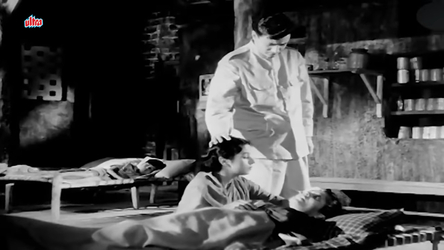
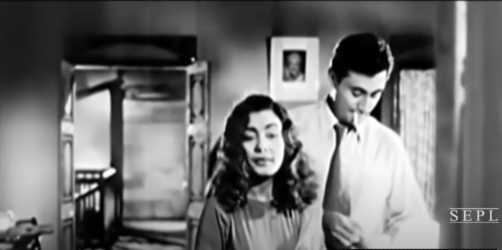
Like Raghubir ‘Raghu’ in Kaala Bazaar. Raghu is a bus conductor when the story begins, and within the space of a couple of minutes, his life takes an about-turn. A belligerent passenger is standing in the bus (which is against the rules), and when Raghu asks him to get off the bus, the man refuses. Both he and Raghu lose their tempers. Fists fly, and the next thing we know, Raghu is without a job.

Raghu’s mother (Leela Chitnis) is ill, and he has a sister (Nanda) and a young brother (?) as well; he cannot afford to be without a job. Desperate, Raghu flounders about, trying to find work. If not work, money.
Continue reading

Aandhiyaan (1951)

In 1951, fresh from the success of the Dev Anand-Geeta Bali-Kalpana Karthik starrer Baazi, Chetan Anand decided to make a film that would highlight the very interesting aspects of film-making he had been learning from studying the works of various European directors. ‘Based on a true incident that took place in Amritsar’, as the film’s credits read, the story of Aandhiyaan was written by Chetan Anand himself, along with Hameed Butt.

The film’s credits roll to an unusual sequence of shots: in each frame, one actor or the other is shown, battling the eponymous ‘aandhi’ or storm, though in this case literal rather than metaphorical.

The story is centred round a young and zealous lawyer named Ram Mohan Kapoor (Dev Anand). Ram lives upstairs from his munshi (Ratan Gaurang), whose daughter Rani (Nimmi) has long been in love with Ram, though she’s too shy to let him know that. When the story begins, Ram’s mother (Durga Khote) is due to arrive, and Ram is getting ready to go to fetch her from the station. Rani makes tea for him, and an excited Ram confides in her: he’s asked his mother to come because he wants her to fix a match for him. With a girl he likes a lot.

Continue reading

Arpan (1957)

When I was going through Chetan Anand’s filmography last year (to commemorate his birth centenary), I stumbled across a Chetan Anand film in which he starred, besides directing it: a film, too, which immediately struck me as unusual, just given its length: a mere one hour. For a Hindi film, rare indeed. Though I didn’t watch Arpan back then, I bookmarked it and decided I’d watch it sometime later.

And it is an unusual film. Not just short, but also somewhat surreal in places. Hauntingly beautiful at times, outright odd at others.

Arpan is set, we are told, 2,500 years ago. A famine is ravaging the land, and people are starving left, right and centre. In this situation, the royalty, of course, is expected to set an example, and thus Princess Madhavi (Sheila Ramani) is going about, a large entourage with her, distributing food to her father’s subjects.

Continue reading

Funtoosh (1956)

Today may (or may not) be the birth centenary of the film maker, writer, and actor Chetan Anand, eldest brother of Dev Anand and Vijay Anand. Different sources list different dates of birth: most sites (including IMDB) list his birth date as January 3, 1921; others, including Wikipedia (yes, I know not the most reliable of sources) say it’s January 3, 1915. (This article says it’s 1921, but then goes on to write that Chetan Anand was 27 years old in 1943, which is either dodgy maths or a suggestion that the year of birth was indeed 1915). The article, barring that slip, is a good, interesting introduction to the life and career of Chetan Anand.

Anyway. Even if I’m six years too late to the party, at least today is Chetan Anand’s birthday.

Continue reading

Aakhri Khat (1966)

Hindi cinema has, for many decades (much of its existence?) been stereotyped. Mush, melodrama, music. The usual plot of countless films over the years has been dominated by a few given elements, even when the film’s main story may straddle other genres, such as thriller or comedy. You can’t have a Hindi film without romance, song and dance, and melodrama, seems to be the rule followed by most film makers.

Which is why the exceptions to the rule come as such a breath of fresh air. Majhli Didi, Dekh Kabira Roya, Kaanoon, Ittefaq… and this touching, tragic yet heartwarming story of a toddler wandering through the streets of big, bad Bombay.

Continue reading

Neecha Nagar (1946)

I am a bit of an iconoclast. Maxim Gorky’s play The Lower Depths, while considered one of the great classics of Russian literature, left me cold when I read it. To me, it seemed too cluttered with characters, too devoid of plot, and just—well, without anything that would make me want to go back to it all over again.
So I approached Neecha Nagar—Chetan Anand’s debut film as a director—with a good deal of trepidation. Because Neecha Nagar was inspired by The Lower Depths, and I expected something horrendously morbid and impossible to understand without the benefit of footnotes.

Continue reading

Book Review: Sidharth Bhatia’s Cinema Modern: The Navketan Story

A few days back, an editor from The Indian Express phoned to ask me if I’d like to review a book for them. Which book? Sidharth Bhatia’s Cinema Modern: The Navketan Story. Too mouthwatering an opportunity to miss, I decided, even though I already had a lot of work to get done. But here it is. You can read the final version (more concise, shorter, perhaps a bit less irreverent) here. And here, right after this sentence, is my first draft: longer, more full of trivia, a little more loony, and (of course!) with some screenshots.

Continue reading

Haqeeqat (1964)

With most films, by the time I see The End come up on the screen, I’ve more or less decided what I’m going to write about it, till which point I’m going to reveal the plot, and so on. With Haqeeqat, I’m still a little dazed. This is one of Bollywood’s earliest—and most realistic—war films, set against a backdrop of what was then the almost inaccessible region of Ladakh. It’s a blend of war and melodrama, propaganda and patriotism… and I’m not sure exactly what can be considered the main story of the film, since it actually consists of a number of stories woven into each other.

Balraj Sahni in Haqeeqat

Continue reading