The Mouse That Roared (1959)

What is a country to do if its economy suddenly takes a nosedive? What if the country’s sole source of income is a product that’s suddenly no more in demand? Are economic reforms in order? Or a smart political move?

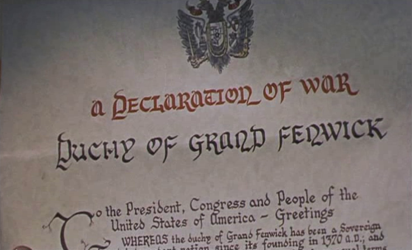
No; I’m not talking a 1950s tale of courage and enterprise in the face of economic disaster (not in the way one would’ve expected, at any rate). Not when you know that the star of this film—in a triple role, too, one of which is a woman—is the inimitable Peter Sellers. And not when you know that it revolves around a fictitious country, supposedly the smallest in the world, which decides that what its economy needs for a turnaround is to declare war on the United States of America.

The way to solvency Continue reading

Dhool ka Phool (1959)

Yash Chopra’s debut as a director, Dhool ka Phool is unusual in a lot of ways.

Leela Chitnis, for instance, is not a coughing-her-guts out (or basket-making) pathetic old mum.
The hero and heroine travel by train—and that too in trains that go over bridges—without the train falling into the river or crashing and the protagonist losing their memory in the process. Or being given up for dead.
And two people in love in the first half-hour of the film end up moving on in life and not loving each other till the end of time.

On the flip side, it does have a long-lost mother feeling an inexplicable affection towards a strange boy, who for no reason that he can fathom, instinctively calls her “Ma!” It does have a thunderstorm at the end of a love song, with the expected consequences [read: raging hormones, libido and “Humein aisi galti nahin karni chaahiye thhi”]. And it does have Manmohan Krishna being the goodie-two-shoes who stands up for what is right and righteous.

Manmohan Krishna as Abdul Chaacha in Dhool ka Phool Continue reading

Jis Desh Mein Ganga Behti Hai (1960)

In one pivotal scene in Jis Desh Mein Ganga Behti Hai, Kammo (Padmini), the daughter of a dacoit chief tells her naïve beloved that they, the dacoits, are not to be scorned or derided, because they wield guns to make things equal between the rich and the poor. They take from the rich and give to the poor, because the poor have always been preyed upon by the rich.

Kammoji, tum log chochilist ho?” asks Raju (Raj Kapoor), wide-eyed. Because chochilists, as he informs Kammo, also work to make things ‘barobar’ between the rich and the poor. And when he is reassured that yes, that is the philosophy of the dacoits, Raju decides there and then that he will no longer think of dacoits as evil people.

Raj Kapoor and Padmini in Jis Desh Mein Ganga Behti Hai Continue reading

Alexander’s Ragtime Band (1938)

The other day, scrolling through previous posts, I realised I hadn’t reviewed any Hollywood films for a while (to be honest, I’ve not even watched many Hollywood films over the past couple of months). I also realised that it’s been ages since I watched any films starring Tyrone Power, one of my favourite Hollywood actors. Time to amend that, I decided. So I got out a Power film I hadn’t watched before. An Irving Berlin production, replete with good songs and plenty of Ty candy.

Tyrone Power and Alice Faye in Alexander's Ragtime Band Continue reading

Nakli Nawab (1962)

Muslim socials are among the genres I can never have too much of. Back in their heyday, they had some of the best music around (remember Chaudhvin ka Chaand? Barsaat ki Raat? Mere Mehboob? The inimitable Pakeezah?) There was the chance to savour the mellifluous sound of Urdu; to peek into a social structure and lifestyles that often went otherwise unexplored in cinema; and to see women in shararas and men in achkans [the latter, like military uniforms, equipped with some inexplicable means of making even Bharat Bhushan and Rajendra Kumar look good].

pic1 Continue reading

Shijibganeun Nal (1956)

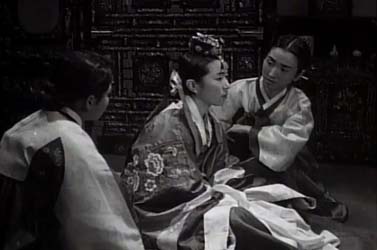
In English, The Wedding Day. Also known (ironically, as it turns out) as A Happy Event in the Maeng Family.

I’ve been watching a lot of (relatively new) Korean films—most of them frothy romances and romcoms—over the past several weeks. They reminded me that I’d never reviewed a Korean film on this blog, and they also reminded me that the first Korean film I ever saw was a romantic one; or what I could remember of it was romantic. The film was shown on Doordarshan, India’s sole television channel back in the early 80s. Doordarshan, back then, showed an interesting mix of foreign cinema: all the way from films like Red Sorghum (which my parents should probably not have let an impressionable 12-year old watch) to Fedora, which bored me to tears. And a Korean historical about a wedding in a family.

The Wedding Day Continue reading

Intequam (1969)

When Anu listed her favourite Sadhna films, I remarked that another Sadhna film I like—though it’s from later in the actress’s career—is Intequam. Based on Vendetta, a Marie Corelli novel (the only film adaptation of a Corelli work that’s in colour), Intequam is a story of vengeance. Though it features a Sadhna whose gorgeousness had begun to suffer because of her medical problems, she’s still interesting—and the central character in this film.

Sadhna with Sanjay Khan in Intequam Continue reading

Topkapi (1964)

RIP, Maximilian Schell.

Of the cinema personalities who have passed on recently and to whom I’ve posted tributes on this blog, nearly all have been people I’ve watched in at least a few films each. People (like Eleanor Parker, who for years I knew only as the Baroness from The Sound of Music) whom I may not initially have been utterly enamoured of, but whom I’ve grown to like and admire after having watched them in numerous roles. Joan Fontaine, Peter O’Toole, Suchitra Sen

The Austrian-born Maximilian Schell (December 8, 1930-February 1, 2014) is the exception, because this is one actor whom I’ve seen—before I watched Topkapi—in only one role: as the earnest young lawyer in Judgment at Nuremberg. Just one performance (an Oscar-winning one), mind you, and that was enough to make me a Max Schell fan. Enough of a fan to mourn his passing.

Maximilian Schell, 1930-2014 Continue reading

The Egyptian (1954)

…and it’s a historical, again!

Frequent visitors to this blog would probably by now have realised that I have a weakness for history and historical films.  Give me a sword and sandals epic, a Mughal extravaganza, or just about any film set in the ancient, medieval, or even early modern world, and I’m happy. Even happier when it’s a somewhat unusual setting. And more when the film maker has spent two years researching the film.

The Egyptian is set in the Egypt of 3,300 years ago. The main story plays out as a flashback, the memories of old Sinuhe (Edmund Purdom), who looks back on his life.

Edmund Purdom with Michael Wilding in The Egyptian Continue reading