Boot Polish (1954)

When I reviewed Les Quatre Cents Coups a couple of weeks back, I was mentally riffling through the list of good films with child protagonists that I’d seen. I couldn’t, sadly, think of many. There were some—The Night of the Hunter, Bhai-Bahen, Bandish, Do Kaliyaan, for instance—in which children played an important part. But these were either not really films about children, or they were films about stylized children: little adults, really, or oversized toddlers.

Then I saw Kaphal – Wild Berries, made by blog reader, fellow blogger and film maker Batul Mukhtiar (aka Banno), and thought: yes, this is what a good film about children should be like. (Here, on my website, is a review of Kaphal). I also remembered, then, that Banno had once recommended a film about children.  The Raj Kapoor production, Boot Polish, which she’d reviewed on her blog, and which I’d never got around to watching. If someone who could make such a lovely film about children could recommend a film, that film would be worth watching.

So here we are. And, thank you, Banno.

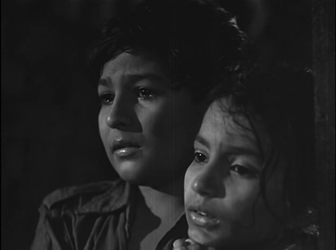
Rattan Kumar and Naaz in Boot Polish Continue reading

Railway Platform (1955)

Railway Platform begins, not on a platform, but in a train.

It starts with a song, Basti-basti parbat-parbat gaata jaaye banjaara, lip-synched by a philosopher and poet (Manmohan Krishna) as he rides in a crowded train compartment. This man, only referred to as ‘kavi’ (poet) throughout the film, acts as a sort of sutradhar. Not strictly the holder of the puppet strings, not always a narrator, but a voice of reason, of conscience, of dissent. His favourite saying is that “Two and two do not always make four; they sometimes make twenty-two.”

The kavi sings a song

Continue reading

Les Quatre Cents Coups (1959)

This is the 400th post on this blog.

And, what with my penchant for honouring precedents, I couldn’t pass up this opportunity to watch a film that has that number—400—in its title. Les Quatre Cents Coups (known in English as The Four Hundred Blows, though the actual translation would be closer to ‘the four hundred dirty tricks’) was directed by François Truffaut, one of the most prominent pioneers of French New Wave cinema. It was Truffaut’s first full-length feature film, a work that not only won much critical acclaim, but also led Truffaut to make a series of sequels featuring the same lead character…

…who is, in Les Quatre Cents Coups, the twelve-year old Antoine Doinel (Jean-Pierre Léaud).

Jean-Pierre Léaud as Antoine Doinel in Les Quatre Cents Coups
Continue reading

Waaris (1954)

As frequent visitors to this blog would know by now, one of my weaknesses is good music—and there have been, over the years, dozens of films that I’ve watched primarily because they had good scores. In some instances, just one song that I really liked. More often than not, my luck’s been pretty shoddy and I’ve ended up sitting through frightful films like Akashdeep, Saaranga, and Akeli Mat Jaiyo.

With Waaris, which I watched mostly because of Raahi matwaale, I had hopes [cautious, considering my track record, but hopes nevertheless]. It stars Suraiya and Talat Mahmood, both favourites of mine, and it was produced by Sohrab Modi, who even if (when acting) had a penchant for ‘declaiming to the skies’, did make some good films.

Talat Mahmood and Suraiya in Waaris Continue reading

Charly (1968)

This was not the film I’d been intending to review this weekend.

The film I’d meant to watch was, instead, quite a different one: a Viking/King Arthur historical, the Robert Wagner-Janet Leigh-Debra Paget starrer Prince Valiant (1954). Why, then, am I reviewing this film, which has nothing to do with Vikings or history? Simply because Prince Valiant turned out to be—as a blog reader had so succinctly described The Long Ships in a comment—a ghanta film. (ghanta, for those not familiar with this particular usage of the Hindi word, refers to something cheesy, inferior, and generally avoidable).

Besides the fact that it consisted of slightly pointless (not to mention extended) violence and some very predictable romance, Prince Valiant had Robert Wagner looking like a masculine Amelie, which really put me off. To recover, I decided to watch Charly instead.

Cliff Robertson in and as Charly Continue reading

Dharmputra (1961)

Several readers have told me, over the past couple of years, that I should watch this film. It is, if you go by just the details of cast, crew, and awards won, a promising film. Directed by Yash Chopra, starring Mala Sinha, Rehman, Ashok Kumar, Shashi Kapoor (in his first role as an adult), Nirupa Roy, Indrani Mukherjee, Manmohan Krishna—with guest appearances by Rajendra Kumar and Shashikala. The winner of the President’s Silver Medal for Best Feature Film in Hindi at the National Film Awards.
And with lyrics by Sahir Ludhianvi, set to music by N Dutta. I could well imagine Dharmputra would be a film worth watching. So when I finally managed to lay my hands on it, I didn’t waste much time getting around to seeing it.

Shashi Kapoor in Dharmputra Continue reading

Gojira (1954)

Aka Godzilla.

I was in the mood for watching something different. This film seemed to fit the bill: the first old Japanese film I’ve seen that wasn’t directed by Akira Kurosawa, and the first monster movie I’ve reviewed on this blog.

Godzilla (1998, the Hollywood version) was a film I didn’t watch for many years after its release, despite the fact that some Indian TV channel or the other was always showing it. Then, I happened to go on a monster movie binge, and ended up watching it. (More, later in this post, about what I thought of it). Importantly, Godzilla encouraged me to look out for the original Japanese film.

Gojira rips Tokyo apart Continue reading

Shikast (1953)

There is a story behind how I ended up watching this film last week.

I had first seen Shikast on TV years ago. I was a pre-teen, and didn’t much care for the film: it was too tragic, too angst-ridden, too lacking in entertainment, as far as I was concerned. For years afterwards, the only thing I remembered about the film was that it starred Nalini Jaywant and Dilip Kumar, and that through most of the film, Nalini Jaywant’s character sported a vivid crescent-shaped scar on her forehead. I had even forgotten the name of the film.

Nalini Jaywant in Shikast Continue reading

Love in Bombay (2013)

Or 1971, if you go by the year the film was made, not the year the film was released. Or 1974, which was when the censor certificate dates from.

I came to know of Love in Bombay a few months back, when a newspaper article mentioned that Joy Mukherji’s sons were finally going to be releasing this film. I forgot about it until I discovered that it had finally been released this last Friday—and then I was in a quandary. To see or not to see, as I put it. Various friends urged me on: Harvey, for instance, said that with Agha Jani Kashmiri having revised the script, it may be pretty good. Beth said that she’d heard the costumes were good. Sidharth Bhatia suggested that the presence of Joy Mukherji and Kishore Kumar might be one reason to watch.

Kishore Kumar, Narendra Nath, and Joy Mukherji in Love in Bombay Continue reading