Aar-Paar (1954)

I saw this on the big screen, on August 10, 2025.

Given that getting to see a Hindi film as old as this on the big screen, as a proper commercial release (re-release, in this case), is a very rare treat, it needs to be put up front.

To mark the birth centenary of Guru Dutt, the National Films Division Corporation of India (NFDC) and the National Film Archive of India (NFAI) collaborated to restore and re-release several of Guru Dutt’s films. These were shown at PVR and Cinépolis cinema halls across India on August 8th through to 10th. Left to myself, I would happily have seen all the films that were being screened; but duty calls. August 9th was rakshabandhan, and we had family coming over for lunch. I was busy all through the previous day cleaning and cooking and generally preparing, and then again through half of the next day. But, once our guests had eaten, I scurried off cinema-wards to watch Sahib Biwi aur Ghulam. The following day, I managed to watch Aar-Paar.

Continue reading

Book Review: Lata Jagtiani’s ‘Thank You, Guru Dutt!’

Lata Jagtiani’s Thank You, Guru Dutt! was released a few months back, to mark Guru Dutt’s birth centenary year. This is a book that follows on the heels of several other (well-acclaimed) books about Guru Dutt, his life and cinema: Nasreen Munni Kabir’s Guru Dutt: A Life in Cinema; Yasser Usman’s Guru Dutt: An Unfinished Story; and Ten Years with Guru Dutt: Abrar Alvi’s Journey, by Sathya Saran, among others. I will admit that I haven’t read any of the aforementioned books, so for me Jagtiani’s book was a first, in that sense.

Continue reading

Baaz (1953)

Today, July 9, 2025, marks the 100th birth anniversary of one of Hindi cinema’s best-known film directors. Born in Mysore on this day in 1925 as Vasant Kumar Shivshankar Padukone, Guru Dutt studied in Calcutta before joining Uday Shankar’s India Culture Centre (in Almora, present-day Uttarakhand) to train in dance. By the time he turned 19, he had moved to Pune, where he began working as a choreographer for Prabhat Studios. By the time Prabhat Studios folded up (in the early 1950s), Guru Dutt had formed a close friendship with Dev Anand, because of whom he received his first break as a director: in 1951, he directed Navketan’s Baazi, starring Dev Anand, Geeta Bali and Kalpana Karthik in a noir thriller that was to become a defining film for Navketan: edgy, stylish, dark, very urban.

Guru Dutt is today revered more for the hard-hitting, cynical cinema he made: films like Pyaasa, Sahib Bibi aur Ghulam and Kaagaz ke Phool hold up the mirror to a world that is selfish, cruel and opportunistic. These are bitter films, films that plumb the depths of human nature; films that—despite following most of the standard tropes of commercial Hindi cinema (a romance between the lead couple; a fair number of songs; a comic character invariably played by Johnny Walker)—were quite different from other Hindi films.

These, too, are the films for which Guru Dutt is mostly remembered today. Is that because over the decades, people have seen how the tragedy and turmoil of Guru Dutt’s personal life was probably reflected in films like these? Is there a voyeuristic tendency to try and spot the man behind the director?

But Guru Dutt also made other films, on other subjects. This one, for instance, an adventure/patriotic film set on the high seas, with Geeta Bali starring as the eponymous ‘Baaz’ (falcon), a woman who becomes a pirate to free her land of a colonial tyrant.

Continue reading

Kaagaz ke Phool (1959)

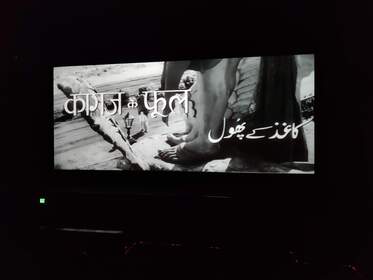
That first photo, because the space beyond the screen is so dark, may not be very obvious as regards context. But this is a photo from a full-sized film theatre, where I watched the re-released Kaagaz ke Phool on July 17th. The re-release was to mark the 65th anniversary of this film, a semi-autobiographical work that was a flop when it was first released, but has gained in popularity ever since. My niece had alerted me to the fact that PVR Inox would be showing Kaagaz ke Phool across its theatres, one show a day for a week, and I knew I couldn’t miss this one. If only for the fact that I get to see precious few old films on the big screen (Hum Dono was the last I saw).

I had thought I’d probably be one of a handful (ten, at the most?) of people in the theatre, because this, after all, is an old film; and this was an afternoon show on a weekday. But to my surprise, there were actually quite a few people, and—best of all—many of them were fairly young. Heartening.

But, to get to the film.

Continue reading

Suhaagan (1964)

I’ve had this film on my radar for a long time. I first came across a mention of it online about ten years ago, and since Guru Dutt had acted in so few films, I was curious about this one (which, incidentally, was also his last film). Back then, I used to subscribe to a video rental service, and having found Suhaagan on that, ordered it—and what I got was the absolutely execrable, horribly regressive Suhaagan that starred Geeta Bali [if ever I decide to draw up a list of Hindi films you must not watch, that Suhaagan will be on it].

The Guru Dutt-Mala Sinha Suhaagan, which several people on my blog have mentioned in the past (including fairly recently), and which I’d searched for on Youtube now and then, finally cropped up in Youtube’s recommendations for me. So I bookmarked it.

Continue reading

12 O’Clock (1958)

Years ago, in the good old days when the single channel on Doordarshan was our main source of entertainment and we therefore watched everything that was telecast, I watched 12 O’Clock. I’d already seen Guru Dutt’s big films—Pyaasa, Sahib Biwi aur Ghulam, Kaagaz ke Phool, Chaudhvin ka Chaand. I assumed, based on those (I had yet to watch Bahurani or Saanjh aur Savera, and had thought Mr & Mrs 55 a flash in the pan), that 12 O’Clock would be along the lines of the serious stuff Guru Dutt churned out.

… which this is not. Because this is one of a handful of the films Guru Dutt acted in but did not direct.

Continue reading

Bahurani (1963)

Inspirations to watch (and review) films come to me from all over. Friends and relatives are occasionally badgered to suggest genres; blog readers’ requests and recommendations (some of them, alas, long-pending) are taken into consideration. And, sometimes, I get inspired by the most outlandish of things. For instance, this film—which I first watched years ago, on TV—jumped to the top of my to-watch list because one day, while washing up in my kitchen, I was reminded of Mala Sinha.

[And no, not because I happened to be scrubbing a colander].

Mala Sinha in and as the Bahurani Continue reading

Some thoughts on the songs of Pyaasa

Why not begin, I thought, where I left off in my last post? The last song I listed in my post on my ten favourite Waheeda Rehman songs was Jaane kya tune kahi, from Pyaasa. Interestingly, this was also the first song in the film. It’s a film I’ve seen a few times – always with increasing appreciation, as I begin to see more nuances, more things to admire about it. But do I really have anything new to say about Pyaasa that hasn’t been said before?

Continue reading

Sahib Bibi aur Ghulam (1962)

After all the lightheartedness of the past few posts, time to get back to serious stuff. I had three none-too-cheery films lined up: Khamoshi, Andaz, and this one. Sahib Bibi aur Ghulam had been popping up in some recent posts (one song was part of the daaru list, and a discussion on Jawahar Kaul—one of the leads in Dekh Kabira Roya—ended up with a general wondering of what role he played in Sahib Bibi aur Ghulam). So Sahib Bibi aur Ghulam it was, a rewatch of a memorable film with some fine performances and superb music.

Meena Kumari and Rehman in Sahib Bibi aur Ghulam

Continue reading

CID (1956)

Long before TV came into our lives, a family treat would be to go out for dinner or for a film at a local cinema. And though Bobby was the first film I saw, CID was the first black and white film I remember. I don’t recall anything of the film except a very brief bit from the climax, but you can imagine how gripping that must have been to have stayed in my memory for well over thirty years.

Mehmood and Dev Anand in CID

Continue reading