Phool aur Patthar (1966)

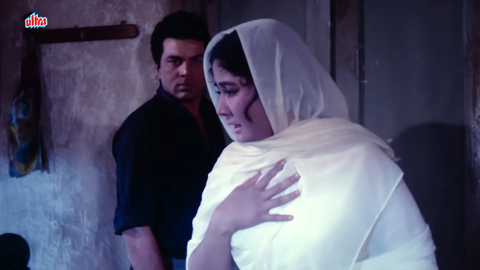
A couple of years back, I watched (and later reviewed) the Meena Kumari-Dharmendra starrer, Bahaaron ki Manzil. A good suspense thriller, it put me in mind of another film starring these two: Phool aur Patthar. I had seen the film many years ago, as a child (implication: this would have been in the early 80s, when Doordarshan’s sole TV channel was our only entertainment besides books and radio, which meant we watched anything that was aired, no matter how mediocre). I remembered nothing of it except that Dharmendra played a thief who ends up being cared for by Meena Kumari, playing a widow.

Continue reading

Udan Khatola (1955)    

Does Udan Khatola hold some sort of record for largest number of love/lust triangles?

Here’s a rough count:

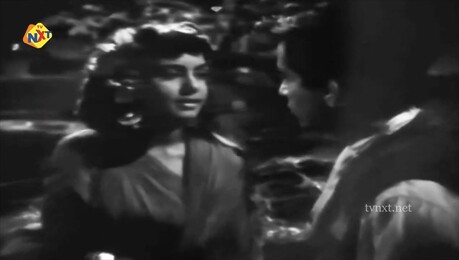
There’s the unnamed aviator, the pardesi (played by Dilip Kumar) who is in love with the local peshwa’s daughter Soni. Who, in turn, loves him back.

Continue reading

Mela (1948)

I have never really wanted to watch this film, the main reason behind that being a long-ago comment by my father, saying that it was a ‘serious’ film. Which meant, basically, that you shouldn’t expect a happy ending. Whatever may happen before that—starry-eyed romance, good songs, even some humour—is all the light-heartedness you could hope for. When tragedy came, it would pile up.

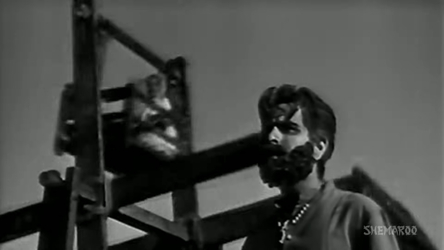
Mela (which I ended up watching mostly for the songs, and partly because I like both Dilip Kumar as well as Nargis) gets off to a bad start, because it begins with gloom and doom. Mohan (Dilip Kumar), old and sad-looking, is released from prison after what seems to be a long, long time in jail. He goes out into the wide world, and walking along, comes across someone singing Yeh zindagi ke mele, while—in the background—crowds of happy, laughing people throng a fair, whirling about on carousels, milling about stalls, enjoying themselves.

Continue reading

Zindagi (1964)

The main reason I watched this film was because of the songs, which include some very good ones. And Vyjyanthimala, whom I invariably enjoy watching. The two male leads, Rajendra Kumar and Raj Kumar, are not favourites of mine, but they aren’t absolutely unbearable either. And there was a star cast of several other people I like, such as Prithviraj Kapoor and Helen. Ramanand Sagar, who wrote and directed Zindagi, also has to his credit one film I really like (Aankhen) and some (Aarzoo, Ghoonghat, Charas) that I don’t mind too much. I figured there might be enough here for me to enjoy.

The story begins with Beena (Vyjyanthimala) coming home to her mother (Leela Chitnis) with the news that she has found a job, finally. Ma is happy, until Beena tells her what the job is: Beena is now a theatre actress. Ma is very upset and goes into a long harangue of how it’s better to be poor than to be in the theatre; their name will be mud, blah blah.

Continue reading

Naya Daur (1957)

Happy 100th birthday, Dilip Kumar!

It was on this day that Mohammad Yusuf Khan, who was to go on to become one of India’s most-loved and finest actors, was born in Peshawar’s Qissa Khwani Bazaar.

In a career spanning several decades, and some sixty-odd films, Dilip Kumar attained a status all his own. He was one of the first to win a Filmfare Award, and went on to win the most Best Actor Awards (until the record was equalled— though not yet surpassed). His scenes have been copied and re-done, his dialogues have become familiar to fans of cinema, his films and his acting closely dissected.

Continue reading

Do Phool (1958)

I have watched hundreds of Hindi films. Many of these I’ve reviewed here on this blog, and for many of those, I’ve had readers mention that so-and-so film was actually a remake of so-and-so Hollywood film, or was inspired from this novel or that play. In some, of course, I’ve been able to spot a source immediately: the grand mansion being run as a hotel by its manager who then forces the owner to pretend to be a guest is lifted from Come September and used—without any credit for the original idea—in both Kashmir ki Kali and Mere Sanam. Adalat is a remake of Madame X; Aradhana of To Each His Own; Gumnaam of And Then There Were None… all uncredited. And umpteen others.

This is something I find very irritating. The amount of work that goes into coming up with a good plot is substantial, and if you’re acknowledging that by thinking it worthy of being copied, then you should certainly think it worthy enough to pay for. But by calmly hogging all the credit and assuming that Indian audiences won’t cotton on to this plagiarism, and Hollywood (or foreign writers), too far from the world of Hindi cinema, will be oblivious.

Anyway, that’s a long, convoluted and messy topic, which I should probably leave for later. For now, the reason why all of that came to my mind: because this film does give credit where it’s due. Not, unfortunately, to the writer of the book (Johanna Spyri), but at least to the book itself.

Continue reading

Sadhu aur Shaitan (1968)

Cinema looking at itself is not an uncommon feature; there have been several notable films, both in India (Kaagaz ke Phool, Sone ki Chidiya) as well as abroad (Cinema Paradiso, 8½, The Bad and the Beautiful, etc), which are about cinema and film-making. But this film, relatively obscure, really should be part of the annals, simply because of its sheer devotion to Hindi cinema. Not because it’s about film-making, not because there is even (as in Solvaan Saal), a single scene on the sets of a film. But because it celebrates Hindi cinema in so many ways, on so many levels.

Sadhu aur Shaitan begins by introducing us to the eponymous ‘sadhu’ of the story: Sadhuram (Om Prakash), a widower who lives with his two children Ganesh (Master Shahid) and Munni (Baby Fauzia), and the maid Ramdeyi (Dulari) who looks after home and the children. Sadhuram is a somewhat excessively ‘good and righteous’ man, the living image of piety (all a little over the top as far as I’m concerned, but at least he isn’t stuffy about his righteousness).

Continue reading

Aakhri Dao (1958)

This was one film where I had a tough time making up my mind: should I review it? Should I not? It’s not a great film, but it’s not absolutely abysmal either. And it has a luminously lovely Nutan, plus some superb songs (courtesy Madan Mohan and Majrooh Sultanpuri) to compensate for other drawbacks in the film. It’s also a film about a murder (as macabre as that may sound, always something that catches my attention).

If for nothing else, as an example of a film that could have been pretty good but ends up a damp squib, this, I decided, was worth reviewing.

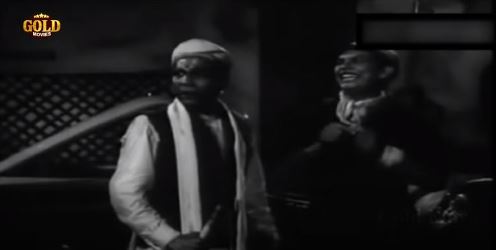
The story centres round Raj Kumar Saxena ‘Raju’ (Shekhar), a mechanic who works in a garage, and lives in a tiny room above the garage along with his friend and colleague Popat (Johnny Walker). Popat has been having a chat with a wealthy customer, Muthuswami Chetiyar (Mirajkar) and is keen on getting Muthuswami to invest in a garage for Popat. The incentive Popat offers is a match for Muthuswami’s daughter: Raju, he says, will be a fine bridegroom. Because he guesses Muthuswami will not be eager to marry his daughter to a mechanic, Popat takes care not to let on that the groom he has in mind is that figure hunched over a car at the other end of the garage…

Continue reading

Hulchul (1951)

Today is the hundredth birthday of one of India’s greatest and most popular dancers of yesteryears. Sitara Devi was born in Calcutta on November 8, 1920, to a father who was a Sanskrit scholar and also both performed as well as taught Kathak. Her mother too came from a family with a long tradition in performing arts, so it was hardly a surprise that from a very young age, Sitara (her birth name was Dhanalakshmi) began to learn Kathak. By the time she was ten, Sitara was giving solo performances; two years later, at the age of twelve, she (having since moved to Bombay with her parents) performed onstage and so impressed film-maker/choreographer Niranjan Sharma that he recruited her to work in films.

Unlike several other skilled danseuses—Vyjyanthimala, the Travancore Sisters, Waheeda Rehman, etc—Sitara Devi did not let cinema take over her dance completely. She danced in a number of films, through the 40s and right up to Mother India (1957), which is believed to be her last onscreen appearance. She continued to give stage performances, even performing at New York’s Carnegie Hall and at the Royal Albert Hall in London.

Sitara Devi wasn’t merely a film actress; she was also a great dancer. I wanted to pay tribute to her through a review of one of her films, and decided I’d choose Hulchul, which I wanted to watch for other reasons as well (more on this later).

Continue reading

Dil Ne Phir Yaad Kiya (1966)

It took me five days to watch this film: I couldn’t bear to watch more than fifteen minutes of it at a time, and I couldn’t do more than two sessions in a day.

That’s what Dil Ne Phir Yaad Kiya is like. Despite starring Dharmendra, Nutan, and Rehman. Despite being picturized in some very pretty locales. And despite having a couple of not-too-bad songs. By the time this travesty of a film ended, I was wanting to tear my hair out. I thought I wouldn’t review it, but then decided this did need to be reviewed, so that other potential viewers could be warned.

This is going to be a shortish review, since I can’t bring myself to explain every fiddly little detail along the way in what is a convoluted (but pointlessly convoluted) plot.

Ashok (Dharmendra) and Amjad (Rehman) are best friends. They live in the same pokey little flat (for which they haven’t paid the rent in a long time), they work in the same toy store, and they spend all their free time telling each other about their respective girlfriends. Ashok’s sweetheart is Ashu (Nutan), who lives back in the village and is constantly being plagued by Ashok’s nasty stepbrother Bhagat (Jeevan)…

Continue reading