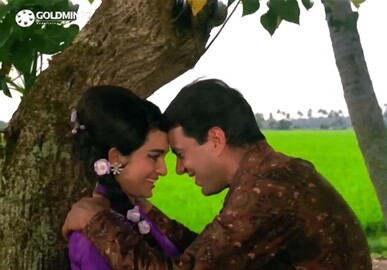
Aaye Din Bahaar Ke (1966)

(Coincidentally enough, I watched Aaye Din Bahaar Ke some weeks back, just after I’d posted my review of Phool aur Patthar. Back then I’d not known that we would be mourning the passing of Dharmendra so soon after. Consider this a tribute).

When I watched Phool aur Patthar some weeks back, I was reminded of the many fairly entertaining films Dharmendra worked in through the mid- and late-1960s. Not all of them were good (some, like Chandan ka Palna, were terrible), but quite a lot of them had at least good songs, a fair deal of entertainment value, and an undeniably handsome male lead to make them worth at least a one-time watch. Some of these (like Aankhen, arguably my favourite Dharmendra film) I’ve reviewed already; there are several others.

Here’s one. I last watched Aaye Din Bahaar Ke perhaps about 20-odd years ago, and actually remembered a fair bit of it. That I didn’t mind watching it again, even though the film is far from perfect, says a lot for it.

The story begins in Darjeeling, where Ravi (Dharmendra) lives with his widowed mother (Sulochana Latkar). Ravi is devoted to his mother: so much so that when Ma is doing her pooja, he tells her, “You may worship your gods, but I will worship only you.” She has devoted her life to looking after Ravi, educating him, etc, which is why this somewhat OTT sentiment.

Continue reading

Anita (1967)

When, for May 31st this year (the 100th birth anniversary of film director Raj Khosla), I wanted to review one of his films, Anita was on my shortlist. Over the course of the years I’ve been writing this blog, I’ve reviewed several of Khosla’s films, including two of the three films (Woh Kaun Thi?, Mera Saaya and Anita) that comprise Khosla’s Sadhana suspense trilogy. Since Manoj Kumar had also passed away earlier this year, it seemed fitting to watch and review Anita, the last of the three films, and a film that starred Manoj Kumar opposite Sadhana.

For a tribute to Khosla, I ended up reviewing Kaala Paani instead. But I did watch Anita (a film that I’d last seen so long back, I remembered only the basics of it). And it seemed appropriate to review it too.

Therefore…

The film begins with a short, rather abrupt scene in which Seth Biharilal (Sajjan) visits a somewhat shady-looking pandit (Ulhas). Biharilal has brought along the horoscope of his 19-year-old daughter Anita for the pandit to have a look at, and to comment upon. The pandit has a peek, and says that this year is going to be really vile for Anita.

Continue reading

Jaal (1967)

I had first watched this film many, many years ago, probably as a young teen. It had been aired on Doordarshan, back in the good old days when our family used to watch pretty much every film that was shown (including some seriously grotty ones like Fauji).

I remembered little of Jaal: Mala Sinha and Biswajeet, yes; and that it was a suspense thriller set in a spooky mansion beside the sea. That was all.

While I don’t like Biswajeet, and the music of Jaal (by Laxmikant-Pyarelal) is forgettable enough to not want to watch it for the songs, I decided I should give this one another try. At least find out what it’s about.

The story begins on a stormy night at sea. A small boat is tossed about on the waves, and we catch glimpses of the lone man on board: Sunder Singh (Sujit Kumar) as he tries to control his vessel. In the distance can be seen (like the boat and the waves, looking patently artificial) a lighthouse. Sunder, however, cannot make it safely to shore; his boat crashes against the rocks and explodes in a great burst of fire.

Continue reading

Night in London (1967)

In which Biswajeet’s character ends up facing a wall studded with red-hot spikes. You don’t just skewered to death, you get barbecued in the process.

Continue reading

Jigri Dost (1969)

Mostly, the films I review on this blog are either the ones I like so much I want more people to watch them; or films I hate so much I want to warn people off them. Or, sometimes, films which may not be otherwise exceptional but have, I think, something that sets them apart: they’re unusual, or they’re somehow of historic importance.

Now and then, along comes a film I decide I have to review because while I don’t find it dreadful, I wonder what it would have been like with a different cast. Even just one actor being replaced by another.

Jigri Dost begins in the palatial home of Chairman Neelkanth (KN Singh), who is a baddie of the first order. He summarily orders his henchmen to raze this bunch of poor people’s huts, extort money from that lot, and so on. He has no scruples, no mercy, no nothing… no inkling, either, that a maid (Aruna Irani) in his home eavesdrops on his every conversation.

Continue reading

Izzat (1968)

When I posted my ‘People with books’ list on World Book Day, I wrote that my favourite scene (in the context of the post) was the one from Izzat: Tanuja and Dharmendra, both holding books (he, Othello, she, The Tribal World of Verrier Elwin), standing in a fairly well-stocked library at her home, and discussing Othello. What more could a book lover like me want from a scene? Especially a scene starring two of my favourite actors.

To those readers who commented, saying that they should probably watch Izzat since it sounded tempting, I was quick to respond: it has been many, many years since I watched this film. My memories of it were very sketchy, with only a vague recollection of the basic plot.

So, for those who want to know what Izzat is all about, I put myself forward as the bali ka bakra. I have rewatched it, and I can safely assure you that despite presence of said library and said bibliophilic conversation (not to mention presence of dishy Dharmendra and gorgeous Tanuja), this is not—emphatically not—a film you want to watch. Unless you’re a Jayalalitha fan (this was her sole Hindi film). Or you love the Himalayas so much you will watch anything as long as there are plenty of snowcapped peaks and deodar woods and bubbling streams.

Continue reading

Taqdeer (1967)

Taqdeer—a remake of the Konkani film Nirmonn (1966, directed by A Salaam, who also directed Taqdeer)—wouldn’t have been a film I’d have watched had it not been for one particular song that I like a lot: Jab-jab bahaar aayi aur phool muskuraaye. I noticed the film was up on Youtube (incidentally, this is a surprisingly good print, and with seemingly no arbitrary snipping off of sections). So I settled down one night to watch. For the song. And discovered that the film wasn’t bad—and was somewhat different from the usual.

Bharat Bhushan and Shalini Madolkar in Taqdeer Continue reading

Intequam (1969)

When Anu listed her favourite Sadhna films, I remarked that another Sadhna film I like—though it’s from later in the actress’s career—is Intequam. Based on Vendetta, a Marie Corelli novel (the only film adaptation of a Corelli work that’s in colour), Intequam is a story of vengeance. Though it features a Sadhna whose gorgeousness had begun to suffer because of her medical problems, she’s still interesting—and the central character in this film.

Sadhna with Sanjay Khan in Intequam Continue reading

Saajan (1969)

The other day, a fellow blogger, mentioning her distaste for Manoj Kumar’s films said that while she has “nothing against the man himself”, she really hates his films. I know what she meant (at least I think I do): I hate that insufferably xenophobic “all that is Indian is good, all that is Western is bad” philosophy espoused by films like Upkaar or, even worse, Purab aur Pachhim.
But I tend to shove that lot of films to the boundaries of my recollection of Manoj Kumar’s films. For me, his best films are the outright entertainers, the romances and suspense thrillers he worked in. Especially the suspense thrillers: Woh Kaun Thi?, Anita, Gumnaam—and this one.

Manoj Kumar and Asha Parekh in Saajan Continue reading

Ten of my favourite filmi qawwalis

I have been meaning to write this post for a long time now—I love qawwalis—but I’ve kept putting it off, because I’ve always thought that it would be impossible to create a list of just ten filmi qawwalis that are my favourites. (Barsaat ki Raat itself features at least three qawwalis that completely bowl me over).

But. I’ve finally decided to take up the challenge, and do it. These are ten fabulous qawwalis from pre-70s films that I’ve seen (though I must confess that I like the qawwalis of some 70s films—especially Rishi Kapoor ones). To make this post a little more challenging, I decided not to include more than one qawwali per film.

Continue reading