Jhansi ki Rani (1953)

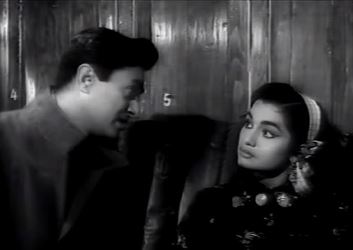
Given my penchant for history, it’s hardly surprising that I would, sooner or later, end up watching this film. It’s been on my radar for a while, though it was only last month that I was reminded of Jhansi ki Rani, because it showed up in my list of YouTube’s suggested videos. Oddly enough, what YouTube suggested wasn’t exactly this film but its English-language counterpart, The Tiger and the Flame, which was released in 1956. Sohrab Modi, who produced and directed (besides acting in) both versions of the film, went all out on creating a spectacular production, bringing in technicians and other crew from Hollywood, including Oscar-winning cinematographer Ernest Haller, who was responsible for the cinematography of Gone with the Wind.

This film was not just made in two languages, but with other differences between them too. The Tiger and the Flame is in Technicolor (the first India-made film in Technicolor) while Jhansi ki Rani is in black and white. Jhansi ki Rani has songs (composed by Vasant Desai with lyrics by Pandit Radheshyam), The Tiger and the Flame is minus the songs. Other than that, though, the films were much the same: the same cast, the same script.

Continue reading

Jab Pyaar Kisise Hota Hai (1961)

Nasir Hussain, as someone (he himself?) once remarked, came to Bombay with one story in his briefcase, and made out of it one blockbuster after another. The story of a son, separated by circumstances from one parent and going through various ups and downs (including falling for the distant parent’s foster offspring, being impersonated by a crook, etc) before the happy ending, was one that was played out in Tumsa Nahin Dekha, Dil Deke Dekho, Phir Wohi Dil Laaya and Pyaar ka Mausam.

But, contrary to popular belief, Nasir Hussain was by no means a one-trick pony. He had other plot elements up his sleeve as well, and they appear now and then sporadically in various films. The ‘couple promised to each other as children’ trope is one [which always ends up with the couple—completely unaware of having been ‘betrothed’ in childhood, even sight unseen—falling in love with each other]. Another was the hero being [mistakenly, of course] believed to have killed a sister [or sister figure] of the heroine’s, after having played fast and loose with her—this, naturally, causing serious heartache and betrayal for the heroine until she realizes that her beloved couldn’t possibly do something so heinous.

Asha Parekh and Dev Anand in Jab Pyaar Kisise Hota Hai

Continue reading

Maya (1961)

A wealthy young man strikes out on his own to see how the rest of the world lives. He pretends to be poor, goes to live in a community of poor people, and falls in love with a poor girl who doesn’t realise he’s a wealthy man. Starring Dev Anand as the protagonist.
Asli-Naqli? No. Interestingly, not. This was Maya, made just a year before Asli-Naqli, but with a very similar storyline.


Continue reading

Abe-Hayat (1955)

I’ve been very busy the last couple of days, and the busy-ness doesn’t look like it’ll come to an end soon. My husband, therefore (and what a model of husbandly devotion!) offered to write the review of Abe-Hayat for me. This, mind you, without having seen the film, just on the basis of a very sketchy gist I’d narrated of the first half while we were on our evening walk. Tarun said he’d do a 3-sentence review:
Once there was an evil jaadugar named Saamri. There was a prince, and a princess. The prince killed Saamri, and then he and the princess lived happily ever after.

Continue reading

Samadhi (1950)

Two confessions, to start with. Firstly, although I am very fond of Ashok Kumar—I think he was a great actor—I find it difficult to envisage him as the dashing hero of a spy thriller. Secondly, I think 50’s and 60’s Hindi cinema (with the notable exception of Haqeeqat) never quite manages to depict war properly. Battlefields are too often obviously sets or, at the most, a bunch of extras letting off firecrackers in a patch of woodland.
So Samadhi, despite being 1950’s top-grossing Hindi film and starring the beautiful Nalini Jaywant—was a film that I approached with trepidation. Which was perhaps just as well, because if I’d begun watching it with expectations way up there, I’d probably have been disappointed. As it was, by the end, I decided it wasn’t bad; in fact, pretty watchable.

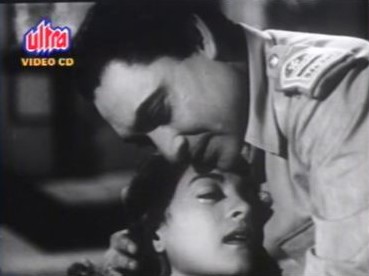
Ashok Kumar and Nalini Jaywant in Samadhi

Continue reading