Aaye Din Bahaar Ke (1966)

(Coincidentally enough, I watched Aaye Din Bahaar Ke some weeks back, just after I’d posted my review of Phool aur Patthar. Back then I’d not known that we would be mourning the passing of Dharmendra so soon after. Consider this a tribute).

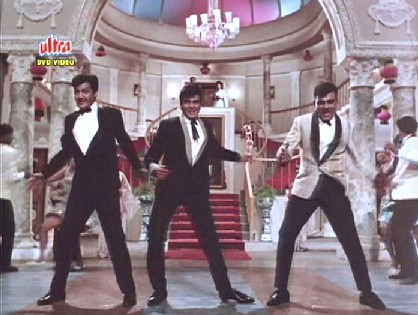
When I watched Phool aur Patthar some weeks back, I was reminded of the many fairly entertaining films Dharmendra worked in through the mid- and late-1960s. Not all of them were good (some, like Chandan ka Palna, were terrible), but quite a lot of them had at least good songs, a fair deal of entertainment value, and an undeniably handsome male lead to make them worth at least a one-time watch. Some of these (like Aankhen, arguably my favourite Dharmendra film) I’ve reviewed already; there are several others.

Here’s one. I last watched Aaye Din Bahaar Ke perhaps about 20-odd years ago, and actually remembered a fair bit of it. That I didn’t mind watching it again, even though the film is far from perfect, says a lot for it.

The story begins in Darjeeling, where Ravi (Dharmendra) lives with his widowed mother (Sulochana Latkar). Ravi is devoted to his mother: so much so that when Ma is doing her pooja, he tells her, “You may worship your gods, but I will worship only you.” She has devoted her life to looking after Ravi, educating him, etc, which is why this somewhat OTT sentiment.

Continue reading

Doli (1969)

The Hindi film industry has always been an upholder of patriarchy. Its male stars attract ridiculously high prices in comparison to their female colleagues, and have disproportionately longer careers than them (plus a much longer time as leads). Sexism is rampant, ranging all the way from sexual discrimination to violence. And, though more women directors, scriptwriters, lyricists etc are around now, it’s still pretty much a male-dominated industry.

Hardly surprising, then, that most of our films tend to look at things (at best) from a male point of view. At worst, they uphold patriarchy in its most virulent forms, reducing women to a cypher, expected to devote their lives to the service of men. Ever-forgiving Sati Savitris, wrapped in saris and simpering prettily every time their lord and master deigns to be kind. Or unkind, it doesn’t matter; he is still her devta.

Doli is one such film, steeped in patriarchy and regressive in the extreme.

It begins in a college, where Amar (Rajesh Khanna) and Prem (Prem Chopra) have just graduated. Amar is the star athlete, Prem the star pupil who has topped the college and won a scholarship for higher studies in America. Later, in their dorm, both Prem and Amar receive letters from home, informing them that their weddings have been fixed. On the same day, in the same town, Nasik. Neither of them is happy about this, but Prem, having known already that a match had been found for him, is rather more resigned.

Continue reading

Nishaan (1965)

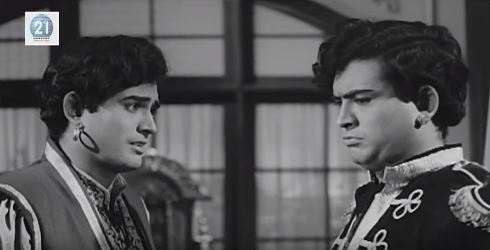
When I watched the 1949 Nishaan last week on Youtube, the topmost recommendation in the side panel was what was billed as another copy of the same film. Just for the heck of it, I clicked on the link, and arrived at a completely different film: Nishaan, yes; but a Nishaan made 16 years after the 1949 one, and a Nishaan too which is important for one major reason: it marks Sanjeev Kumar’s debut in a lead role (and that too a double role).

Sanjeev Kumar had already played small parts in two films—Hum Hindustani and Aao Pyaar Karein, but this film, with ‘Introducing Sanjeev Kumar’, was his first big role(s). He didn’t soar to success immediately, and most of his films over the next couple of years were fairly forgettable (as Nishaan is, to some extent). But despite the general unimpressiveness of this film, what stands out is the very natural acting of its leading man.

Continue reading

Ghazal (1964)

Those who frequent this blog have probably figured out by now that I have a soft spot (a very soft spot) for Muslim socials. So much so that I will watch just about any Muslim social out there, even if it features people who aren’t among my favourites. Even if it has a fairly regressive theme, and even if I end up not agreeing with half the things in the film. So, when I come across a Muslim social that stars some of my favourite actors (Sunil Dutt? Meena Kumari? Rehman? Prithviraj Kapoor? Rajendra Nath? Check, check, check), has lyrics by my favourite lyricist (Sahir Ludhianvi), and had its songs composed by one of my favourite music directors (Madan Mohan—and how appropriate, too, for a film called Ghazal to be scored by the Ghazalon ka Shahzaada): to not watch this would be a crime, I thought.

Meena Kumari and Sunil Dutt in Ghazal Continue reading

Waaris (1969)

Today’s Holi and much of Delhi has been busy slathering everybody else with colour. Out in the street (and in the neighbours’ yard) I saw people drenched in purple, green, yellow and red.
My husband and I don’t celebrate Holi—we’re both too fastidious and have better things to do in life than wasting hours getting colour off ourselves. So here’s my way of celebrating Holi: watching a Hindi film. And that too a colour film—yes, I’ve suddenly realised that the last Hindi colour film I reviewed was Leader, way back in June 2009. A situation pleading to be amended!

Continue reading

Dillagi (1966)

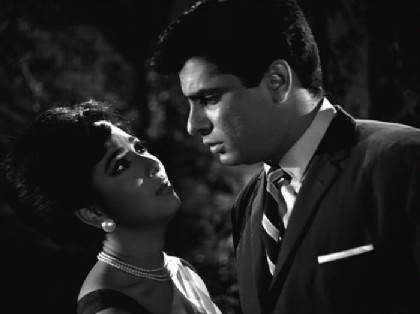
This was what I call a ‘shot in the dark’ film—I noticed it on Induna and decided I’d give it a try, even though I hadn’t heard of it before. The decision was arbitrary, and mainly because the picture of the DVD cover appealed to me. I should probably have had a look at the plot summary on imdb but I didn’t, and ended up with a film that I actually rather liked, even apart from the fact that the lead pair looked yum.

Sanjay Khan and Mala Sinha in Dillagi

Continue reading