Kundan (1955)

Some days ago, in this delightful post about chai in Hindi cinema, I came across a mention of Kundan. Aao hamaare hotal mein chai peeyoji garam-garam sounded so interesting that I bookmarked the film without even really checking to see what it was all about (though the cast, barring Nimmi—whom I often find very irritating—appealed to me). Then, just a couple of days later, Anu posted this wonderful tribute to Sohrab Modi, in which she listed Kundan as one of her favourite ten films directed by Modi. Adapted from Victor Hugo’s classic Les Miserables.

That sealed it. I had read Les Miserables a couple of years ago, and had been blown away by it: by the depth and width of it, the characterization, the sheer scope of it all. And now, it looked as if the universe was pushing me towards Kundan. I had to watch this one.

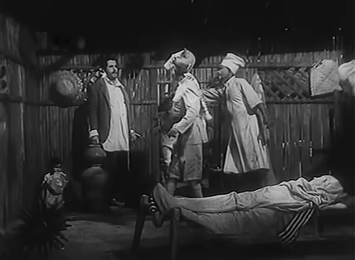
The story gets off to a flying start. Kundan (Sohrab Modi) is a very poor man who lives with his very ill sister and her little daughter Radha. Unable to earn [it’s not clear why, given that he looks able-bodied enough], a desperate Kundan finally steals a loaf of bread from a bakery and runs home to give it to Radha. Since he’s made no attempt to commit this theft in secrecy, the alarm has been raised and Kundan is arrested even as Radha is eating the loaf.

Continue reading

Police (1958)

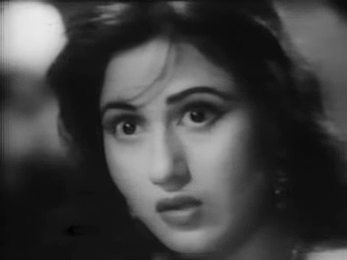
If you’ve been reading this blog some years, you probably know by now that I am a fan of Madhubala’s. I’ve watched most of her films (several of which I have not got around to reviewing on this blog), I’ve done lists of my favourite songs of hers, and I have waxed eloquent every now and then about how much I like her.

One of the things I dislike about much of the online (at least) raving about Madhubala is that the praise is invariably just about her beauty. How gorgeous, how exquisite. Yes, indeed; but Madhubala’s beauty, I think, often comes in the way of people appreciating what a good actress she was, too. Watch her performances in films like Mughal-e-Azam and Amar, for instance, and if you can look past her face, you will see how well she holds her own against heavyweight thespians like Dilip Kumar and Prithviraj Kapoor.

And she was a fantastic comedienne too. The madcap way she matches Kishore Kumar in Chalti ka Naam Gaadi, for example. Or her airhead character in Mr & Mrs 55. Interestingly, Madhubala is often compared to Marilyn Monroe, almost entirely on the basis of their beauty and popularity; but I think the two stars had one more thing in common: both could portray the ditzy beauty very well. This, in fact, is just the type of woman Manju, of Police, is: nutty, silly, a clown. But so endearing too (and, it goes without saying, so gorgeous).

Continue reading

Howrah Bridge (1958)

Aaiye meherbaan baithiye jaan-e-jaan, and Mera naam Chin Chin Choo. Two great actresses, two iconic songs.

When I was doing the Helen tributes last month, I was reminded of Mera naam Chin Chin Choo all over again—and remembered, too, that I had never reviewed Howrah Bridge on this blog. It has also been many years since I last watched the film (before I launched Dusted Off), so I decided it was high time I revisited this.

Howrah Bridge begins very far from the bridge, and in fact from Kolkata: in Rangoon, where Prem Kumar (Ashok Kumar) finds his father (Brahm Bhardwaj) in a flap. Daddy is distraught because Prem’s elder brother Madan (Chaman Puri, in a cameo role) has run off from home, taking with him an invaluable family heirloom, a dragon which has been in the family for generations. We later discover that the dragon was crafted in China many centuries ago, and from there came to be owned by the king of Burma, after which it passed into the possession of Prem’s family.

Continue reading

Lahore (1949)

I’d been meaning to watch this film for a while now, because there’s a family history related to Lahore.

My uncle David Vernon Liddle ‘Verni’, as some of you may know, was a guitarist in Hindi cinema (this guest post, written by my father, Verni’s younger brother, is all about him). In 1947, Verni—then very young, no more than 16 years of age, but already an accomplished musician and making inroads into the Hindi film industry—was in Lahore and recording the songs for Lahore. Partition happened, and of course, there was so much violence and chaos that Verni had to flee Lahore and head eastwards into India. En route, during his travels, he ended up losing his sole pair of chappals and for quite a few days wandered about barefoot. Once he landed up in Punjab, he was able to make his way to some relatives in Ludhiana, and an aunt finally gave him a new pair of slippers! Verni also spent some time right after he came into Indian Punjab, working at a langar in a camp. The camp included Muslims and Sikhs, and Verni, being a Christian, was one of the few who was therefore not regarded with suspicion by anyone. This was what got him a job (sort of) serving food at the camp.

I am not sure about the story behind how Lahore came to be made. Since the music of most films back then used to be recorded before the film itself was completed, it’s possible that the songs of Lahore (written by Rajinder Krishan and composed by Shyam Sundar) had been readied even before filming began. As it is, it’s not as if the songs are very specific to this film or any particular scenarios; they are ‘generic’ love songs and sad songs, which could be fitted in pretty much anywhere in the average 50s or 60s film. It may just be that the real story of Lahore, of Partition disrupting a romance and a family, evolved somewhere in the course of time before, during and just after Partition.

So, this was a film I wanted to watch.

Sadly, I could find only one copy online (on the SEPL YouTube channel, never one I am happy to view films on because they have zero QA). This version turned out to be a mess: not only were there scenes arbitrarily chopped off, midway through the film, the sequence of the reels went for a toss too, so the chronology was all haywire.

This review, therefore, will be a little different from my usual style. What follows is not as detailed a synopsis as I usually provide, and it includes most of the film, so be aware that there are

Some spoilers ahead.

The story is set in Lahore, where Chaman (Karan Dewan) and Leelo (Nargis) are neighbours as well as collegemates, and sweethearts. Their love story is known and approved by their respective families. Leelo only has her mother (?), but Chaman lives with a fairly large family.

Continue reading

Bhabhi ki Chudiyaan (1961)

Some days back, a blog reader wrote to me (after having recommended several Hollywood films over the past weeks) to tell me that I was ‘wasting my time’ watching and reviewing ‘silly Indian films’.

I was initially too furious to be able to respond, but I eventually wrote back to say how unjustified and insulting this comment was. This, after all, is my blog. Nobody— not my family, not my friends, not the people who might be considered to have some sort of say—tells me what to watch. Recommendations, requests: more than welcome. Judgemental and rude remarks, no. You do not govern how I spend my time.

Once I simmered down a bit, I decided this called for a tribute to ‘silly Indian films’. So, for the duration of August 2022, I’m only going to be focusing on Indian cinema. Not one film from outside India is going to feature on Dustedoff all through this month.

So, to kick off ‘Silly Indian Film Month’, a review of a film I’ve been meaning to watch for a long time now.

Bhabhi ki Chudiyaan begins by introducing us to Mohan (Master Aziz), who lives with his elder brother Shyam (Balraj Sahni). Shyam and Mohan only have each other for family; their mother died giving birth to Mohan, and their father died a few months later. On his deathbed, he entrusted to Shyam the care and bringing up of Mohan. Shyam works as a clerk, and in order to be able to focus on Mohan’s education and upbringing, hasn’t even married. The two brothers somehow make do, but on days such as this—when Shyam has been too busy to make it to Mohan’s school function, where Mohan is getting various prizes—there is angst. Mohan is annoyed and tearful.

Continue reading

Sadhu aur Shaitan (1968)

Cinema looking at itself is not an uncommon feature; there have been several notable films, both in India (Kaagaz ke Phool, Sone ki Chidiya) as well as abroad (Cinema Paradiso, 8½, The Bad and the Beautiful, etc), which are about cinema and film-making. But this film, relatively obscure, really should be part of the annals, simply because of its sheer devotion to Hindi cinema. Not because it’s about film-making, not because there is even (as in Solvaan Saal), a single scene on the sets of a film. But because it celebrates Hindi cinema in so many ways, on so many levels.

Sadhu aur Shaitan begins by introducing us to the eponymous ‘sadhu’ of the story: Sadhuram (Om Prakash), a widower who lives with his two children Ganesh (Master Shahid) and Munni (Baby Fauzia), and the maid Ramdeyi (Dulari) who looks after home and the children. Sadhuram is a somewhat excessively ‘good and righteous’ man, the living image of piety (all a little over the top as far as I’m concerned, but at least he isn’t stuffy about his righteousness).

Continue reading

Zindagi ya Toofaan (1958)

After many years of telling myself I should read Mirza Hadi ‘Ruswa’s Umrao Jaan Ada, I finally got around to reading a Hindi translation a couple of weeks back. This turned out to be an underwhelming experience (more details here, on my Goodreads review of the book), but it impelled me to read a synopsis of Umrao Jaan Ada. I ended up reading, too, about the screen adaptations of the book (which is regarded by many as the first Urdu novel), and was surprised to discover that, besides the Rekha-starrer and the (much later) Aishwarya Rai-starrer, there were two other films, both released in 1958, based on Umrao Jaan Ada. One was Mehendi; the other was Zindagi ya Toofaan. I haven’t got around to watching Mehendi yet, but the fact that one of my favourite actresses of the 50s, Nutan, starred in Zindagi ya Toofaan, made me eager to watch this one.

Continue reading

Doli (1969)

The Hindi film industry has always been an upholder of patriarchy. Its male stars attract ridiculously high prices in comparison to their female colleagues, and have disproportionately longer careers than them (plus a much longer time as leads). Sexism is rampant, ranging all the way from sexual discrimination to violence. And, though more women directors, scriptwriters, lyricists etc are around now, it’s still pretty much a male-dominated industry.

Hardly surprising, then, that most of our films tend to look at things (at best) from a male point of view. At worst, they uphold patriarchy in its most virulent forms, reducing women to a cypher, expected to devote their lives to the service of men. Ever-forgiving Sati Savitris, wrapped in saris and simpering prettily every time their lord and master deigns to be kind. Or unkind, it doesn’t matter; he is still her devta.

Doli is one such film, steeped in patriarchy and regressive in the extreme.

It begins in a college, where Amar (Rajesh Khanna) and Prem (Prem Chopra) have just graduated. Amar is the star athlete, Prem the star pupil who has topped the college and won a scholarship for higher studies in America. Later, in their dorm, both Prem and Amar receive letters from home, informing them that their weddings have been fixed. On the same day, in the same town, Nasik. Neither of them is happy about this, but Prem, having known already that a match had been found for him, is rather more resigned.

Continue reading

Miss Mary (1957)

This film has been on my watchlist for a long time now. Earlier this year, when I reviewed the delightful Maya Bazaar, my attention was drawn to Miss Mary, because—like Maya Bazaar—this was a film that was originally made in Tamil and Telugu (as Missiamma/Missamma) and, in this case, then into Hindi too. I was already aware that the film had some lovely songs, and Meena Kumari in a light-hearted role is always a pleasure to watch.

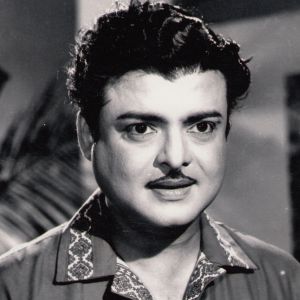
Plus, it stars Gemini Ganesan, whose birth centenary it is today. He was born on November 16, 1919, into a distinguished family that included his aunt Muthulakshmi Reddi, a much-respected social reformer who was instrumental in passing the Devadasi Abolition Act. Thanks to Muthulakshmi, Ganesan was enrolled at Ramakrishna Mission Home, and acquired a fairly strong ‘classical’ education here, including Sanskrit, the Vedas and Upanishads, and yoga. As an adult, though, Ganesan’s career graph was rather more eccentric: he harboured dreams of becoming a doctor, attempted to join the Indian Air Force, and ended up teaching chemistry at Madras Christian College. In 1947, a job at Gemini Studios (from which Ganesan drew his screen name) led him to receive a casting offer from the studio—and Gemini Ganesan’s acting career was launched.

Gemini Ganesan, b Nov 16,1919

Continue reading

Gateway of India (1957)

Hindi cinema has a tendency towards stories that stretch over long periods of time. Days, at the least, but often months, often many years too (that old trope of children growing up has been a part of too many films to name). It is the unusual film, especially in the 50s and 60s, that extends over just a few hours. Solvaa Saal was one such; Gateway of India is another. Both films are about runaway girls who meet the loves of their lives in the course of one night. That, though, is where the resemblance stops.

Continue reading