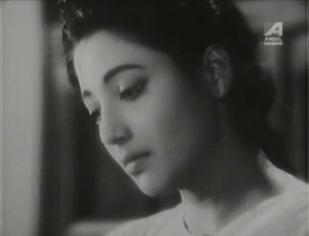
Ekti Raat (1956)

This, actually, was not the film review I was intending to post this week. But then, over the weekend gone by, I met Moon Moon Sen, and I was reminded (of course I would be!) of her mother, Suchitra Sen.

I was in Dehradun on October 11 and 12, attending an arts and literature festival. The guest of honour was Moon Moon Sen, still beautiful, and with a serene calmness to her that was—as someone mentioned—very ‘peaceful’ (to which Ms Sen replied that she has a horrible temper!) Moon Moon Sen was mostly involved in graciously felicitating those who participated in panel discussions and so on; I was thrilled to have her place a scarf around my neck. But the last session of the festival was a conversation with her, and it was very interesting. She answered questions about herself, of course, but also about her mother (“always, ‘Madam’, never ‘Mrs Sen’ or ‘Suchitra’” she recalled). Not just a star, but a mother (“I only knew her as Mummy”), and one whom young Moon Moon was obviously very protective about: she said she shielded her mother when Suchitra Sen had to make her way through a crowd. She had no qualms even about punching anyone who tried to get fresh with her Mummy.

I remembered, then, that I had a Suchitra Sen film review ready to be published. Here it is, a light-hearted comedy, directed by Chitta Bose, based on a story by Balaichand Mukherjee ‘Banaphool’ and with a screenplay by Nipendrakrishna Chatterjee.

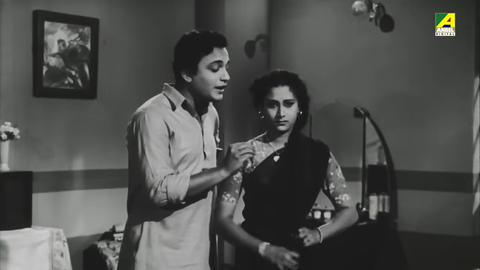
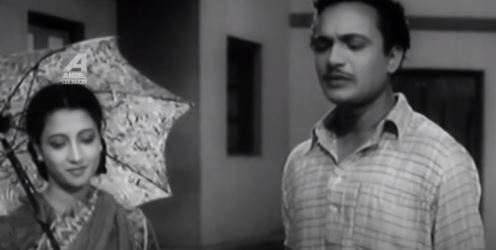
The story begins in the Calcutta home of Shushubhon Dutta (Uttam Kumar) and his wife Anita (Sabita Chatterjee), who have been married a few months. The two are constantly bickering, and we see them in the middle of an argument even as the film starts. Anita is hot-tempered, Shushubhon likes to needle her.
Continue reading

Shaarey Chuattar (1953)

Bengali cinema is one of the few regional language cinema industries for which it’s relatively easy to find subtitled copies. Even when the film in question is an old one.

Over the years, several Bengali readers have recommended Shaarey Chuattar to me. I had been under the impression that I should watch this film for the Uttam Kumar-Suchitra Sen pairing (it was the their first film together, the first of many films in which they were co-stars). But, now that I’ve seen it, I can safely say that this is a film you should watch not for these two, but for the film itself. True, Suchitra Sen and Uttam Kumar provide some eye candy and are a likable romantic couple, but the romance in Shaarey Chuattar is not the main thing.

Continue reading

Sagarika (1956)

Every now and then, when I’ve reviewed a Hindi film (Mamta, Sahib Bibi aur Ghulam, Kabuliwaalah, Khamoshi) or even mentioned one (Devdas, Chori Chori), someone or the other has popped up and either informed me (or reminded me) that this film was originally made in Bengali.

It was a little different with Sagarika. This film nobody told me about. I happened to be trawling IMDB checking out the synopses of all of Suchitra Sen and Uttam Kumar’s films, and realized—even as I read the plot of Sagarika—that this was exactly the same story as one of my favourite Hindi films, Bimal Roy’s lovely Prem Patra. Could I resist the temptation to watch it? No.

Uttam Kumar and Suchitra Sen in Sagarika Continue reading

Mamta (1966)

While watching Pakeezah some months back (and reading Meghnad Desai’s book about the film), I was struck by how fond old Hindi cinema used to be of the motif of the ‘chaste tawaif’. A paradox, seemingly, because how could a woman be a tawaif – a prostitute, to put it bluntly – and be chaste? But films like Pakeezah and Adalat did just that: they portrayed women who lived in kothas, sang (in Adalat) and danced (in Pakeezah) but were ‘good’ women, chaste and pure, women who may have been lusted after by bad men, but who – thanks to fate, good friends and relatives, kind strangers (both human and animal) – were always able to avoid the fate worse than death: of yielding their chastity to a man they were not married to, or weren’t going to eventually marry, even if only in secret.

Suchitra Sen as Devyani/Panna Bai in Mamta Continue reading

Deep Jwele Jaai (1959)

It’s sad that, over the past year or so, barely a month has passed without my having to post a tribute to yet another film personality who’s passed on. Last month, with Eleanor Parker, Joan Fontaine and Peter O’Toole passing away within days of each other, I thought it couldn’t get worse. And I hoped that 2014 would be better.

But, alas. We say goodbye to yet another luminary of the film world. This time, the beautiful and very talented (not to mention wildly popular) Suchitra Sen (April 6, 1931-January 17, 2014), who made a mark in Hindi cinema even in the few films she acted in (Bombai ka Babu, Devdas, Mamta and Aandhi being the best-known), but ruled Bengali cinema.

Suchitra Sen Continue reading

Chaowa-Pawa (1959)

Serendipity: noun. plural: serendipities. The faculty of making fortunate discoveries by accident; the occurrence of such a discovery. Coined by Horace Walpole in 1754, based on a fairy tale called The Three Princes of Serendib (‘Serendib’ being present-day Sri Lanka)—the three princes in question often making such lucky discoveries.

And what does this have to do with Chaowa-Pawa (‘To Want and To Have’)? Simply that, while I had set about watching this film because I really, really like the lead pair—Uttam Kumar and Suchitra Sen—I realized, within the first half hour of the film, that it was a remake of one of my favourite old Hindi films, Chori-Chori (which, as many of you would know, was a remake of It Happened One Night). Serendipity? Absolutely.

Uttam Kumar and Suchitra Sen in Chaowa-Pawa

Continue reading

Agni Pariksha (1954)

Or Ogni Porikkha, if you want to be phonetically correct.

Over the last twenty-odd years, I’ve heard countless Bengalis rave about Uttam Kumar and Suchitra Sen as the ultimate onscreen romantic couple. I’ve seen both of them act (separately) in a few (admittedly Hindi) films, and have been very impressed.
So, finally: an Uttam Kumar-Suchitra Sen film, and one that was a big hit too. Agni Pariksha: ‘trial by fire’.

Continue reading

Bombai ka Babu (1960)

Much as I do not like like Dev Anand in his post-60’s avatar (the too-black hair, the bandanna and the cap don’t make him look any younger; they just bash home the fact that he’s aging most disgracefully)—I do like him in a lot of the films he did in the 50’s and early 60’s. There are some great suspense films here (CID, Baat ek Raat ki, Kaala Paani, Jewel Thief) and some great drama/thriller/romance/whatever (Jaal, Hum Dono, Paying Guest, Solvaan Saal, Guide, the very unusual Ferry)—and this, a simple story of a thief who finds himself impersonating the long-lost son of a village zamindar.

Continue reading