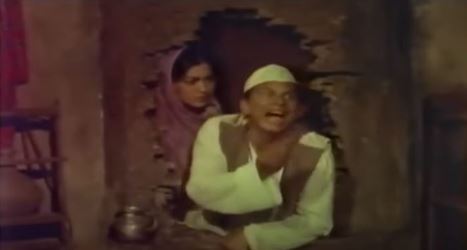
Thana Theke Aschi (1965)

When I reviewed An Inspector Calls a couple of weeks back, blog reader AS, in a comment, mentioned that a Bengali version of the film (or rather of the play by JB Priestly, on which it was based) was also made, starring Uttam Kumar: Thana Theke Aschi. This was a film that had been recommended to me earlier as well, so I had it bookmarked; but I hadn’t known it was a version of An Inspector Calls.

Now, fresh from my viewing of (and gushing over) An Inspector Calls, I decided I had to watch Thana Theke Aschi while the story was still fresh in my mind.

The story begins with a brief glimpse of a faceless woman, lying dead on the floor of a dingy little hut, an empty bottle of carbolic acid near her hand. The corpse is found by another woman, who starts to scream.

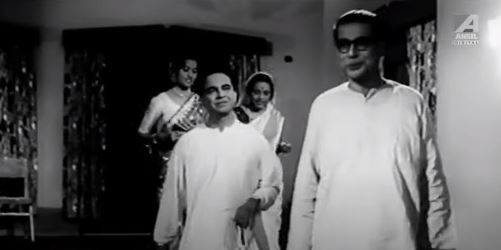
The scene then shifts to the home of the wealthy Chandramadhav Sen (Kamal Mitra), where an engagement party is in full swing. Mr Sen’s daughter Sheila (Anjana Bhowmick) has just gotten betrothed to Amiya (?), the son of one of Mr Sen’s business associates. It’s a grand party, and once it’s over, Amiya stays on, chatting with the Sens.
Continue reading

In Memoriam: Lata Mangeshkar – My Favourite Solos with Ten Composers

The ‘Nightingale of India’ is no more. Lata Mangeshkar, aged 92, passed away on February 6.

What can be said about Lata that has not already been said? That she was a singer par excellence, that there was never quite anyone else like her? That the sheer volume of her work, in so many languages, across so many years, coupled with the quality of her work, sets her apart from not just her contemporaries, but also those that have followed? That there is unlikely to ever be any other singer (at least female singer) who will be able to match Lata Mangeshkar?

I will not repeat what others, including bloggers like Anu and AK have already so beautifully expressed by way of tribute; let it suffice that for me, too, Lata’s voice was an intrinsic part of growing up, of life itself.

Continue reading

An Inspector Calls (1954)

…at the home of the wealthy and respectable Birling family, just as they finish dinner.

The Birlings have been dining with a guest: Gerald Croft (Brian Worth) has just got engaged to the daughter of the house, Sheila Birling (Eileen Moore). Gerald has got her a wonderful ring, and there’s been much love and affection and congratulations being showered all around.

Continue reading

Nastik (1954)

A hundred years ago, on January 27, 1922, in Golconda (Hyderabad) was born Hamid Ali Khan, known to thousands of Hindi film viewers (and, even thousands more who have perhaps never watched any of his films) as Ajit. The man of ‘saara shahar mujhe loin ke naam se jaanta hai’. The iconic villain, suave and eerily soft-spoken though at the same time very oily and dangerous, of films like Zanjeer, Yaadon ki Baaraat, and Kalicharan. The baas of Raabert and Lilly (who was constantly being told not to be silly).

But long before he became the stuff of really bad jokes, before he attained the stature of one of Hindi cinema’s greatest onscreen villains, Ajit was a hero. Coming to Bombay in the face of parental opposition (having first sold his college books to finance the trip), Ajit had to struggle a lot to find work in the cinema industry. He began as an extra, and worked in several films until being noticed by the Gujarati-Hindi director Nanabhai Bhatt (Mahesh Bhatt’s father) who not only gave him the screen name Ajit, but also launched him in a leading role. Across the 50s and 60s, Ajit acted in a slew of films, both as leading man (Nastik, Dholak, Baradari, Marine Drive, Tower House, Opera House, etc) as well as in major supporting roles (of special note here are Naya Daur and Mughal-e-Azam, in both of which he appeared alongside Dilip Kumar).

Continue reading

Guest Post: The Unsung Villains of Yesteryears, by Balaji Vittal

Balaji Vittal has written several books along with Anirudha Bhattacharjee. I’d read and enjoyed their biographies of SD Burman and RD Burman, as well as their collection of top songs, Gaata Rahe Mera Dil; so when Balaji Vittal wrote to me informing me about the publication of his first solo foray into cinema writing, I was intrigued—especially as the premise of Vittal’s book sounded thoroughly entertaining. Pure Evil: The Bad Men of Bollywood explores the villains of Hindi cinema. From dacoits to smugglers to mafia dons and gangsters, from serial killers to terrorists and traitors, to small-time crooks, evil relatives, adulterous spouses, even anti-heroes: they’re all here, described in detail.

Pure Evil isn’t a book that fits completely into the time line of my blog, since a good deal of its focus ends up being on more recent cinema than Dustedoff restricts itself to. While I haven’t reviewed the book here, you can read a fairly detailed review I wrote on Goodreads, here.

And, while we’re on the topic, a piece Balaji Vittal wrote specifically to feature here as a guest post. On the unsung villains of the Hindi cinema of the 40s and 50s: nasty characters who were a little offbeat as far as villains went, in the films they featured in.

Continue reading

To Sir, With Love (1967)

RIP, Sidney Poitier.

When I heard the news of Sidney Poitier’s death (on January 6th, 2022), one of the first thoughts that came to me was: what a sad coincidence, that the last English-language film I’d reviewed on this blog was one of his (The Bedford Incident). Then, the realization that, in so many years of blogging, while I’ve watched and/or reviewed several films of Poitier’s (including the wonderful Lilies of the Field, for which he won an Academy Award; The Long Ships; The Defiant Ones), I’ve never seen a few of his most iconic films, such as In The Heat of the Night, Guess Who’s Coming to Dinner, and A Raisin in The Sun.

I will watch those sometime, sooner or later; but for now, to commemorate the life and career of one of my favourite actors, I decided to rewatch a film I haven’t seen in several decades. The film that’s probably the one with which most Indians (at least) associate Poitier, about a school teacher who manages to change the lives of the disturbed and insecure students he has to teach.

Continue reading

Ten of my favourite devotional songs

I made my first song list pretty soon after I started blogging. And once my blog began drawing some readers, I also began getting requests for themes for song lists. One theme (along with lullabies) that several people have requested over the years but which I’ve not yet been able to compile—till now, that is—has been that of the devotional song. The bhajan.

Mostly, I steered away from handling this theme because the most common and most popular bhajans just didn’t float my boat: I invariably found them too screechy and shrill. But as time has passed and I’ve been exposed to more devotional songs from the films of the 50s and 60s (in particular), I’ve realized that there are many bhajans that I do like. So, finally, a post. A list of ten devotional songs that I especially like. As always, these are from pre-1970s Hindi films that I’ve watched.

Continue reading

The Bedford Incident (1965)

In my younger days, I used to watch a lot of war films: not the newer, more gory and violent ones, but the older, not so graphic type. My favourites were adventure films like Where Eagles Dare, though somewhere down the line I also developed a liking for more nuanced films, films like Battleground or Paths of Glory or La Grande Guerra, which showed the harsh reality of war, of the horror it is to go into battle, to fight a war plotted out by people sitting in a conference room far away…

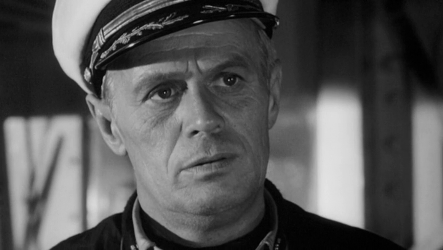
The Bedford Incident is different. The people sitting in a distant conference room are there all right, but the real problem here seems to be not them, but the man who commands the USS Bedford. Captain Eric Finlander (Richard Widmark) is a hard, embittered man who gives no quarter. 

Continue reading

Aakhri Dao (1958)

This was one film where I had a tough time making up my mind: should I review it? Should I not? It’s not a great film, but it’s not absolutely abysmal either. And it has a luminously lovely Nutan, plus some superb songs (courtesy Madan Mohan and Majrooh Sultanpuri) to compensate for other drawbacks in the film. It’s also a film about a murder (as macabre as that may sound, always something that catches my attention).

If for nothing else, as an example of a film that could have been pretty good but ends up a damp squib, this, I decided, was worth reviewing.

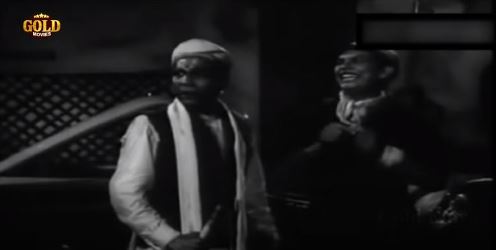
The story centres round Raj Kumar Saxena ‘Raju’ (Shekhar), a mechanic who works in a garage, and lives in a tiny room above the garage along with his friend and colleague Popat (Johnny Walker). Popat has been having a chat with a wealthy customer, Muthuswami Chetiyar (Mirajkar) and is keen on getting Muthuswami to invest in a garage for Popat. The incentive Popat offers is a match for Muthuswami’s daughter: Raju, he says, will be a fine bridegroom. Because he guesses Muthuswami will not be eager to marry his daughter to a mechanic, Popat takes care not to let on that the groom he has in mind is that figure hunched over a car at the other end of the garage…

Continue reading