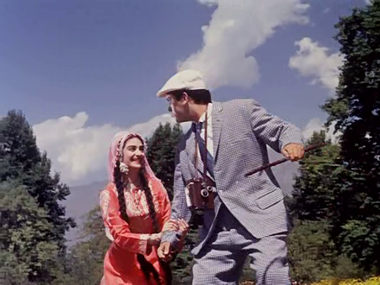
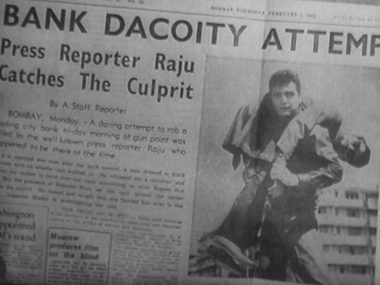
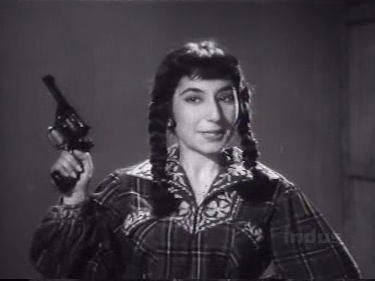
This post is two weeks late. Late, because it’s a tribute to the actress Kalpana, who passed away on January 4 this year. I didn’t get to know about her death till the 8th, and then – though I did want to do a tribute post – I couldn’t think of a film I hadn’t reviewed, and liked well enough to want to review. (Two of my favourite films – Professor and Pyaar Kiye Jaa – starred Kalpana, but I’ve already reviewed them. And other Kalpana films I’ve seen include Naughty Boy and Saheli – both of which I found almost impossible to sit through). Last weekend, in desperation, I watched Teesra Kaun, thinking I’d review that; but that was a disappointment too. So, finally: an old classic. Not a great film, but very pretty. And a good Kalpana showcase.
Category Archives: Dusted Off
Maya (1961)
A wealthy young man strikes out on his own to see how the rest of the world lives. He pretends to be poor, goes to live in a community of poor people, and falls in love with a poor girl who doesn’t realise he’s a wealthy man. Starring Dev Anand as the protagonist.
Asli-Naqli? No. Interestingly, not. This was Maya, made just a year before Asli-Naqli, but with a very similar storyline.
The 7th Voyage of Sinbad (1958)
Ever since I began this blog, I’ve maintained one annual tradition: on my birthday, I post a review of a film featuring a film personality who shares my birthday. I’ve reviewed Ittefaq (starring Nanda); Wild in the Country (starring Elvis Presley) and Baghdad ka Jaadoo (with Fearless Nadia). This time, it’s back to Baghdad – with Kerwin Matthews, who, like me, was born on the 8th of January. The 7th Voyage of Sinbad is typical Kerwin Matthews fare: he gets to swing a sword, battle an array of fearsome (sometimes unintentionally hilarious) monsters, and generally be the man who wins the day for the good guys.
Taj Mahal (1963)
I ended up re-watching this film in a roundabout sort of way, which is a story in itself. A few months back, my sister (a historian, whose PhD was on 19th century Delhi) remarked, “I’d like to watch Lal Qila. I’ve never been able to find it in stores.” So, good little sister that I am (and a shameless opportunist), I figured out at least one of the things I’d gift my sister for Christmas.
Before gift-wrapping the VCD, I decided to watch Lal Qila, and write up a review right after. The latter didn’t happen – because Lal Qila is so badly written, so badly directed, and such a crashing bore, I couldn’t make head or tail of it most of the time. Only Rafi’s superb renditions of Bahadur Shah Zafar’s poetry – especially Na kisi ki aankh ka noor hoon – are a saving grace.
I was so peeved and disappointed after Lal Qila, that I needed this to buoy myself up. In any case, I told myself: logically, the two films are related (other than the fact that both feature Helen): the Lal Qila and the Taj Mahal were both built by Shahjahan.
Here we go, then. One of Hindi cinema’s better historicals, with a stellar cast and very good music.
Book Review: Sidharth Bhatia’s Cinema Modern: The Navketan Story
A few days back, an editor from The Indian Express phoned to ask me if I’d like to review a book for them. Which book? Sidharth Bhatia’s Cinema Modern: The Navketan Story. Too mouthwatering an opportunity to miss, I decided, even though I already had a lot of work to get done. But here it is. You can read the final version (more concise, shorter, perhaps a bit less irreverent) here. And here, right after this sentence, is my first draft: longer, more full of trivia, a little more loony, and (of course!) with some screenshots.
Paths of Glory (1957)
We’ve been on a spate of tributes all this month. First, it was a farewell for Dev Anand, the man who embodied ‘leading man’ for so many Indians across generations. Then, there were birthdays – for the ‘hunkiest of them all’, Dharmendra, and then for one of Hindi cinema’s greatest thespians, Dilip Kumar. Somewhere amidst all those tributes, another great birthday got left out. Kirk Douglas turned 95 on December 9, 2011. So, here’s wishing Mr Douglas a (rather belated) happy birthday, and here’s looking at one of his best-known films.
Dev Anand in Ten Moods
As teenagers, my friends and I were unanimous about one thing: there was no beating Shammi Kapoor and Dev Anand as the most watchable stars. Not that they were then in their prime; this was in the very late 80s, but as far as my pals and I were concerned, Hindi film heroes stopped being interesting somewhere in the 60s. Both Shammi Kapoor and Dev Anand were all we starry-eyed sahelis could’ve hoped for: utterly handsome, always in films that were generally happy (we conveniently forgot Guide), and always singing the most awesome songs.
We weren’t mature enough then to appreciate that Dev Anand was actually also a good actor, who could switch from melancholy to philosophy, tapori to suave gentleman, in a jiffy.
Ten of my favourite saheli songs
(And a very brief tribute to Dev Anand, 1923-2011).
This is the second of my ‘prize posts’ for the Classic Bollywood Quiz. The first of these posts was dedicated to Karthik, who’d once suggested I do a list of lesser-known composers. This post is dedicated to Anoushka Dave, our overall winner. Anoushka, whose prize included a signed copy of my latest book, also got the chance to tell me which post she’d like me to do: which film to review, or which list to come up with. Anoushka suggested this one: ten saheli characters, or ten saheli songs.
This was, for me, a very unusual (and interesting) challenge, because I’d never really thought of it. Some pondering, and I realised that while Hindi cinema makes a huge deal about a bromance, the female equivalent of it has been largely pushed into the background. Offhand, I could think of only one film (the forgettable Saheli, starring Kalpana and Vijaya Choudhary) that focused on girl friends. But songs? Yes, with some effort (a lot of it, actually), I could draw up a list of ten songs that featured sahelis, at work, at play, at general saheli-ness.
High Noon (1952)
I was – at least as far as emotional maturity is concerned – a baby when I first saw High Noon, and I didn’t care for it much then. Not that I wasn’t fond of Westerns; I adored Westerns. In book form, in cinema, in song. For me, the genre was all that was gloriously outdoorsy and never-say-die: cowboys and Comanche, Monument Valley, smoking barrels and rearing horses, the good versus the bad in that final gunfight. High Noon turned all of that on its head, and left me feeling uncomfortable and disappointed.
I didn’t realise till much later that that disappointment was not the disappointment of watching a film that was bad. Rather, it was the disappointment of discovering that what I’d been rejoicing in till then was not the ultimate in a genre. Some growing up had happened.
I have rewatched High Noon since then, and I’ve come to appreciate this film deeply. I still do like hard-core Westerns like The Good, the Bad and the Ugly and Stagecoach and The Magnificent Seven a lot – but High Noon is in a class all by itself.
Insaan Jaag Utha (1959)
The main reason I rented this film was that the credits were so absolutely mouthwatering. A cast that included Sunil Dutt, Madhubala, Minoo Mumtaz, Madan Puri and Nishi Kohli. Music by S D Burman. Shakti Samanta as director. A winner, I’d have thought.
Alas, no. While it’s not a dud, Insaan Jaag Utha isn’t more than the sum of its otherwise stellar parts. The story is a mishmash of tropes. It doesn’t seem to know where it’s going, the plot has a lot of holes, and it’s not really too interesting.