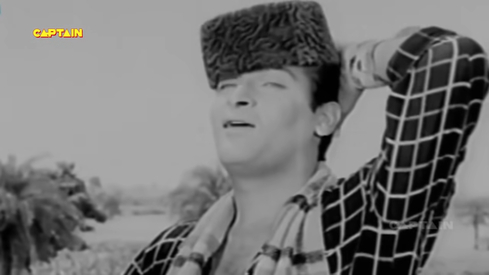
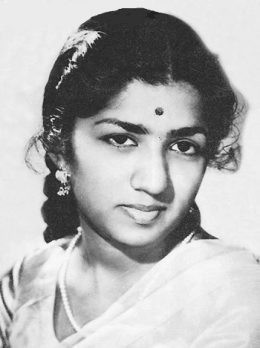
Today is the birth centenary of the ‘King of the Ghazal’, the inimitable Talat Mahmood. Talat was born on February 24, 1924 in Lucknow, and it was in Lucknow itself that he obtained his initial training in music: at the Marris College of Music, where he learnt classical Hindustani music from Pandit SCR Bhatt. By the age of sixteen, Talat was singing the ghazals of Urdu’s foremost poets for All India Radio Lucknow, and was soon taken on by HMV as well. His first introduction to cinema came through the film industry in Calcutta, where he not only sang songs (under the name ‘Tapan Kumar’), but also acted in several films. In 1949, at the age of twenty-five, Talat moved to Bombay, and the rest, of course, is history: he went on to become one of Hindi cinema’s most distinctive voices, and his songs—romantic, filled with pathos, tender, soulful—still live on.
Continue readingCategory Archives: Ten of my favourite…
Ten of my favourite flower songs
Over the years, I’ve done several songs that focus on my love—and, it would seem, the love of some film-makers and lyricists, too—for nature. I have done lists of nature songs; tree songs; and bird songs. Over the years, too, I’ve several times been told I should do a list on flower songs. I’ve always ducked that one, because Harvey, years ago, did a superb post on flower songs, and how I could I possibly hope to even match, let alone excel, a botanist writing about flower songs?!
But over the past couple of years, my interest in flowers has grown exponentially, and while I may not know a hundredth of what Harvey knows, at least I can depend upon my enthusiasm to steer me through. So here goes.
Flowers are, to put it bluntly, the sexual part of a plant. Contained in them are the female and male reproductive organs, plus (often) nectar, to entice pollinators such as bees, butterflies, bats, other insects, small birds, and so on.
Flowers are beautiful, flowers are useful (there would be no fruit without flowers), and human beings have admired and used flowers in a myriad ways since time immemorial. We’ve decorated with them, we’ve used their designs to fashion everything from jewellery to embroidery. We’ve painted and carved them, we’ve celebrated them in literature and in song.
Continue readingHelen and another Actress: Ten Dance Songs
As part of the birthday celebrations of Helen (she turned 85 on November 21st, 2023), another post of Helen songs.
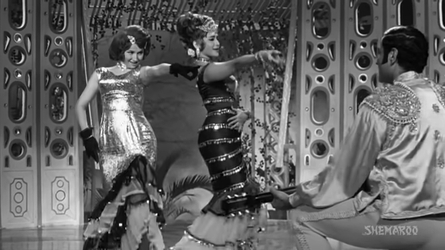
While Helen has shimmied to umpteen songs by herself (or with a band of male dancers in attendance), there are also a fair number of songs where Helen isn’t the only woman dancing. To celebrate my favourite dancer’s 85th birthday, I thought, it would be fun to come up with a list of song-and-dance sequences featuring Helen with another actress.
Continue readingTen of my favourite Helen songs
And, of course, that pretty much implies: Ten of my favourite Helen dances.
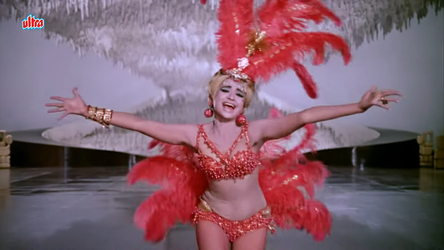
The ‘Queen of the Nautch Girls’ (as a 1973 documentary about her dubbed Helen) turns 85 today: she was born on November 21, 1938, in Yangon. The story of the long journey from Myanmar to Mumbai is not something Helen talks about (she seems to be amazingly reticent; Jerry Pinto, writing about her in The Life and Times of a Bollywood H-Bomb, says that he wasn’t able to get hold of her for even a short interview). But that she entered cinema, courtesy dancing mentor Cuckoo, as a teenager, is well-known. And that she burst upon the firmament of the Hindi silver screen and made it her own is there for everybody to see. From the mid-1950s onward, Helen was to be seen increasingly in Hindi cinema, and with the foot-tapping Mera naam Chin Chin Choo, she rocketed to the top: by the 60s, no commercial film worth its salt could be without a Helen number.
Continue readingDev Anand: Ten Songs, Ten Voices
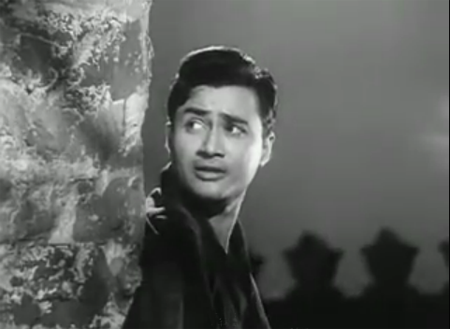
The very first Hindi film song I remember watching was a Dev Anand one. I was nine years old, and the film was CID. The film had already had a couple of songs (Boojh mera kya naav re, Leke pehla-pehla pyaar) that featured him, but when Aankhon hi aankhon mein ishaara ho gaya came on, it cast its spell on me. I was completely bowled over, and from then on, was a starry-eyed Dev Anand fan.
Over the years, as I’ve become older and wiser (more cynical?), the love for Dev Anand has been tempered somewhat. I don’t like the mannerisms, the exaggerated drawl and pout, the puff of hair, and the larger-than-himself persona he took on once he became a superstar. I find him a bit embarrassing in later films, from the 70s onward, where he’s trying desperately to appear much younger than he really was.
But, in his heyday, I think there was nobody to rival Dev Anand in the charisma department: nobody as suave, as charming, as watchable. And, as if that wasn’t all, his films always had great music. About 90% of my favourite songs as a teenager were from Dev Anand’s films. Munimji, CID, Nau Do Gyarah, Guide, Solvaan Saal, Kaala Paani, Kaala Bazaar, Baat ek Raat ki, Teen Deviyaan… one wonderfully entertaining film after another, one great song after another.
Continue readingLata Mangeshkar: Ten Composers, Ten Songs – Part 5
The first post in this series of song lists was posted as a tribute to Lata Mangeshkar when she passed away in early 2022. I had previously posted a song list featuring Lata in Ten Moods, so this time I wanted to be different: to showcase Lata’s work with different music directors. Naturally, given Lata’s oeuvre (even till just 1970, which is my self-imposed cut-off for this blog), that list, with just ten composers included, was far from enough. I ended up doing several more posts in the series, and every time, some reader or the other would comment: “What about so-and-so composer? How about this song?”
Continue readingShailendra in Ten Moods
One of Hindi cinema’s leading lyricists, and a stalwart poet in his own right (I cannot resist wondering if that shouldn’t be “in his own left”, given Shailendra’s socialist leanings!), Shailendra was born on this day a hundred years ago. I have written about him before, in this post to mark an earlier one of his birthdays. But, since I like Shailendra’s poetry so much, I could not let his birth centenary pass without a post dedicated to him. A list of Shailendra’s songs, therefore, that are in ten different moods. And, so that this post isn’t a repeat, even in a small way, of my earlier Shailendra post, none of the songs here are from my earlier post.
Continue readingMukesh in Ten Moods
Today is the birth centenary of one of Hindi film music’s greats: Mukesh Chand Mathur was born on July 22, 1923, in Delhi. In a far too short lifetime (he died in 1976, before his fifty-third birthday) Mukesh sang playback for many of Hindi cinema’s most popular songs. He was Raj Kapoor’s ‘voice’, known and loved not just in India but in countries far and wide, from the Soviet Union to Turkey.
Introduced to the film industry by Motilal, who was a relative, Mukesh’s first hit song ended up being for Motilal himself: Dil jalta hai toh jalne de in Pehli Nazar (1945). He had already debuted four years earlier, with the song Dil hi bujha hua toh from Nirdosh (1941), the film which also marked Mukesh’s debut as an actor.
Continue readingTen of my favourite crooner/club songs
This post has been in the pipeline a long, long time. When I first started this blog way back in November 2008, the very first ‘ten favourites’ song list I compiled was for Madhubala songs—and (unlike what I now do, which is to steer clear of assigning ‘absolute favourite’ status to any particular song), I actually went out on a limb and marked one Madhubala song as my favourite. That was Aaiye meherbaan baithiye jaan-e-jaan. And, even as I was putting that down on my list, I thought to myself: “I must do a list of my favourite crooner and club songs someday.”
Well, here it is, finally. It’s not as if I’ve spent the last many years thinking of this post; but the ‘Crooner Songs’ folder has been there on my laptop all these years, even with some screenshots taken of the songs I knew had to be part of the list.
In any self-respecting, urban-centric film of the 50s and 60s, a club song was almost de rigueur. It would probably be picturized on someone of the likes of Helen, but not necessarily: at times, what was needed was not someone who was a fabulous dancer, but someone who could project the oomph one associated with the club singer.
Continue readingTen of my favourite spooky songs
Some days back, I watched A Shamshir’s Woh Koi Aur Hoga (1967), starring Mumtaz, Feroz Khan, and Sohrab Modi. It turned out to be one of the most incoherent and illogical films I’d ever seen: Sohrab Modi’s character, a professor, is drugged (by Asit Sen in yellowface, a Chinese villain pretending to be the professor’s Indian servant) and made to do the dirty work of the Chinese: that is, inject hapless victims with something that will drain the blood from their bodies. The corpses are then covered with wax and sold off as mannequins to the wealthy gullible who want realistic-looking statues in their homes (and are possibly not averse to the frightful stench).
But, digressions aside: there was also, in the film, Mumtaz. Wearing a shimmery white dress and roaming about the hills at night, singing a sad song. Repeatedly.
Watching Ae raat ke andhere mujhko gale lagaa le, I was reminded of many other songs with a similar premise: a ghostly figure (invariably female), wandering about in the night and singing a signature spooky song. There is often an echo, sometimes other props, something else perhaps to suggest darkness, mystery, ghosts.
Continue reading