Crime and the Hindi film song: Ten examples

I attended an interesting Conference on Crime Fiction at St Stephen’s College, Delhi University, last month (for more on that, click here). During a couple of the less-engrossing sessions, I found my mind wandering a bit – but not too far: only to crime in cinema. And from there, to songs about crime.

Also, over the past several months, I’ve been wracking my brains over what post to dedicate to friend, blog reader, fellow-blogger and participant in the Classic Bollywood Quiz, Raja. For the other prize winners, deciding a post was fairly easy: some had requested particular posts in the past; some had voiced interests in a way that made me fairly sure of what they’d like. But Raja? I was flummoxed.

Then I remembered that Raja, besides sharing my love for old Hindi cinema (and its songs), also has a fantastic sense of humour. And a strong sense of justice, of what’s right and what’s not. This post, therefore, is dedicated to you, Raja. I hope you enjoy it.

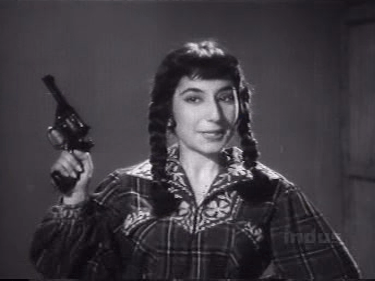
Here it is, then: a list of ten film songs – as always, mostly from pre-70s films that I’ve seen – that talk about crime. To leave no room for doubt, they’re all actions that are illegal under the Indian Penal Code (or Acts of Parliament). And yes – no crimes are repetitions.
Continue reading

Harvey (1950)

No prizes for guessing whom this prize post is dedicated to.

(For those who’re not in the know: I hosted a Classic Bollywood Quiz last year on this blog, and the prizes for that—one for each participant—was a post dedicated to that participant. My friend and fellow blogger Harvey got the Quick Worker Award for the quiz—he had to perforce submit his answers within a couple of days of the quiz being posted, and still managed to get 7 out of 10 right. Impressive).

So: the all-important question. Why am I dedicating this post (about a sweet man whose best friend is an invisible giant rabbit) to Harvey? No, not because I think my pal is nuts. But because Harvey was the one who recommended Harvey to me, and because I found this such an unusual film. And with such an endearing moral to it. Thank you, Harvey. That warmed my soul.

Continue reading

Azaad (1955)

After all the unhappiness over the past week or so – first Ravi’s death, and then Joy Mukherji’s – you’d think the last film I’d want to see would be one that starred the ultimate tragedy couple: Dilip Kumar and Meena Kumari.

But, thanks to Anu, who assured me that Azaad was loads of fun, I decided I should try watching this one. And yes, Anu: I loved it. Loved Meena Kumari’s pretty peppiness. Loved Dilip Kumar at his swashbuckling, handsome, thoroughly attractive self. Loved the smoke rings (almost perfect circles) that Pran blew. Loved Sai and Subbulaxmi’s awesome dancing. Loved C Ramachandra’s fantastic music.

Continue reading

Ten of my favourite Joy Mukherji songs

Because my Ravi tribute was swiftly turning into a Joy Mukherji tribute – and because I thought Joy merited a tribute all his own – I decided to do a Joy Mukherji post. My intention had originally been to review a Joy Mukherji film – until I realised that I’d already reviewed all my favourite Joy starrers.

Joy Mukherji (Feb 24, 1939-Mar 9, 2012) was the son of Shashadhar Mukherji, one of the founders of Filmalaya. Filmalaya, therefore, was the company which launched Joy in the 1960 film Love in Simla (which also marked the debut of Sadhana). Of all the aspiring young actors who tried to emulate the vastly successful Shammi Kapoor in the 60s, the tall and handsome Joy Mukherji was probably the best at projecting some of the effervescence, the joie de vivre, and the sheer attractiveness that made up Shammi’s onscreen persona. Where Shammi danced up a storm with Aaja aaja main hoon pyaar tera, Joy was joy personified with Duniya paagal hai. While Shammi oozed romance with Ae gulbadan ae gulbadan, Joy was tender in O mere shaahekhubaan, seductive in Aa jaa re aa zara aa.

You will be missed, Joy. Sorely.


Continue reading

Ten of my favourite Ravi songs

This was not what I’d planned as my next post. But I learnt this morning that Ravi – the man who composed some wonderful tunes from the 50s and 60s – is no more. He passed away yesterday, the 7th of March, just four days after his 86th birthday. Ravi (born Ravi Shankar Sharma) also had a teeny-weeny link with my family. Like my uncle, he too sang part of the chorus for Vande Mataram!

More importantly, though, Ravi made a name for himself as a composer of songs that ranged from dreamily romantic to peppy, madcap to devotional (Ravi himself learnt how to sing by listening to his father sing bhajans when Ravi was a child).


Continue reading

The Mark of Zorro (1920)

The highlight of last week was—no, not an old film that I watched at home, but a new film that I watched in a cinema theatre. The Artist. A couple of friends, both people with excellent taste in cinema, recommended it to me. So I wheedled my husband into coming to watch The Artist.

And, oh. What a film. What a wonderful combination of humour, emotion, heart-breaking sorrow—and hope. It’s been a long, long time since I saw a new film that made me gush so much. (Yes, well; that probably also had a lot to do with the fact that the gorgeous Jean Dujardin is very gushworthy).


Continue reading

Ten Bits of Trivia from Classic Hindi cinema

This is another of the prize posts for those who participated in the Classic Bollywood Quiz I hosted on this blog last year. I’ve two awards left to ‘hand out’ – (read ‘two more posts to dedicate to readers’) – but this post is dedicated to Neha, whose blog is really niche: it’s a collection of interesting trivia about black-and-white Hindi films. Neha won the Hope Springs Eternal Award in the quiz, simply because she didn’t allow herself to be deterred by the fact that she couldn’t guess more than a handful of the answers. Atta-girl, Neha! That’s the attitude.

Anyway, here goes: a post for Neha. Since Neha’s so keen on trivia, I decided to do something along those lines for her post. Not, unfortunately for Neha, from just black-and-white Hindi films, but at least from pre-70s Hindi films. Just some little snippets that I’ve discovered over the years, and thought were fun.

Continue reading

Body of Evidence: Notes from a Crime Fiction Conference

It is tough being a writer of crime fiction in India. Especially if you happen to write in English.

I have actually had other writers – of more ‘literary’ fiction, generally – look at me with faintly raised eyebrows, as if wondering if I’ll be able to respond intelligently, should they condescend to address a few sentences to me. I’ve had readers ask, “Since you’ve done so much research, why don’t you use it to write something constructive? Like a book on what India might have been like if Dara Shukoh, instead of Aurangzeb, had succeeded Shahjahan?”

(That reader actually added that crime fiction, after all, was a ‘hobby’).

So it is a very refreshing change to be part of something that doesn’t tolerate crime fiction, it celebrates it.

Continue reading

The 300 Spartans (1962)

This is the 300th post on this blog. A landmark for me, which I decided to celebrate with a film about 300-something.

The 300 Spartans is based on a real-life incident, the Battle of Thermopylae in about 480 BC, when a handful of Spartan warriors led by King Leonidas, faced up to the invading army of the Persian king Xerxes. The film begins just as the vast armies of Xerxes (David Farrar) are pouring into Greece.

Continue reading

Ten of my favourite Hindi film ghazals

This is another of my ‘prize posts’, dedicated to one of the people who participated in the Classic Bollywood Quiz I hosted on this blog last year. One of the quiz questions was a toughie that no-one was able to answer: Which was Sahir Ludhianvi’s first ghazal to be recorded in Hindi cinema? I did provide one clue: the operative word is ‘ghazal’.

This post therefore is dedicated to Ravi Kumar, the only person who guessed which song I was referring to, though since his guess came in the wake of his submission, it didn’t count. The song was Tadbeer se bigdi hui taqdeer bana le, from Baazi (1951) – a song which is, in my opinion, a good example of what a ghazal is and isn’t. No, it’s not defined by its music – so, it needn’t be slow and soulful; it can be fast-paced and peppy. What does define a ghazal are its lyrics: rather, its structure and its rhyme scheme.

Continue reading