Kab? Kyon? Aur Kahaan? (1970)

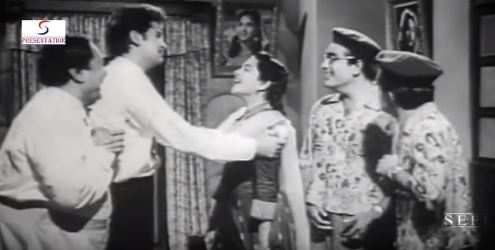
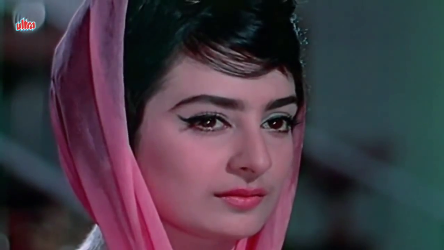
If you’ve been reading this blog for a while, you’ve probably realized by now that I’m a sucker for suspense films. And that I have a soft spot for Dharmendra. And Helen. And Pran. Bring all of those together, and I’m pretty much willing to give it a try. Kab? Kyon? Aur Kahaan? is a film I’d watched many years ago, and liked, so I decided it was time for a rewatch [especially since I’d forgotten pretty much everything of it except for one very taut and tense section]. As it turned out, this was one of those films that make me realize how much more forgiving I was in my younger days. I’d forgotten, for instance, how Babita’s eyebrows managed to give Dharmendra’s a run for their money in the bushiness department.

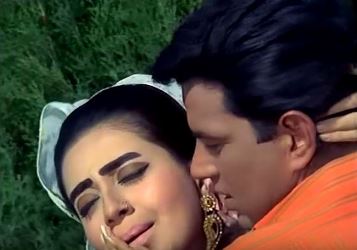
Babita and Dharmendra in Kab? Kyon? Aur Kahaan?

Continue reading

Oonche Log (1965)

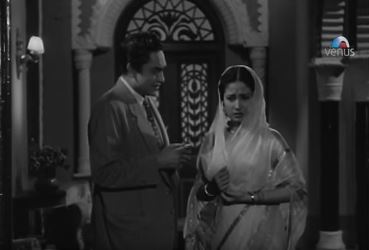
A scene near the beginning of Oonche Log is an interesting revelation of some of the themes that govern the film, and eventually have a bearing on its climax.

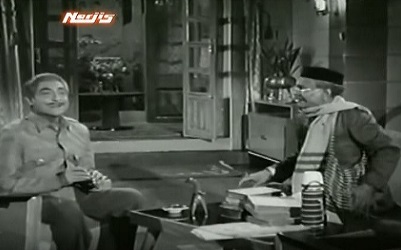
Major Chandrakant (Ashok Kumar) is a blind, widowed ex-officer of the Indian National Army. He now lives in Ooty. One evening, he receives at his home a friend, the school teacher Dhuni Chand (Kanhaiyyalal). There are more dissimilarities than similarities between the two men: Dhuni Chand is poor, barely managing to make ends meet on his salary and what he makes from the odd tuition, while the major is comfortably off, spending his time writing his memoirs.

Major Sahib receives DhunI Chand

Continue reading

Jhuk Gaya Aasmaan (1968)

Rajendra Kumar is one of those actors whom I’ve repeatedly mentioned as ‘not being one of my favourites’. Saira Banu, beyond her first few films (notably, Junglee and Shaadi), I find too shrill for my liking. Despite the fact that these two star in Jhuk Gaya Aasmaan, it remains one film I like a good deal—because it has such an unusual story.

A story to which there’s a brief nod in the first scene. Sanjay (Rajendra Kumar) and Priya (Saira Banu) meet in what looks like an obviously ‘indoor set’ representation of a cliff. There’s a little banter, she insisting that he’s irritating her with his wooing, he professing his love for her and asserting that he could do anything for her—even give up his life. Priya eggs him on: yes, please. Go ahead. Show us.

Priya begs Sanjay to jump off Continue reading

Hum Sab Chor Hain (1956)

I have to admit that I watched this film against all advice. Anu had watched it a couple of years back (and had written up a review of it); but I—remembering a long-ago viewing of Hum Sab Chor Hain, which I’d enjoyed immensely—decided to give it a try anyway.

And, it seems the version I got to watch, while as incoherent in the second half as the one that Anu saw, at least had some more parts intact. The main problem, from what I could see, was that—possibly in transferring the film from celluloid to digital—the reels got mixed up, with one of the reels that should’ve come early in the film ending up later, thus making things very confusing. Despite that (and despite some shameful editing in the last half-hour by the video production company), this evoked one reaction in me: If only this could’ve been available in the original version. Because, if you try to fit the pieces together and imagine what might have been in the bits so summarily chopped off, you can see the outline of what must have been a pretty funny and entertaining film.

Ram Avtar, Shammi Kapoor, Nalini Jaywant, Rajendranath in Hum Sab Chor Hain

Continue reading

New Delhi (1956)

Over the years, I have heard and read much praise for this relatively little-known film. Its songs, which various people have introduced to me over the years, are good, and Anu—whose taste and opinion usually match my own—had good things to say about New Delhi in her review of the film. I decided it was time to watch it for myself.

New Delhi is set, of course, in New Delhi (though a bit of Old Delhi intrudes now and then, even as it does in everyday life in Delhi today). The film begins outside New Delhi Railway Station, where Anand Kumar (Kishore Kumar) has just arrived from Jalandhar, to study radio engineering. Anand hails a passing taxi at the same time that Janaki (Vyjyantimala), who is standing a few steps further along the road, does too. One taxi draws up; both Anand and Janaki get into it, and then start arguing over whose taxi this is.

Anand meets Janaki in a taxi

Continue reading

Yeh Zindagi Kitni Haseen Hai (1966)

Every now and then [with distressing frequency], I come across a film that, just by looking at its cast and crew, sounds mouthwatering enough. This was one of those. Saira Banu, when she still looked pretty. Joy Mukherji, still at the height of his career. Ashok Kumar. Motilal. Ravi as the composer. RK Nayyar as the director. Europe.

Sounds good?

Saira Banu in Yeh Zindagi Kitni Haseen Hai

Continue reading

Pesh Hai: The Muslim Social—Random Thoughts

Including some recommendations, and some warnings.

This post was sparked off by a comment, by blog reader and fellow blogger Ava, on my review of the Sunil Dutt-Meena Kumari starrer, Ghazal. Like me, Ava ‘adores’ Muslim socials, and in her comment, suggested that I make a list of ten of my favourite Muslim socials. A great suggestion, I thought. And then thought some more. Were there ten Muslim socials I loved to bits? Were there some which were fabulous when it came to certain aspects, and horrendous on other counts? Were there some, perhaps, that I wouldn’t watch again (except possibly at gunpoint)?

All that thinking, I decided, had to be shared. Also in the hope that it might elicit some responses from those reading this blog post—please do comment, share your thoughts, and feel free to disagree. With the tameez and tehzeeb one would expect in a Muslim social.

Meena Kumari as Naaz in Ghazal

Continue reading

Noorjehan (1967)

Give me a period film, and I’m willing to give it a shot. If it happens to be set in Mughal India, so much the better. If the cast features people like Meena Kumari, Pradeep Kumar, Rehman, Veena, Lalita Pawar and Nighar Sultana: well, there’s hope that the acting will be passable. And when I realize that the music composer is Roshan: then I’m certainly on for it.

Noorjehan, of course (though Richard would probably question that ‘of course) is about the noblewoman who married the fourth of the Great Mughals, Jahangir. Born in May 1577 and named Mehrunissa, she was the daughter of a man who rose to great prominence in the Mughal court: Itmad-ud-Daulah (‘Pillar of the State’) was the title given to him, and the marriage of Mehrunissa to Jahangir made of Mehrunissa a powerful woman, too. Initially given the title Noormahal (‘Light of the Palace’) by her doting husband, she was subsequently given the title of Noorjehan (‘Light of the World’) and went on to become probably the most influential of imperial consorts in the Mughal dynasty, a wealthy woman in her own right, as well as a woman who exercised a good deal of power from beyond the purdah.

pic1

Continue reading

Abhilasha (1968)

A lot of my memories of 50s and 60s cinema date back to the 1980s, when almost all the films I watched were those shown on Doordarshan. In the early years, with Doordarshan being the sole channel, my sister and I (our parents were rather more discerning) watched every single Hindi film that was telecast, down to painful stuff like Jai Santoshi Ma and the thoroughly obscure Fauji, with Joginder Singh (who, if I remember correctly, also produced and directed it) in the lead role.

But, to get around to the topic of this post: Abhilasha, not a very well-known film but one which made an impression on me because of two songs I liked a lot. And because it depicted a mother-son relationship that was a little different from the usual.

Meena Kumari and Sanjay Khan in Abhilasha

Continue reading

Dil Hi Toh Hai (1963)

Some months back, I watched two relatively new Muslim socials: Daawat-e-Ishq and Bobby Jasoos. Both were an interesting reflection on the way the Muslim social has changed over the years (after close to disappearing during the 90s). The Muslim social of the 1950s was, more often than not, a film that, even when set amongst the wealthy upper class—the nawabs and their kin—came heavily burdened with all the stereotypical trappings of what was perceived as ‘Muslim’: the qawwalis and mushairas, the shararas and sherwanis. (I’ll write about all of those, and more, in a post to follow).

Bobby Jasoos and Daawat-e-Ishq had shed those to quite an extent. But that process had begun in earlier films, even as far back as the 60s. In Neend Hamaari Khwaab Tumhaare, for example, where Nanda’s character—the daughter of a nawab, no less—doesn’t merely have a Western education, but spends most of her time in skirts and dresses. And this film, where Nutan’s Jameela is a firebrand, giving as good as she gets, and by no means the simpering and demure Muslim girl exemplified by her contemporaries in films like Mere Mehboob, Mere Huzoor, and Chandni Chowk.

Nutan as Jameela in Dil Hi Toh Hai

Continue reading