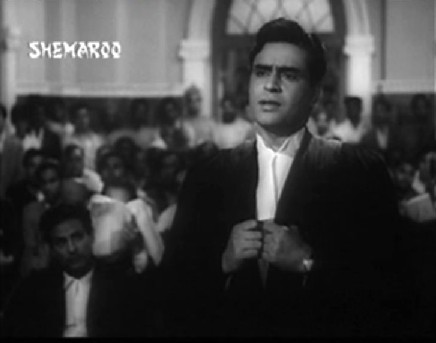
Shahjehan (1946)

After a longish hiatus, I’ve begun working on my next novel. Like my first book, The Englishman’s Cameo, this one too features the Mughal detective Muzaffar Jang, and is set during the final years of Shahjahan’s reign. I’ve been doing other bits of writing—very little of it related to history—and decided I needed something to help build up atmosphere and get me back in the mood. A historic film, set in Shahjahan’s time? Shahjehan? With Naushad’s hit score, and the chance to hear (and see) K L Saigal singing some of his best-known songs?
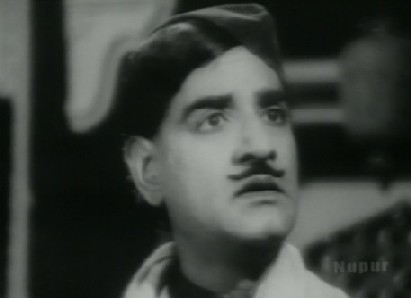
Alas. Alas, alas, alas. Or, to put it more bluntly: &$%@##%@!!!

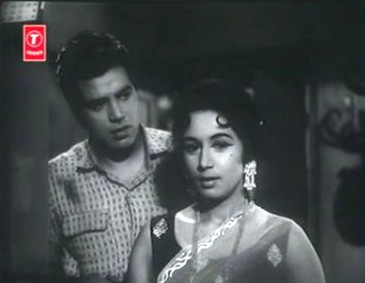
Continue reading

Bhai Bahen (1959)

My sister and I were discussing, with much fondness, my father’s love for classic Hindi cinema. When my parents bought a DVD player, I offered to look out for old films that I could buy for them. “Any particular favourites you’d like me to buy you?” I asked. Papa’s list included Sangdil, Daag, Anari, Ratan, Andaaz, Albela, Sone ki Chidiya and a bunch of other films—all of them selected mainly because they had superb music.

And I am very much my Papa’s daughter. It takes just one good song for me to rent a film (I may not go so far as to buy it, though). I’ve done it with Akashdeep, and I’ve done it again with Bhai Bahen. Here, fortunately, I was a little luckier. Even though the best thing about it is the lovely Saare jahaan se achha, Bhai Bahen is, overall, an interesting and rather offbeat little film.

Continue reading

Akashdeep (1965)

Once upon a time, there was a writer.

No: it wasn’t Dharmendra, and it certainly wasn’t Nanda (old Hindi cinema, at least, doesn’t seem to believe women capable of writing anything more complex than a love letter, if that).
This writer was someone quite different, and one day (I’m guessing) decided that it was time to show the world what he was capable of. So, with a producer and a director, the writer went into action, and what resulted was Akashdeep. Looking at the film, I’m assuming this was somewhat of a collaborative effort. A “how about this?” and a “don’t you think it would be a good idea—?” sort of film.

Continue reading

Ek Thi Ladki (1949)

Harvey’s recent post on Mr Sampat sparked off a brief discussion on one of Hindi cinema’s finest character actors, Motilal. Since Motilal was known—at least in the 50’s and 60’s—as a character actor, it seemed appropriate to review a film in which he’s the hero. Not that Ek Thi Ladki (‘There was a girl’) really allows much scope for a hero. True to its name, it centres around its heroine, the spunky and vivacious Meena Shorey. But Motilal is a very likeable leading man; I S Johar, in his debut, is a deliciously crooked crook; and one of my favourite vamps—Kuldeep Kaur—is in it too.

Continue reading

Ten of my favourite Hemant songs

My maternal grandfather used to work in the Gramophone Company of India. Mummy grew up in a house full of LPs, and a lot of those—including dozens of albums from Hindi films of the 50’s and 60’s—ended up in our house. I grew up listening to music; but for a long time, I couldn’t tell one singer from another. The first singer whose voice I learnt to identify (I must have been about 11 or 12 at the time, I think) was Hemant.
Hemant Kumar Mukherjee was born on June 16, 1920, and went on to become one of Hindi cinema’s great music directors—and a singer with a very distinctive voice, rich and deep and sonorous.

So, as a birthday anniversary tribute: my ten favourite Hemant songs. These are all from the 50’s and 60’s, from films that I’ve seen, and in no particular order. Frankly, each song is a masterpiece in itself.

Continue reading

Kanoon (1960)

9 years before he made the superb suspense thriller Ittefaq, B R Chopra produced and directed this film. It too starred Nanda (though not in as pivotal a role as in Ittefaq). It too didn’t have a single song—though it did have a ballet performance. And, like Ittefaq, it hinged on a murder.
But Kanoon wasn’t by any means a precursor to Ittefaq. Ittefaq is mainstream murder mystery; Kanoon straddles with consummate skill the line between crime detection and social issues. It’s an excellent, unusual and gripping film that merits viewing.

Continue reading

Announcing the Johnny Walker Songs Compilation DVD

How many actors have had films named for them? How many appear in the lyrics of songs? And how many, without being lead actors, manage to invariably feature in at least one song in every film they’ve acted in?

Continue reading

Jewel Thief (1967)

This is one of those films that have a very interesting—and unexpected—twist that can come totally as a bolt out of the blue if you’re watching it for the first time. Subsequent watchings, no matter how far apart, tend to dilute the suspense a good deal because (unless you have a really frightful memory) you know what’s coming. And somehow, unlike films like Teesri Manzil or Mera Saaya or Woh Kaun Thi?, Jewel Thief lacks other elements that could encourage repeated viewings.

Continue reading

Kismet (1943)

My mother’s grandfather was one of those domineering patriarchs who governed everything his family did, including the films they saw. The films deemed worthy of watching were very limited; Hollywood, by virtue of producing films with a Biblical theme, managed to get some (like Quo Vadis, The Ten Commandments and Ben Hur) past his strict censorship, but Hindi cinema didn’t have a chance. Kismet holds the distinction of being the only Hindi film he allowed his family to see. Considering it’s quite a formulaic potboiler (with an anti-hero and a girl who gets pregnant without being married), I was surprised at his choice—but then, it may have had something to do with the fact that Kismet was a huge hit that ran for 3 years in a theatre in Calcutta, where my mum’s family lived. Great-granddad must’ve thought anything that sustained so must have some merit.

Continue reading

Changez Khan (1957)

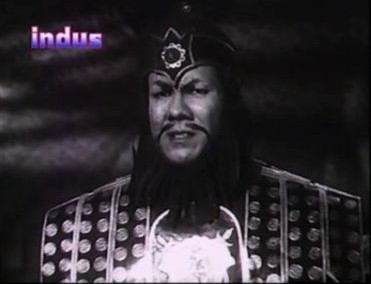
Of the many things that fascinate me about old Hindi cinema, this is one: the making of films set in a time and space wholly alien to India of the mid-1900’s. The 1950’s, especially, seem to favour these sort of films, set in exotic locales and needing costumes, makeup, and sets that were vastly different from what one saw in the more usual Bollywood drama, thriller or even mythological. There was Yahudi (with Dilip Kumar looking far from Roman in a light-haired wig and ankle-length gown); Aurat (based on the story of Samson and Delilah)—and this one, about the Mongol warrior king, Changez (better known to the West as Genghis) Khan.

Continue reading