Priceless Parodies

This is going to be my last post for a couple of weeks: I leave on Friday for a two-week jaunt through Switzerland and Alsace, so film watching and reviews are going to take a back seat. But before I go, I decided to do one last post, on parodies. I am providing translations, but they’re rather slipshod. Sorry!

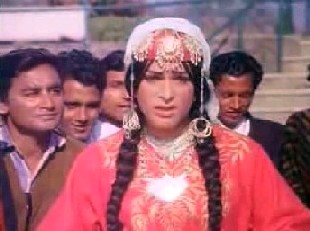
Hindi film songs offer plenty of scope for parodying. In fact, I’ve come across songs that actually parody earlier film songs. My favourite is Suno suno kanyaaon ka varnan (Haseena Maan Jaayegi, 1968), with a madcap Shashi Kapoor singing Mere desh ki ladki sona nigle, nigle heere-moti (“The girl of my country swallows up gold, diamonds and pearls”) instead of the more patriotic Mere desh ki dharti sona ugle, ugle heere-moti (“The land of my country produces gold, diamonds and pearls”), from Upkar (1967). Amusingly enough, the song includes a parody of a song which was originally filmed on Shashi Kapoor: Pardesiyon se na ankhiyaan milaana (Jab Jab Phool Khile, 1965). Best of all? He’s in drag through most of the song. Awesome!

Suno suno kanyaaon ka varnan, Haseena Maan Jaayegi

Continue reading

Do Bigha Zameen (1953)

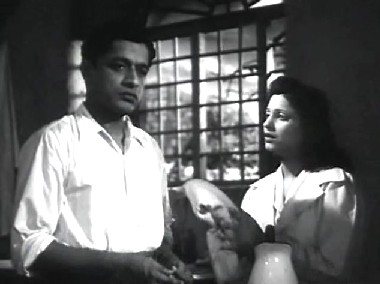
Bimal Roy, Hrishikesh Mukherjee, Guru Dutt, Asit Sen: some of my favourite directors, and all men with a string of poignant, meaningful films to their credit. Not always very happy films, but films that step away from the usual masala of Hindi cinema. Films that, like the classic Do Bigha Zameen, are not about bewigged, gadget-toting gundas and their better-than-good (not to forget immensely strong) nemeses, but about common people with common problems.

Do Bigha Zameen

Continue reading

Ten of my favourite Manna Dey songs

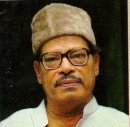
Prabodh Chandra Dey—better known as Manna Dey—turns 90 years old on May 1, 2009. A long innings, and though with too little recognition (in fact, far less than a talent like his deserves), a superb one. In my opinion, Manna Dey’s was one of the most beautiful male voices to have ever sung playback for Hindi cinema: warm, sensuous, and with a glorious smoothness, throaty and full of feeling, that’s unparalleled. Listen to him sing a qawwali, a raag, a rock-and-roll number—all with equal ease, panache and conviction, and it’s easy to become a fan. Happy birthday, Mr Dey; may you and your songs live long!

Prabodh Chandra Dey, aka Manna Dey

Continue reading

Hariyali aur Raasta (1962)

My guardian angel in charge of film viewing seems to think I’m in serious need of improvement. Which is probably why I’m finding myself subjected to a series of films centred round the difference between good women and bad women. That Touch of Mink tried to touch on it in a humorous way; Bhabhi was more blunt (are sledge hammers blunt?); and Hariyali aur Raasta, though not quite as in-your-face as Bhabhi, had very much the same message: good women choose honour, family and home over all else.

Manoj Kumar and Mala Sinha in Hariyali aur Raasta

Continue reading

Bhabhi (1957)

I made such a mistake doing a Westward the Women post for International Women’s Day. Granted, it’s a good film, and highly recommended—but does it really teach a woman anything substantial? Knowing how to harness a mule or drive a wagon isn’t all there is to life. So here’s compensation: a film replete with lessons for women (and men, too). There are do’s and don’ts for just about any situation in life, including—though never stated—filmmaking.

Pandari Bai in Bhabhi

Continue reading

Love in Simla (1960)

Memsaab reviewed Love in Simla a while back. I am, on purpose, not reading it again, just to make sure I don’t end up subconsciously lifting phrases and ideas (though my excuse can always be that imitation is the sincerest of flattery!) I can’t hope to write as delightfully as memsaab does, but for what it’s worth, here’s my two cents.

Love in Simla is the quintessential Cinderella story: the fairy godmother helps turn the ugly duckling into a swan so she can steal Prince Charming from the clutches of the evil stepsister. Of course, this being Bollywood, the swan has a heart of gold and can’t bring herself to harm even the evil stepsister.

Sadhana in Love in Simla

Continue reading

Shikar (1968)

After all the melodrama of the recent Hindi films I’ve been watching, I decided it was time to sit back and enjoy one of my favourite genres: the thriller. And a thriller the way only the Bollywood of the 1950’s and 60’s could manage: with lots of romance thrown in, a gorgeously vampish Helen, hummable songs, a comic side plot starring none other than the inimitable Johnny Walker—and, interestingly enough, a supporting actor who manages to steal the limelight from the hero.

Dharmendra and Sanjeev Kumar in Shikar

Continue reading

Hum Dono (1961)

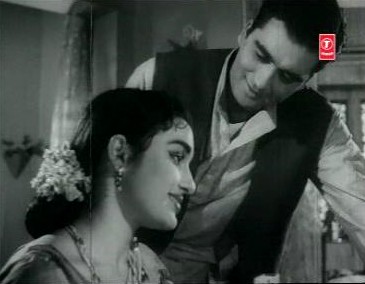
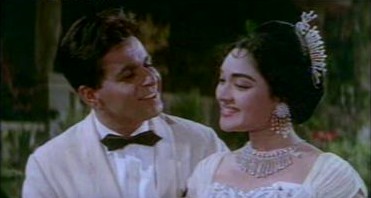
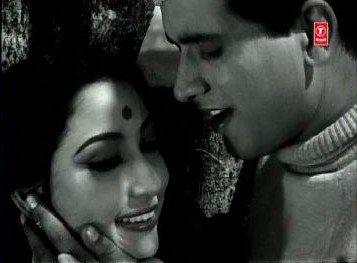
After Usne Kaha Tha, it’s time for yet another Nanda film (though Sadhana plays an equally, if not more important role in it). And a coincidence: this one too is against the backdrop of World War II. But that’s where the resemblance ends. Hum Dono is a very different story, more mainstream than Usne Kaha Tha, yet equally enjoyable—and with superb music by the underrated Jaidev.

Dev Anand and Sadhana in Hum Dono

Continue reading

Shaadi (1962)

Shaadi isn’t one of the better films I’ve seen in recent times. In fact, it had some definitely irritating moments, and it called for more suspension of disbelief than is generally expected in Hindi films. On the other hand, it had quite a cast: Saira Banu, Manoj Kumar, Dharmendra, Indrani Mukherjee, Balraj Sahni, Om Prakash, Manorama, and others. Even more interestingly, it was Saira Banu’s second film and one of Dharmendra’s first few films. Overall bearable, especially since I didn’t have anything better to do.

Saira Banu in Shaadi

Continue reading

Beti (1969)

There are some things I have very little patience with while I’m watching a film. Weepiness, for instance. Precocious children for another. Endless bhajans (unless the bhajan in question happens to be of the calibre of Allah tero naam or Man tadpat hari darshan). Mindless self-sacrificing which can’t possibly benefit anyone.
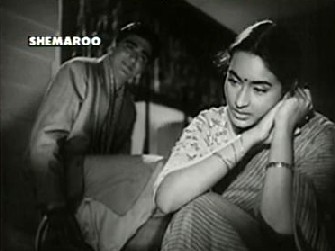
And much more. Beti, unfortunately, has all of these in ample doses. I saw it primarily because I like the lead pair (Nanda is an old favourite, and I haven’t given up on Sanjay Khan, despite the lamentable Ek Phool Do Maali). And when a film lists Rajendranath, Shyama and Asit Sen in its cast, one can hope for lots of entertainment.

Or so I thought.

Sanjay Khan and Nanda in Beti

Continue reading