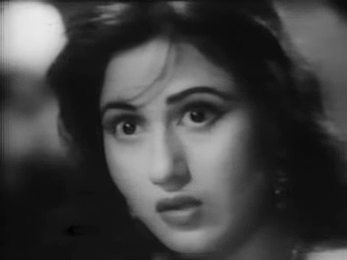
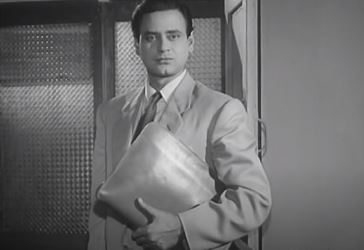
Anita (1967)

When, for May 31st this year (the 100th birth anniversary of film director Raj Khosla), I wanted to review one of his films, Anita was on my shortlist. Over the course of the years I’ve been writing this blog, I’ve reviewed several of Khosla’s films, including two of the three films (Woh Kaun Thi?, Mera Saaya and Anita) that comprise Khosla’s Sadhana suspense trilogy. Since Manoj Kumar had also passed away earlier this year, it seemed fitting to watch and review Anita, the last of the three films, and a film that starred Manoj Kumar opposite Sadhana.

For a tribute to Khosla, I ended up reviewing Kaala Paani instead. But I did watch Anita (a film that I’d last seen so long back, I remembered only the basics of it). And it seemed appropriate to review it too.

Therefore…

The film begins with a short, rather abrupt scene in which Seth Biharilal (Sajjan) visits a somewhat shady-looking pandit (Ulhas). Biharilal has brought along the horoscope of his 19-year-old daughter Anita for the pandit to have a look at, and to comment upon. The pandit has a peek, and says that this year is going to be really vile for Anita.

Continue reading

Tumse Achha Kaun Hai (1969)

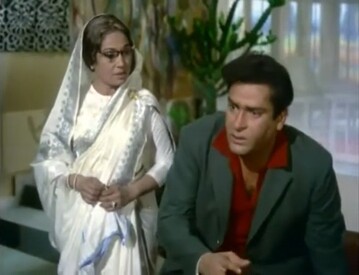
Lalita Pawar plays an ageing and very wealthy woman who employs a man (played by Shammi Kapoor) to reform her granddaughters, who are getting too wild for her liking. The man, poor and in desperate need of money to pay for the treatment of an ailing family member, takes up the offer, even though it will require him to pretend to be someone he’s not. In the process, he ends up falling in love with one of the granddaughters—much to the annoyance of the indignant grandmother.

This was the gist of the story of Professor (1962), though with one qualification: Shammi Kapoor’s Preetam in that film is initially hired just as a tutor for the younger brothers of the granddaughters; it’s only a little later that he’s also given the task of tutoring the young women. It was, as I’ve said on more than one occasion—and of course in my review of the film—a delightfully entertaining film, romantic and fun and with absolutely fabulous music.

Seven years later, Shammi Kapoor acted in another film with a somewhat similar plot. Here, in Tumse Achha Kaun Hai, he is Ashok, a musician; and Lalita Pawar plays Sarojini Devi, the very wealthy woman who approaches him with a proposition: that he take on the task of setting to rights her granddaughters, all three of whom (she feels) are a disgrace to Sarojini Devi.

Continue reading

Police (1958)

If you’ve been reading this blog some years, you probably know by now that I am a fan of Madhubala’s. I’ve watched most of her films (several of which I have not got around to reviewing on this blog), I’ve done lists of my favourite songs of hers, and I have waxed eloquent every now and then about how much I like her.

One of the things I dislike about much of the online (at least) raving about Madhubala is that the praise is invariably just about her beauty. How gorgeous, how exquisite. Yes, indeed; but Madhubala’s beauty, I think, often comes in the way of people appreciating what a good actress she was, too. Watch her performances in films like Mughal-e-Azam and Amar, for instance, and if you can look past her face, you will see how well she holds her own against heavyweight thespians like Dilip Kumar and Prithviraj Kapoor.

And she was a fantastic comedienne too. The madcap way she matches Kishore Kumar in Chalti ka Naam Gaadi, for example. Or her airhead character in Mr & Mrs 55. Interestingly, Madhubala is often compared to Marilyn Monroe, almost entirely on the basis of their beauty and popularity; but I think the two stars had one more thing in common: both could portray the ditzy beauty very well. This, in fact, is just the type of woman Manju, of Police, is: nutty, silly, a clown. But so endearing too (and, it goes without saying, so gorgeous).

Continue reading

Howrah Bridge (1958)

Aaiye meherbaan baithiye jaan-e-jaan, and Mera naam Chin Chin Choo. Two great actresses, two iconic songs.

When I was doing the Helen tributes last month, I was reminded of Mera naam Chin Chin Choo all over again—and remembered, too, that I had never reviewed Howrah Bridge on this blog. It has also been many years since I last watched the film (before I launched Dusted Off), so I decided it was high time I revisited this.

Howrah Bridge begins very far from the bridge, and in fact from Kolkata: in Rangoon, where Prem Kumar (Ashok Kumar) finds his father (Brahm Bhardwaj) in a flap. Daddy is distraught because Prem’s elder brother Madan (Chaman Puri, in a cameo role) has run off from home, taking with him an invaluable family heirloom, a dragon which has been in the family for generations. We later discover that the dragon was crafted in China many centuries ago, and from there came to be owned by the king of Burma, after which it passed into the possession of Prem’s family.

Continue reading

Zindagi (1964)

The main reason I watched this film was because of the songs, which include some very good ones. And Vyjyanthimala, whom I invariably enjoy watching. The two male leads, Rajendra Kumar and Raj Kumar, are not favourites of mine, but they aren’t absolutely unbearable either. And there was a star cast of several other people I like, such as Prithviraj Kapoor and Helen. Ramanand Sagar, who wrote and directed Zindagi, also has to his credit one film I really like (Aankhen) and some (Aarzoo, Ghoonghat, Charas) that I don’t mind too much. I figured there might be enough here for me to enjoy.

The story begins with Beena (Vyjyanthimala) coming home to her mother (Leela Chitnis) with the news that she has found a job, finally. Ma is happy, until Beena tells her what the job is: Beena is now a theatre actress. Ma is very upset and goes into a long harangue of how it’s better to be poor than to be in the theatre; their name will be mud, blah blah.

Continue reading

Woh Kaun Thi? (1964)

I began this blog on November 4. 2008 (with a review of Vacation from Marriage), so this post marks the fifteenth birthday of Dusted Off. I dithered over how I might celebrate the occasion, and finally came to the conclusion that it would be good to mark it with a review of a film I’ve been meaning to review ever since I decided to start blogging about classic cinema. Woh Kaun Thi? is a film I enjoy a lot, and which I’ve seen in various avatars: first on Doordarshan, when I was a teenager. Then, when VHS tapes became available, multiple times on our VCR. Then, when CDs came along, this was one of the first VCDs I bought… then the DVD. Now YouTube.

The story begins on a stormy night. Dr Anand (Manoj Kumar) is driving down a pot-holed and lonely road when he sees a woman (Sadhana), clad in white and standing in the middle of the road. Anand tells her to move out of the way, but when she doesn’t respond, he is compelled to get out and talk to her. To all his questions—who is she, where is she going, isn’t she scared to be out here alone—she gives evasive, mysterious answers. Finally, however, she consents to let Anand give her a lift, but on one condition: he is not to ask any questions. [Given the way he’s been bombarding her with questions, I’m not surprised].

Continue reading

Mem-Didi (1961)

Today marks hundred years of the birth of one of Hindi cinema’s finest directors: Hrishikesh Mukherjee was born on September 30, 1922, in Calcutta.  Beginning in the late 1940s, Mukherjee worked as a film editor in Calcutta, before moving on to Bombay, where too he continued as editor, gradually moving on to direction as well. Mukherjee’s first film as director was Musafir (1957), and while it didn’t fare too well, it set the tone for a lot of Mukherjee’s later works: films about everyday people, with everyday triumphs and everyday sorrows. His were not the masala films that have always tended to dominate Hindi cinema, and yet—whether he was making classic comedies like Chupke-Chupke or Golmaal, or more nuanced, sensitive films like Majhli Didi, Satyakam, or Abhimaan, Hrishikesh Mukherjee made films that were hard to fault. He is one of the rare directors for whom I will watch a film just because it’s been made by this person.

Continue reading

Apradhi Kaun (1957)

The world of Hindi cinema is peppered with names that anyone familiar with the industry (at least the industry of the 50s and 60s) can quickly slot into categories. Star. Villain. Comedian. Character actor. There are many, many names that automatically fall into (almost exclusively) one of these categories. Those that have shifted from one category to another—like Pran, for instance, once the quintessential villain but in later years the more interesting ‘good man’, or Ajit and Premnath, both initially hero and later villain—have again usually not done too many shifts.

Abhi Bhattacharya is one of those relatively rare individuals who seem to have appeared in a wide variety of roles, a wide variety of films. He was the idealistic school teacher of Jagriti, the ‘other man’ of Anuradha. The kind-hearted, principled example of the bhadralok in films like Amar Prem, and the straying older brother of Dev Anand in Love Marriage. He played Krishna and Arjun and Vishnu (the latter in a slew of mythologicals). He even played the villain, in the Vinod Khanna-Yogita Bali starrer, Memsaab.

This year marks the birth centenary of Abhi Bhattacharya (as far as I’ve been able to find out, he was born in 1921, though I’ve not been able to discover exactly when in 1921). To commemorate his career, I wanted to watch a Bhattacharya film, but a dilemma presented itself: which one? Hindi or Bengali? (since Bhattacharya had what seems to have been a very successful career in Bengali cinema as well). Eventually, I homed in on this film, a rare whodunit in Hindi cinema that’s pretty well made too.

Continue reading

Teen Bahuraaniyaan (1968)

I had read a review of this film on a blog years ago, but besides the fact that it starred Prithviraj Kapoor as the father-in-law of three women, I remembered nothing of what I’d read. Then, some weeks back, when Shashikala passed away, a couple of people remembered her role, as a popular film star, in this film. I was tempted to watch it.

The teen bahuraniyaan (the three daughters-in-law) live in one rambling house along with their husbands, their children, and their father-in-law Dinanath (Prithviraj Kapoor)a retired school teacher. The patriarch’s three sons, from eldest to youngest, are Shankar (Agha), Ram (Ramesh Deo) and Kanhaiya (Rajendranath). Appropriately enough, their wives, respectively, are Parvati (Sowkar Janki), Sita (Kanchana) and Radha (Jayanthi). Sita’s sister Mala (Vaishali), who’s come to town to do college, also lives with them.

Continue reading

Jagriti (1954), Bedari (1956)

One review suffices for two films, really. Jagriti was an Indian film, Bedari a Pakistani one. Why I say one review suffices is because Bedari was a blatant copy of Jagriti: so blatant that when Pakistanis cottoned onto the fact that it was a copy, there was a furore which resulted in the Federal Board of Film Censor in Pakistan banning Bedari.

I’ll discuss the synopsis by looking at Jagriti, since Bedari used exactly the same plot, down to the scenes.

Jagriti begins by introducing us to the very wild teenager Ajay Mukherjee (Raj Kumar), who spends his after-school time gallivanting around the village with his gang of equally wild friends. They steal mangoes from an orchard and leave the irate gardener with a bump on his head; Ajay slips onto a ferry and deprives a banana-seller of an entire day’s worth of bananas.

By the time Ajay gets home, his uncle (Bipin Gupta) has been besieged by some very upset villagers. He’s had to soothe them, pay up their damages, and promise that the situation will be amended.

Continue reading