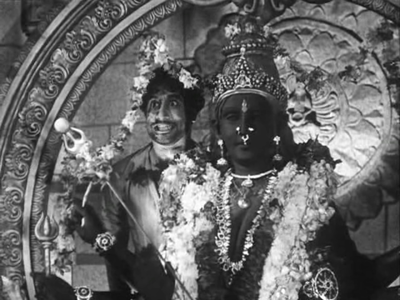
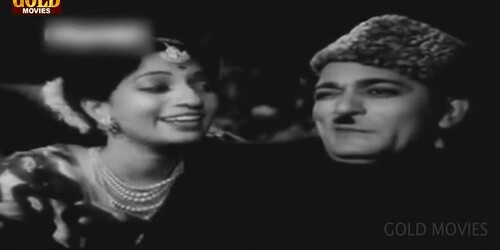
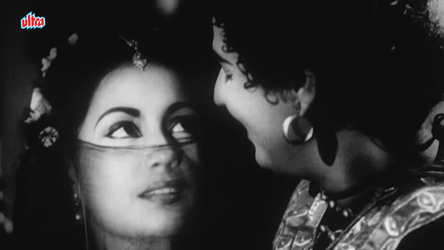
I came to this film quite by chance. Back in April, when I reviewed Jhansi ki Rani, blog reader Maitreyee Mishra, commenting on that review, asked if I’d watched any other films featuring its lead actress, Mehtab. I had had to admit that I hadn’t; in fact, it seemed that most of Mehtab’s films were nowhere to be found—at least not online. I did find one film, though: AR Kardar’s Sanjog (1943), which starred, alongside Mehtab, Noor Mohammad ‘Charlie’.
Continue readingTag Archives: film review
My Man Godfrey (1936)
And also, to some extent, My Man Godfrey (1957).
My Man Godfrey—the original one, starring William Powell—is one film that I’ve been meaning to watch for a long time now, mostly because so many people have told me what a lot of fun it is, and how it seems to have shades of PG Wodehouse in it (an author in whose pursuit I have watched several films, not always with the most satisfying of results).
It did seem to me, within the first few minutes of My Man Godfrey, that there were shades of a Wodehousian sense of humour here.
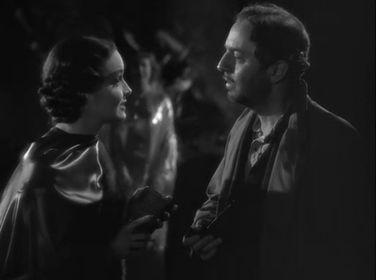
The film begins at a riverside dump, where a rather ragged, unshaven and tattered Godfrey (William Powell) is among several homeless men standing about when a fashionable high society lady, Cornelia Bullock (Gail Patrick) comes flouncing along, with a formally-dressed man in tow. Cornelia takes one look at Godfrey and tries to get him to come with her. She’s participating in a ‘scavenger hunt’ at a posh hotel, and the first person to bring along a ‘forgotten man’ to the hunt stands to win the prize.
Continue readingKaagaz ke Phool (1959)
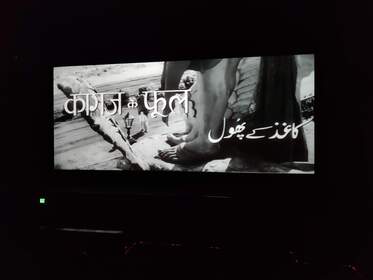
That first photo, because the space beyond the screen is so dark, may not be very obvious as regards context. But this is a photo from a full-sized film theatre, where I watched the re-released Kaagaz ke Phool on July 17th. The re-release was to mark the 65th anniversary of this film, a semi-autobiographical work that was a flop when it was first released, but has gained in popularity ever since. My niece had alerted me to the fact that PVR Inox would be showing Kaagaz ke Phool across its theatres, one show a day for a week, and I knew I couldn’t miss this one. If only for the fact that I get to see precious few old films on the big screen (Hum Dono was the last I saw).
I had thought I’d probably be one of a handful (ten, at the most?) of people in the theatre, because this, after all, is an old film; and this was an afternoon show on a weekday. But to my surprise, there were actually quite a few people, and—best of all—many of them were fairly young. Heartening.
But, to get to the film.
Continue readingHimalaya ki God Mein (1965)
I realized the other day that there are umpteen well-known old films that I have seen but have never got around to reviewing on this blog—invariably because I had watched them before I started Dustedoff, and because there were so many ‘new’ old films to watch and write about, I never got around to rewatching stuff. It’s time to amend that, and revisit some films that perhaps should be talked about.
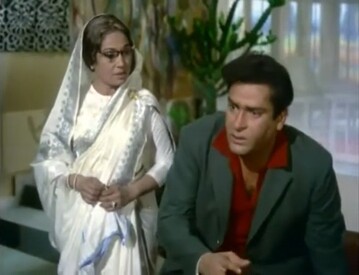
To begin with, Himalaya ki God Mein. Directed by Vijay Bhatt, Himalaya ki God Mein beat Haqeeqat and Waqt to win the Filmfare Best Film Award, and was a superhit. I had watched this donkey’s years ago, when it was telecast on Doordarshan. I remembered almost nothing of it except the fact that Manoj Kumar played a city doctor who relocated to the mountains to treat villagers and ended up falling in love with a village girl played by Mala Sinha. That was it. Time for a rewatch, I decided.
The film begins at night, on an aeroplane where Dr Sunil (Manoj Kumar) and his fiancée, also a doctor, Neeta (Shashikala) are travelling. Another passenger on the plane suddenly clutches his chest; Sunil examines him, diagnoses a heart problem, and asks that the plane land immediately.
Continue readingThe Spiral Staircase (1946)
Years ago, when I first watched Wait Until Dark, I was blown away by the ingenuity of the idea: a blind woman trapped inside a house with a murderer on the loose. Audrey Hepburn was superb as the woman who must use all her wits to keep one step ahead of her pursuer, and if possible, to turn the tables on him.
That was the film I kept remembering when I was watching The Spiral Staircase, a story about a mute girl who is caught in a large mansion with a murderer coming after her.
The story begins, not at the mansion, but at a small hotel in the nearby town. On the ground floor of the hotel, a film (silent, shown with an accompanying pianist providing the music) is being projected. A small but engrossed audience is in attendance, and this includes Helen (Dorothy McGuire), who is mute.
Continue readingAladdin aur Jaadui Chiraagh (1952)
Some weeks back, when I reviewed Police (1958), the thought that had stayed in my mind regarding Madhubala’s character—and her acting—in that film and otherwise, in the larger context of her career, was that she got sadly stereotyped. Too many people, film-makers most of all, ended up slotting her as the ravishingly beautiful woman who need only be cast for the fact that she could light up a screen like few others could. Her acting ability (which was actually very good) got overlooked far too often.
Something similar, though in a different way, happened to Meena Kumari. In Meena Kumari’s case, the ‘Tragedy Queen’ label got affixed fairly early in the actress’s career and branded her forever as the Main Chup Rahoongi type: the weepy, self-sacrificing, stoic Bhartiya naari. Despite films like Kohinoor, Azaad, Majhli Didi, Tamasha and Bandish, most people today associate Meena Kumari with ‘serious’ roles.
So, this film, which starred Meena Kumari in one of her lighter roles.
Continue readingBedazzled (1967)
If, like me, you were old enough to be watching films in 2000—and you watched Hollywood films—you might have come across the Brendan Fraser-Elizabeth Hurley comedy Bedazzled. It was about a geeky, socially inept but otherwise sweet fellow (Fraser) who makes a pact with the Devil (Hurley), who promises to grant him seven wishes in return for his soul. Unfortunately for our hero, all his wishes come to nought, leaving him even more distressed than he was originally. It was a funny film, and Brendan Fraser, in my opinion, shone as a comic actor.
I discovered, a few weeks ago, that the 2000 Bedazzled, directed by Harold Ramis, was actually a remake of a 1967 British film of the same name. Directed by Stanley Donen, Bedazzled was based on a story by Peter Cook and Dudley Moore, who also acted as the leads in the film: Dudley as Stanley Moon, Peter as the Devil.
The story begins in a church, where Stanley is praying very hard that God give him a sign. Something to assure a despondent Stanley that there is someone listening.
Continue readingPolice (1958)
If you’ve been reading this blog some years, you probably know by now that I am a fan of Madhubala’s. I’ve watched most of her films (several of which I have not got around to reviewing on this blog), I’ve done lists of my favourite songs of hers, and I have waxed eloquent every now and then about how much I like her.
One of the things I dislike about much of the online (at least) raving about Madhubala is that the praise is invariably just about her beauty. How gorgeous, how exquisite. Yes, indeed; but Madhubala’s beauty, I think, often comes in the way of people appreciating what a good actress she was, too. Watch her performances in films like Mughal-e-Azam and Amar, for instance, and if you can look past her face, you will see how well she holds her own against heavyweight thespians like Dilip Kumar and Prithviraj Kapoor.
And she was a fantastic comedienne too. The madcap way she matches Kishore Kumar in Chalti ka Naam Gaadi, for example. Or her airhead character in Mr & Mrs 55. Interestingly, Madhubala is often compared to Marilyn Monroe, almost entirely on the basis of their beauty and popularity; but I think the two stars had one more thing in common: both could portray the ditzy beauty very well. This, in fact, is just the type of woman Manju, of Police, is: nutty, silly, a clown. But so endearing too (and, it goes without saying, so gorgeous).
Continue readingPaigham (1959)
This is a film that’s been on my radar for a while now. Dilip Kumar, Vyjyanthimala. A cast also boasting of Motilal and Johnny Walker. Some good songs. Paigham, I thought, might be worth a watch.
I will admit, though, that my heart sank a bit when I saw the opening credits and discovered that this is a Gemini Studios release. Like AVM, I now approach Gemini with trepidation: while their films often had great casts and excellent music, they were invariably just too melodramatic for my liking.
But I persevered.
Paigham begins by introducing us to Manju (Vyjyanthimala) who, along with her best friend Malti (B Saroja Devi), has just finished college: Manju at the top of her class, Malti at the bottom. Malti isn’t fazed by this; she’s a wealthy girl, her father Seth Sewakram (Motilal) a prosperous cotton mill-owner. Malti, in fact, has promised Manju that she will ask her father to give Manju (who’s done a course in shorthand and secretarial work) a job at the cotton mill, which is in a town named Rangpur.
Continue readingBunny Lake is Missing (1965)
A little girl, an American newly arrived in England, goes missing from the nursery school she’s just joined. The police come to investigate, but things begin to get very puzzling soon after and the superintendent in charge of the case ends up wondering: Is Bunny Lake really missing? Does Bunny Lake even exist?
This film, produced and directed by Otto Preminger, was nominated for several BAFTA awards, and having seen it, I wonder why it didn’t win even a single award. It’s a gripping story, and moves swiftly from the very start.
It begins at a home in London, where Steven Lake (Keir Dullea) goes about picking up stuff, making sure everything is draped in covers, before he locks up the house and has a word with a couple of workmen who are there to help shift some stuff to another home. Much later in the film, when Steven and his sister Ann are talking to the police, it transpires that Steven, who is a journalist, has been working in London for some time and was staying in Frogmore End (which is the house shown in the opening frames).