In which Biswajeet’s character ends up facing a wall studded with red-hot spikes. You don’t just skewered to death, you get barbecued in the process.


In which Biswajeet’s character ends up facing a wall studded with red-hot spikes. You don’t just skewered to death, you get barbecued in the process.
RIP, Harry Belafonte.
I have an admission to make: Harry Belafonte was the first singer I ever crushed on.
When I was a child, my parents had a large collection of LPs, and among the many singers we heard on those, the ones who stood out for me were Connie Francis, Pat Boone, Jim Reeves—and Harry Belafonte. I still remember a Belafonte album (Belafonte Sings of the Caribbean) we had, which was one of my favourites. This one was also present among the LPs at my maternal grandparents’ home in Kolkata, which we visited sometimes for Christmas. My mother’s father had worked for the Indian music giant HMV, so their home had a massive collection of LPs, with Belafonte front and centre. We didn’t just listen to his carols and hymns at Christmas; we listened to every song he’d made popular, from the soulful Jamaica Farewell (one of the first English language songs I learnt to sing) to hilarious ones like Matilda, Man Smart Woman Smarter, and the classic There’s a Hole in the Bucket (which, by the way, is also a favourite with my daughter: she and I sing it together and always end up having a good laugh).
I loved his voice. I thought the photo of him, smiling and so handsome, on the LP cover, showed that he didn’t just have the most fantastic voice, he was also easily the best-looking of all the singers.

In 1951, fresh from the success of the Dev Anand-Geeta Bali-Kalpana Karthik starrer Baazi, Chetan Anand decided to make a film that would highlight the very interesting aspects of film-making he had been learning from studying the works of various European directors. ‘Based on a true incident that took place in Amritsar’, as the film’s credits read, the story of Aandhiyaan was written by Chetan Anand himself, along with Hameed Butt.
The film’s credits roll to an unusual sequence of shots: in each frame, one actor or the other is shown, battling the eponymous ‘aandhi’ or storm, though in this case literal rather than metaphorical.
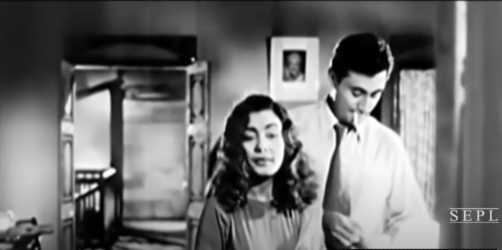
The story is centred round a young and zealous lawyer named Ram Mohan Kapoor (Dev Anand). Ram lives upstairs from his munshi (Ratan Gaurang), whose daughter Rani (Nimmi) has long been in love with Ram, though she’s too shy to let him know that. When the story begins, Ram’s mother (Durga Khote) is due to arrive, and Ram is getting ready to go to fetch her from the station. Rani makes tea for him, and an excited Ram confides in her: he’s asked his mother to come because he wants her to fix a match for him. With a girl he likes a lot.
Meaning, Blood-lust.
More than Hindi cinema, I think, Bengali cinema has drawn from Western literature: including not just the more serious literary works, but also a good deal of popular literature. Of these, mysteries have been adapted often (possibly a reflection, too, of the fact that there’s been a long and much-respected corpus of Bengali mystery and detective fiction?) This is one, based on Arthur Conan Doyle’s The Hound of the Baskervilles.
The film begins with a brief and mysterious scene in which somebody finds a dead body among the marshes of a principality called Ratnagarh. We are never shown the face of the man who stumbles upon the corpse; but the news of this death is brought to Kolkata, to the ace detective Smarajit Sen (Shishir Batabyal) by Dr Palit (Kamal Mitra), the doctor at Ratnagarh. Sen’s assistant, Sanyal (?), is also present.
When Basu Chatterji passed away in 2020, I wanted to pay a tribute to him, because he was one of my favourite directors from the 70s and 80s (and he directed Byomkesh Bakshi, a television series I love). But given that I restrict my blog to films from before the 70s, there was only one film that would fit: Sara Akash, Chatterji’s first film, which was released in 1969.
This was in June 2020, at the peak of the lockdown. The situation was dire. We were getting news of people we knew who were ill with Covid, even a few who had succumbed. Close family were suffering the fallouts of the lockdown. I tried watching Sara Akash, but couldn’t sit beyond the first five minutes. Perhaps I was not in the right frame of mind.
But now I was tempted to give it another try, because I’d been reading about the film in Anirudha Bhattacharjee’s Basu Chatterji and Middle-of-the-Road Cinema (my review here).

I dithered over this film for a long time after I’d finished watching it. Should I review it? Should I not? It wasn’t a great film, but it wasn’t terrible, either. It wasn’t as if a review was needed to warn potential viewers off it. Or vice-versa, to alert people to a film they must see.
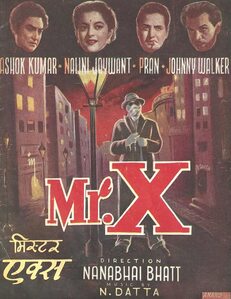
Eventually, I decided that at least a brief review was in order, because this film had an interesting connect to another film I’ve wanted to watch for a while: Mr X.
In 1957, Nanabhai Bhatt had directed a science fiction film (borrowing from HG Wells’s novel The Invisible Man) that starred Ashok Kumar and Nalini Jaywant. According to this web page on Mike Barnum’s blog, the film is about a man who ingests a drug that makes him invisible; he uses this invisibility to go on a Robin Hood-esque spree, helping the poor by robbing the rich. The cops, baffled by the invisible man, dub him Mr X.
I’ve long wanted to watch Mr X, mostly because it features one of my favourite N Dutta songs, Laal-laal gaal. The film isn’t available online, at least, or even on DVD, from what I can tell; perhaps there are carefully guarded prints deep in some archive…
I have a soft spot for heist movies.
And Shirley MacLaine.
And Michael Caine.
And movies about inept crooks.
Which, given that they all come together in Gambit, made this a film I had to watch.
Gambit begins in Hong Kong, where Harry Dean (Michael Caine) surreptitiously follows a woman through the streets of Hong Kong. He watches until she goes into a night club.
Later, we see the woman in action, as she (Shirley MacLaine) dances at the club. Harry takes a seat beside his friend and associate Emile (John Abbott) and they watch the woman, Emile with a surprised but approving look on his face. Yes, she will be the perfect fit.

A simple-hearted—even outright simple, really—man turns out to be the look-alike of a much-wanted criminal. As a result, the police train him to impersonate the criminal so that they can get enough evidence to crack down on a web of crime.
I have no idea if Don (1978) was inspired by Mr India. Don is in many ways a very different film (the criminal, for one, dies fairly early on in the proceedings; for another, it’s a much more complex plot): but there is that fleeting resemblance.
Mr India begins by introducing us to Gullu (IS Johar), naïve and simple, as he goes about job-hunting, and getting rejected at every office because he doesn’t fit the regional profiles demanded by the parochial employers of these places. Gullu gets briefly hired by someone who wants to rig a ‘Mr India’ weight-lifting competition, with Gullu pretending to hoist what is actually wooden dumbbells rather than iron.

This is a film that’s been on my watchlist for a long time. It was recommended to me all over again last year when Sidney Poitier passed away, and since then, I’ve been meaning to watch it. So, finally.
Guess Who’s Coming to Dinner? is a film that can be easily summed up in one sentence: a young white woman and an African American man fall in love, and their shocked families have to learn to cope with their feelings. This is a story not so much of plot—very little actually happens, and most of the nearly two hours of the film consists of dialogue, of people discussing this frighteningly new development that has hit all of them—but in that time, the film manages to make several very pertinent points, not just on racism (which is, naturally, the most obvious) but other issues as well.

When I was going through Chetan Anand’s filmography last year (to commemorate his birth centenary), I stumbled across a Chetan Anand film in which he starred, besides directing it: a film, too, which immediately struck me as unusual, just given its length: a mere one hour. For a Hindi film, rare indeed. Though I didn’t watch Arpan back then, I bookmarked it and decided I’d watch it sometime later.
And it is an unusual film. Not just short, but also somewhat surreal in places. Hauntingly beautiful at times, outright odd at others.
Arpan is set, we are told, 2,500 years ago. A famine is ravaging the land, and people are starving left, right and centre. In this situation, the royalty, of course, is expected to set an example, and thus Princess Madhavi (Sheila Ramani) is going about, a large entourage with her, distributing food to her father’s subjects.

 Dustedoff