Hindi cinema’s fascination for the Mughals is – well, fascinating. Even before independence, we were busy churning out semi-historicals such as Humayun (1945) and Shahjehan (1946); then, in the 50s and 60s, there followed a spate of rather more big-budget extravaganzas, complete with big names, vast armies, glittering palaces and superb music: Mughal-e-Azam, Taj Mahal and Anarkali (Note: As a character, Anarkali seemed to be especially popular. Besides the Bina Rai-Pradeep Kumar version, there were Tamil, Telugu and Malayalam versions of her story; even a Pakistani version starring Noor Jehan. And that list neither includes the two versions made in 1928, nor a 1935 film starring Ruby Myers. Note that Mughal-e-Azam is also about Anarkali).
Tag Archives: Mala Sinha
Pyaar ka Sapna (1969)
The buy-a-film-because-of-a-song bug bites again. I’ve had this happen to me umpteen times, and the symptoms are invariably the same: I remember hearing a lovely song (generally back in the long-ago days of my childhood), and I think, if the music is so fabulous, what must the film be like? (Yes, a nincompoop’s logic, but what the hell). Sometimes, I discover on imdb that the film has a cast I like. Very occasionally, I even find that it has a director I have great faith in.
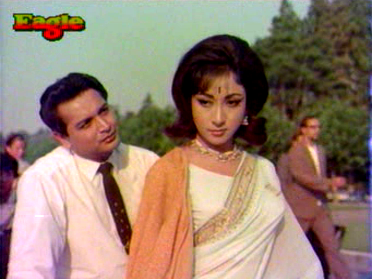
When a film, besides starring the beautiful Mala Sinha, also includes three more of my favourite actors—Ashok Kumar, Helen and Johnny Walker—and features a deliciously romantic song, I can’t not buy.
Gyaarah Hazaar Ladkiyaan (1962)
What is a writer without readers? What is a blogger without people who stop by to read, comment, suggest, recommend, and encourage?
So, in gratitude to everybody who’s been visiting this blog over the months: this month on Dusted Off is dedicated to you. All through September 2010, the posts here will be connected in some way or the other to the readers of Dusted Off. The film reviews will be of films that have been recommended, given, or otherwise suggested by readers; and the lists—those ‘top tens’ I’m so fond of—will be of requests made by readers.
To begin with, this film. When I posted a review of Bhai Bahen a while back, it sparked off a discussion on N Dutta’s music—and reader Ash mentioned Gyaarah Hazaar Ladkiyaan, for which too the score had been composed by Dutta. After we’d indulged in much speculation about the film’s plot (what an intriguing title, right?!), another reader, Shalini, was kind enough to say that she had a copy, and was even more kind enough to share it. Therefore…
Dillagi (1966)
This was what I call a ‘shot in the dark’ film—I noticed it on Induna and decided I’d give it a try, even though I hadn’t heard of it before. The decision was arbitrary, and mainly because the picture of the DVD cover appealed to me. I should probably have had a look at the plot summary on imdb but I didn’t, and ended up with a film that I actually rather liked, even apart from the fact that the lead pair looked yum.

Eye Candy Part 4: Bollywood’s Classic Beauties
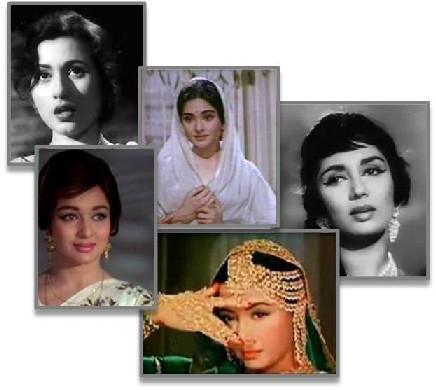
The last of the eye candy posts, and (in my opinion), the toughest. Hindi cinema—and this is irrespective of era—seems to be replete with beautiful women. Offhand, I can’t think of a single leading lady whom I’d put in the `plain’ category. So, selecting the ten women from the 50’s and 60’s whom I think are the ultimate when it comes to sheer pulchritude was a very, very difficult task. But it’s finally done, and after having changed, rearranged and turned around my list God knows how many times, I’m finally done.

Hariyali aur Raasta (1962)
My guardian angel in charge of film viewing seems to think I’m in serious need of improvement. Which is probably why I’m finding myself subjected to a series of films centred round the difference between good women and bad women. That Touch of Mink tried to touch on it in a humorous way; Bhabhi was more blunt (are sledge hammers blunt?); and Hariyali aur Raasta, though not quite as in-your-face as Bhabhi, had very much the same message: good women choose honour, family and home over all else.

If only I were a film star…
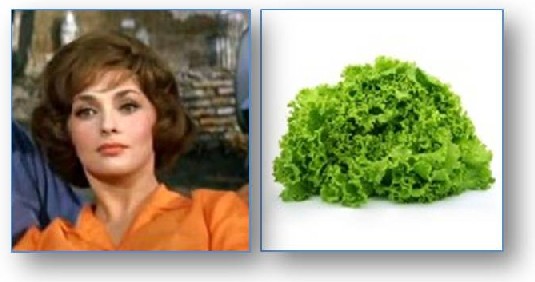
……I’d have had a vegetable named after me.
Seriously. Gina Lollobrigida has a humble lettuce named after her. The lollo lettuce—green and red varieties—supposedly looks like the gorgeous Italian’s hair style, all curly and wavy and yummy. See the resemblance?

Ujala (1959)
I watched this film because it stars Shammi Kapoor. Also, perhaps, because the cast had Kumkum in it—a very good dancer and a not-bad actress, and sadly underrated. Some of the songs I’d heard were hummable. And Mala Sinha (even though she’s beginning to pall on me after a series of awful Mala Sinha-starrers I’ve seen recently) is still bearable. I thought I could deal with Raj Kumar.
What I hadn’t bargained for was an erratic screenplay, some awful acting, and much irritating shrieking and sobbing on the part of Leela Chitnis. But Shammi Kapoor keeps me going through it all.

Pooja ke Phool (1964)
I’ve been on a Dharmendra-Mala Sinha spree, and it’s been a disaster. Baharein Phir Bhi Aayengi started off promisingly, but deteriorated; and Neela Akash was an even bigger disappointment. I had grave doubts about Pooja ke Phool, and sadly, it proved even worse than Neela Akash. I’m not sure I want to watch any more Dharmendra-Mala Sinha starrers. I’ve had enough.
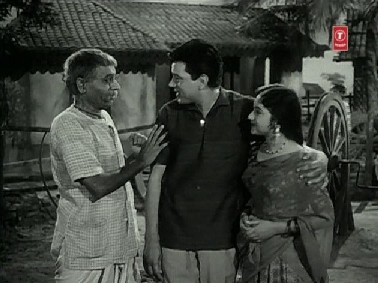
The film begins in a village where a poor blacksmith called Hansraj (Nana Palsikar) is slogging his butt off trying to scrape together money to pay for a college education for his younger brother Balraj `Raj’ (Dharmendra). The only other member of the family is Hansraj’s daughter Vijay (Sandhya Roy).

Neela Akash (1965)
When I see Dharmendra, Mala Sinha, Madan Puri, Mehmood and Shashikala as part of the cast, I’m inclined to sit back with a happy smile and look forward to the movie. I expect to be entertained, not subjected to a string of disconnected scenes that make me want to weep with frustration. But yes, after Baharein Phir Bhi Aayengi (also Dharmendra and Mala Sinha—I’m losing my faith in these two), Neela Akash was another disappointment.
The film begins with the graduation of Neela (Mala Sinha), the eldest of the three offspring of Karamchand (Raj Mehra) and his wife (Sulochana Latkar). Karamchand is the type of father nobody should be subjected to: he’s bossy, selfish, prone to gambling (and worse, losing) at the races, and a drunk. Fortunately, a good-at-heart goon called Abdul Chacha (Madan Puri) hauls him home every night.