Aar-Paar (1954)

I saw this on the big screen, on August 10, 2025.

Given that getting to see a Hindi film as old as this on the big screen, as a proper commercial release (re-release, in this case), is a very rare treat, it needs to be put up front.

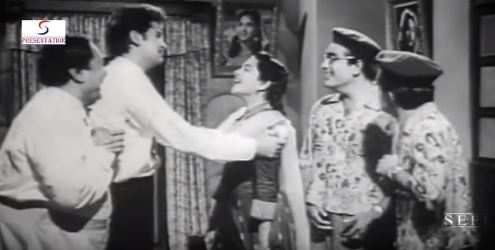
To mark the birth centenary of Guru Dutt, the National Films Division Corporation of India (NFDC) and the National Film Archive of India (NFAI) collaborated to restore and re-release several of Guru Dutt’s films. These were shown at PVR and Cinépolis cinema halls across India on August 8th through to 10th. Left to myself, I would happily have seen all the films that were being screened; but duty calls. August 9th was rakshabandhan, and we had family coming over for lunch. I was busy all through the previous day cleaning and cooking and generally preparing, and then again through half of the next day. But, once our guests had eaten, I scurried off cinema-wards to watch Sahib Biwi aur Ghulam. The following day, I managed to watch Aar-Paar.

Continue reading

Baaz (1953)

Today, July 9, 2025, marks the 100th birth anniversary of one of Hindi cinema’s best-known film directors. Born in Mysore on this day in 1925 as Vasant Kumar Shivshankar Padukone, Guru Dutt studied in Calcutta before joining Uday Shankar’s India Culture Centre (in Almora, present-day Uttarakhand) to train in dance. By the time he turned 19, he had moved to Pune, where he began working as a choreographer for Prabhat Studios. By the time Prabhat Studios folded up (in the early 1950s), Guru Dutt had formed a close friendship with Dev Anand, because of whom he received his first break as a director: in 1951, he directed Navketan’s Baazi, starring Dev Anand, Geeta Bali and Kalpana Karthik in a noir thriller that was to become a defining film for Navketan: edgy, stylish, dark, very urban.

Guru Dutt is today revered more for the hard-hitting, cynical cinema he made: films like Pyaasa, Sahib Bibi aur Ghulam and Kaagaz ke Phool hold up the mirror to a world that is selfish, cruel and opportunistic. These are bitter films, films that plumb the depths of human nature; films that—despite following most of the standard tropes of commercial Hindi cinema (a romance between the lead couple; a fair number of songs; a comic character invariably played by Johnny Walker)—were quite different from other Hindi films.

These, too, are the films for which Guru Dutt is mostly remembered today. Is that because over the decades, people have seen how the tragedy and turmoil of Guru Dutt’s personal life was probably reflected in films like these? Is there a voyeuristic tendency to try and spot the man behind the director?

But Guru Dutt also made other films, on other subjects. This one, for instance, an adventure/patriotic film set on the high seas, with Geeta Bali starring as the eponymous ‘Baaz’ (falcon), a woman who becomes a pirate to free her land of a colonial tyrant.

Continue reading

Howrah Bridge (1958)

Aaiye meherbaan baithiye jaan-e-jaan, and Mera naam Chin Chin Choo. Two great actresses, two iconic songs.

When I was doing the Helen tributes last month, I was reminded of Mera naam Chin Chin Choo all over again—and remembered, too, that I had never reviewed Howrah Bridge on this blog. It has also been many years since I last watched the film (before I launched Dusted Off), so I decided it was high time I revisited this.

Howrah Bridge begins very far from the bridge, and in fact from Kolkata: in Rangoon, where Prem Kumar (Ashok Kumar) finds his father (Brahm Bhardwaj) in a flap. Daddy is distraught because Prem’s elder brother Madan (Chaman Puri, in a cameo role) has run off from home, taking with him an invaluable family heirloom, a dragon which has been in the family for generations. We later discover that the dragon was crafted in China many centuries ago, and from there came to be owned by the king of Burma, after which it passed into the possession of Prem’s family.

Continue reading

Naya Daur (1957)

Happy 100th birthday, Dilip Kumar!

It was on this day that Mohammad Yusuf Khan, who was to go on to become one of India’s most-loved and finest actors, was born in Peshawar’s Qissa Khwani Bazaar.

In a career spanning several decades, and some sixty-odd films, Dilip Kumar attained a status all his own. He was one of the first to win a Filmfare Award, and went on to win the most Best Actor Awards (until the record was equalled— though not yet surpassed). His scenes have been copied and re-done, his dialogues have become familiar to fans of cinema, his films and his acting closely dissected.

Continue reading

Humsaaya (1968)

In which Joy Mukherji single-handedly (with some help from the snow-clad Himalayas) defeats an invading army of Chinese guerrillas, thus lending a whole new meaning to the phrase ‘humsaaya aasmaan ka’.

Continue reading

12 O’Clock (1958)

Years ago, in the good old days when the single channel on Doordarshan was our main source of entertainment and we therefore watched everything that was telecast, I watched 12 O’Clock. I’d already seen Guru Dutt’s big films—Pyaasa, Sahib Biwi aur Ghulam, Kaagaz ke Phool, Chaudhvin ka Chaand. I assumed, based on those (I had yet to watch Bahurani or Saanjh aur Savera, and had thought Mr & Mrs 55 a flash in the pan), that 12 O’Clock would be along the lines of the serious stuff Guru Dutt churned out.

… which this is not. Because this is one of a handful of the films Guru Dutt acted in but did not direct.

Continue reading

Kahin Din Kahin Raat (1968)

Let’s say you’re a film maker in the Hindi cinema of the late 1960s. You’ve set your heart on making a thriller. You have some money, but not enough to be able to hope to churn out something with Shammi Kapoor, set in Europe. You see all these glittering films—Teesri Manzil, An Evening in Paris, Jewel Thief—being released, and it irks you. If they can do it, why can’t you? So one day you gird up your loins, and inspired by all of these, and all the James Bond movies you can lay your hands upon, you set out to make your own thriller.

You cannot afford Shammi Kapoor [or is he perhaps too discerning to agree after he’s read the script?], so you settle for Biswajeet instead. You don’t have the budget to shoot abroad, but that doesn’t matter. You will make do by bringing abroad here to India, by plonking a bronze wig onto Biswajeet and having him pretend to be a Parisian named Robbie for much of the film.

Biswajeet with Helen in Kahin Din Kahin Raat Continue reading

Hum Sab Chor Hain (1956)

I have to admit that I watched this film against all advice. Anu had watched it a couple of years back (and had written up a review of it); but I—remembering a long-ago viewing of Hum Sab Chor Hain, which I’d enjoyed immensely—decided to give it a try anyway.

And, it seems the version I got to watch, while as incoherent in the second half as the one that Anu saw, at least had some more parts intact. The main problem, from what I could see, was that—possibly in transferring the film from celluloid to digital—the reels got mixed up, with one of the reels that should’ve come early in the film ending up later, thus making things very confusing. Despite that (and despite some shameful editing in the last half-hour by the video production company), this evoked one reaction in me: If only this could’ve been available in the original version. Because, if you try to fit the pieces together and imagine what might have been in the bits so summarily chopped off, you can see the outline of what must have been a pretty funny and entertaining film.

Ram Avtar, Shammi Kapoor, Nalini Jaywant, Rajendranath in Hum Sab Chor Hain

Continue reading

Book Review: Raju Bharatan’s Asha Bhosle: A Musical Biography

At the risk of being labelled an iconoclast and being trolled by diehard Lata fans, I have mentioned several times on this blog how much I like Asha Bhonsle. It’s not that I don’t like Lata: I do, very much, and there are many, many songs of hers that I cannot imagine anyone else singing, or singing better than she does. But when I think of Asha, of Aage bhi jaane na tu and Saba se yeh keh do and Yehi woh jagah hai… I cannot help but think that Asha is too often unfairly dismissed as being second to her Didi.

So, when I was offered a chance to review Raju Bharatan’s Asha Bhosle: A Musical Biography (Hay House Publishers India Pvt Ltd, ₹599, 332 pages), I jumped at it. (If you want to read a shorter and more tactful review, read the one I wrote for The New Indian Express, here).

Raju Bharatan's 'Asha Bhosle: A Musical Biography'

Continue reading

Mohabbat Zindagi Hai (1966)

Considering ‘arranged marriages’ were—and still are—so common in India, the fact that old Hindi cinema tended to focus mostly on ‘love marriages’ seems rather odd to me. It’s more romantic, I suppose, to imagine that one will fall in love and end up, after various trials and tribulations and having encountered sundry obstacles, married to one’s sweetheart.

There were exceptions, though, the occasional film about people getting married first, and falling in love later. There was Ghoonghat, Saanjh aur Savera, Blackmail, or those examples of child marriages, Chhoti si Mulaqat and Ji Chaahta Hai. Most of them about people who are forced—because of their own submissiveness, and because they can’t pluck up the courage to say no to bossy elders—into getting married to near or complete strangers.

Unlike this one. Mohabbat Zindagi Hai is one of the few examples (Mr & Mrs 55 was another) of someone getting married for a very mercenary reason. And, as in Mr & Mrs 55, the heroine here is an heiress who needs to get married in a hurry in order to inherit. No husband, no money. But, unlike Mr & Mrs 55, the heroine here doesn’t marry because she thinks she can easily divorce her unwanted husband soon after; she marries him because he’s on death row. He won’t be alive three days after their wedding.

Dharmendra and Rajshree in Mohabba Zindagi Hai Continue reading