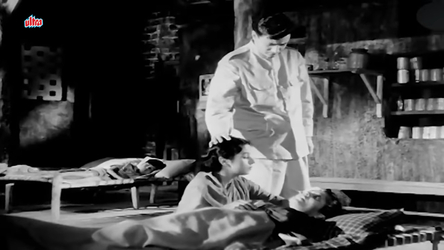
Aar-Paar (1954)

I saw this on the big screen, on August 10, 2025.

Given that getting to see a Hindi film as old as this on the big screen, as a proper commercial release (re-release, in this case), is a very rare treat, it needs to be put up front.

To mark the birth centenary of Guru Dutt, the National Films Division Corporation of India (NFDC) and the National Film Archive of India (NFAI) collaborated to restore and re-release several of Guru Dutt’s films. These were shown at PVR and Cinépolis cinema halls across India on August 8th through to 10th. Left to myself, I would happily have seen all the films that were being screened; but duty calls. August 9th was rakshabandhan, and we had family coming over for lunch. I was busy all through the previous day cleaning and cooking and generally preparing, and then again through half of the next day. But, once our guests had eaten, I scurried off cinema-wards to watch Sahib Biwi aur Ghulam. The following day, I managed to watch Aar-Paar.

Continue reading

Kaala Paani (1958)

Today is the 100th birth anniversary of one of my favourite Hindi film directors, the suspense-specialist Raj Khosla (I hasten to add: I am well aware that that’s a generalization, since Khosla made a lot of films, too, that had nothing to do with the thriller/suspense genre: Mera Gaon Mera Desh, for example; Chirag, Main Tulsi Tere Aangan Ki, Do Badan, etc). But it is Khosla’s prowess with this particular genre that I especially admire, a skill and talent he showcased in classics of the genre such as Woh Kaun Thi? ((1964), Mera Saaya (1966), CID (1956) and Kaala Paani (1958). In each of these films, he managed to combine the classic elements of the Hindi masala film—a romance, a comedic side track, lots of fabulous songs—while making sure that the suspense remained (mostly) taut, the mystery a solid one.

To commemorate Khosla’s birth centenary, I wanted to review one of his suspense films. Several of these (CID, Mera Saaya, Ek Musaafir ek Haseena, Woh Kaun Thi?) I have already reviewed; I was torn between some of the others: Solva Saal, Kaala Paani, and Anita, all of which I have seen at some time or the other. I decided, eventually, that it was time to rewatch Kaala Paani, a film that I’ve watched several times, but too far back to have reviewed it on this blog.

The story begins on a night in Bombay, with a woman (Mumtaz Begum) hurrying through the streets to the home of a family friend, Mr Kapoor (?). She is in great distress, and confides in Kapoor: Karan has discovered the truth. What this truth is we discover when Kapoor hurries to Karan’s home to find Karan (Dev Anand) sitting, looking bereft. He has found out (how, we aren’t told) that his father Shankar Lal has, for the past fifteen years, been incarcerated in Hyderabad jail for the murder of a tawaif named Mala. Not, as Karan has been led to believe all these years, dead.

Continue reading

Aasmaan Mahal (1965)

Blog reader Raunakjoy, commenting on Himalaya ki God Mein (which won the Filmfare Award for Best Film, outdoing films like Waqt and Haqeeqat), remarked that there were, besides these contenders for the award, also lesser-known but equally—if not more—meritorious films, like Aasmaan Mahal.

I had to admit I had never even heard of Aasmaan Mahal before, let alone watched it. Directed by Khwaja Ahmed Abbas, this film—as I discovered from a cursory look at Google search results—appears in the Limca Book of Records as one of the first Hindi films to not use sets for shooting. Also, the film won Prithviraj Kapoor an honourable mention at Karlovy Vary for his portrayal of an ageing and impoverished nawab trying desperately to hold on to the tatters of his family’s once-substantial prestige.

Continue reading

Kaala Bazaar (1960)

The first time I watched Kaala Bazaar was perhaps in my early teens: the film was being shown on Doordarshan, and given that back then I was very fond of Dev Anand, I watched it. I have very vague recollections of that viewing. What I do recall, vividly, is that I didn’t like that my hero was a criminal.

… which, as I came to realize later, was actually not so very uncommon a style for the characters Dev Anand played. Unlike the other major romantic hero of the time, Shammi Kapoor, Dev Anand didn’t just play characters who got up to ‘mischief’, so to say; his characters—from Tony in Jaal to Raju in Guide, from Chhagan in Roop ki Rani Choron ka Raja to Babu in Bambai ka Babu, plus others—were outright criminals: thieves, conmen, smugglers, men definitely on the wrong side of the law.

Like Raghubir ‘Raghu’ in Kaala Bazaar. Raghu is a bus conductor when the story begins, and within the space of a couple of minutes, his life takes an about-turn. A belligerent passenger is standing in the bus (which is against the rules), and when Raghu asks him to get off the bus, the man refuses. Both he and Raghu lose their tempers. Fists fly, and the next thing we know, Raghu is without a job.

Raghu’s mother (Leela Chitnis) is ill, and he has a sister (Nanda) and a young brother (?) as well; he cannot afford to be without a job. Desperate, Raghu flounders about, trying to find work. If not work, money.

Continue reading

Mem-Didi (1961)

Today marks hundred years of the birth of one of Hindi cinema’s finest directors: Hrishikesh Mukherjee was born on September 30, 1922, in Calcutta.  Beginning in the late 1940s, Mukherjee worked as a film editor in Calcutta, before moving on to Bombay, where too he continued as editor, gradually moving on to direction as well. Mukherjee’s first film as director was Musafir (1957), and while it didn’t fare too well, it set the tone for a lot of Mukherjee’s later works: films about everyday people, with everyday triumphs and everyday sorrows. His were not the masala films that have always tended to dominate Hindi cinema, and yet—whether he was making classic comedies like Chupke-Chupke or Golmaal, or more nuanced, sensitive films like Majhli Didi, Satyakam, or Abhimaan, Hrishikesh Mukherjee made films that were hard to fault. He is one of the rare directors for whom I will watch a film just because it’s been made by this person.

Continue reading

The Clerk and the Coat (1955)

Aka Garam Coat, though The Clerk and the Coat is the title as it appears in the credits of this film, and is also the title for which the Censor Certificate was issued.

This film had been among my bookmarks for a long time, but I’d been putting off watching it because I had a suspicion it would turn out to be very depressing. And I’ve not been in a state of mind conducive to being able to watch depressing cinema. But after having watched several rather ho-hum films (Kismat ka Khel, Passport) I figured I should take the plunge and watch something good, even if not exactly frothy and cheery. Garam Coat, after all, was written by Rajinder Singh Bedi, for whom I have a great deal of respect.

The story is set in an unspecified North Indian town, where Girdhari (Balraj Sahni) lives with his wife Geeta (Nirupa Roy) and their three children: two girls and a pampered toddler named Chanda. Girdhari is a clerk at the post office, where he handles money orders. His two best friends are his colleagues Munilal ‘Muni’ (Rashid Khan) and Sher Khan (Jayant). Girdhari’s salary is so meagre that he and Geeta have to carefully monitor every paisa. This for the rent, this for the milkman, this for the kiraane ki dukaan from where they buy their groceries. This much for the insurance premium, for the electricity bill, for the girls’ school fees.

Continue reading

Pyaar ki Baatein (1951)

I came across this film while I was doing research for my post on Khayyam (who composed two songs for Pyaar ki Baatein) and I was immediately intrigued. Because this film starred somebody whose career I’ve always been a bit baffled by. Trilok Kapoor, younger brother of the stalwart Prithviraj Kapoor, and uncle of three immensely popular leading men—Raj Kapoor, Shammi Kapoor and Shashi Kapoor—had the looks and the talent to make it big (not to mention the family connections, so important in the Hindi film industry), but why did his career veer away into the realms of mythologicals? Why did a man who starred opposite famous actresses like Noorjehan and Nargis (in Mirza Sahiban and Pyaar ki Baatein respectively) end up playing Shiv (or other mythological characters) in one film after another?

I still don’t know, and watching Pyaar ki Baatein only befuddled me further on this count. Because it’s exactly the sort of film, I think, that should have led Trilok Kapoor to star in more of the raja-rani type of films that so many (in my opinion, less attractive) actors, like P Jairaj and Mahipal, made their own.

Continue reading

Do Dooni Chaar (1968)

Mention Shakespeare and Hindi cinema, and most eyes light up. Vishal Bhardwaj’s tragedy trilogy—Omkara, Maqbool, and Haider—come immediately to mind for those who cannot think back further than the 1990s, if that. Those who belong to a certain generation (my own) will probably remember fondly the delightful comedy, Angoor, based on A Comedy of Errors.

Fewer, perhaps, will know that Hindi cinema’s tryst with Shakespeare is much older than Angoor. In 1928, a Hamlet adaptation called Khoon-e-Nahak was released; the same play was adapted for screen again in 1935, this time as Khoon ka Khoon, starring Sohrab Modi in the title role opposite Naseem Banu as Ophelia. In 1941, The Merchant of Venice was adapted as a film named Zaalim Saudagar. And in 1954, Kishore Sahu produced, directed and acted in Hamlet, an interesting and unusual film for Hindi audiences since it was a fairly faithful enactment of the play—down to the costumes, the names, etc.

Along with Hamlet (which seems to win hands down when it comes to popularity among Hindi film makers), another popular play for adaptation seems to be A Comedy of Errors. In 1969, it had been made (though with many departures from the original plot, and with no twin servants) as Gustakhi Maaf, with Tanuja in the double role, opposite Sanjeev Kumar. It’s interesting to note that while Sanjeev Kumar would go on to act in another adaptation of the play (Angoor), Tanuja had already acted in yet another version. Do Dooni Chaar, released in 1968 and quite clearly the inspiration for Angoor.

Continue reading

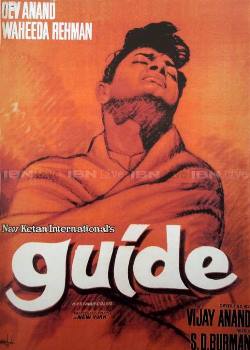
The Guide (1965)

In 1960, RK Narayan won the Sahitya Akademi Award for his novel, The Guide, published in 1958. The story is of a small town tourist guide who has an affair with the lonely wife of an archaeologist, an affair that has a lasting impact on his life.

Of course, anybody who knows anything about Hindi cinema would recognize the plot (and the name) immediately: this, after all, was (minus the ‘The’) the name of one of Hindi cinema’s most popular films ever made. The Dev Anand-Waheeda Rehman starrer Guide, directed by Vijay Anand, won an impressive seven Filmfare Awards (and that excluding what should definitely have been an award, for SD Burman’s brilliant score for the film).

Continue reading

Yasmin (1955)

Fellow blogger and soul sister Anu, at Conversations Over Chai, watched Bahaar for two reasons: one, that it starred Vyjyanthimala; two, that it featured the delightful Saiyyaan dil mein aana re. As it happened (and both Anu and I agreed this was nothing new) she—as I have been, countless times—found herself a victim of the somewhat irrational logic that good music + an actor we like = good film.

But, to get down to this week’s post. A film I watched because, one, it stars Vyjyanthimala; and two, because it has great music. I had steeled myself for something pretty irritating, so perhaps the fact that I began this film with low expectations had much to do with my eventual enjoyment of it. Yasmin isn’t  a masterpiece, but I still liked it, predictability and all.

Continue reading