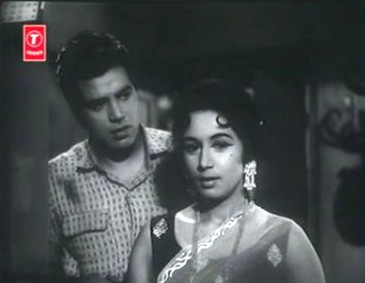
Jaal (1967)

I had first watched this film many, many years ago, probably as a young teen. It had been aired on Doordarshan, back in the good old days when our family used to watch pretty much every film that was shown (including some seriously grotty ones like Fauji).

I remembered little of Jaal: Mala Sinha and Biswajeet, yes; and that it was a suspense thriller set in a spooky mansion beside the sea. That was all.

While I don’t like Biswajeet, and the music of Jaal (by Laxmikant-Pyarelal) is forgettable enough to not want to watch it for the songs, I decided I should give this one another try. At least find out what it’s about.

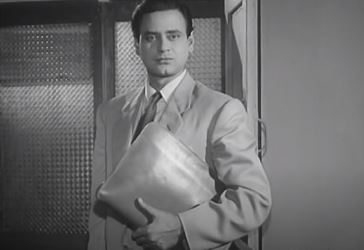
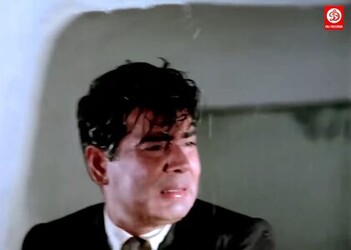
The story begins on a stormy night at sea. A small boat is tossed about on the waves, and we catch glimpses of the lone man on board: Sunder Singh (Sujit Kumar) as he tries to control his vessel. In the distance can be seen (like the boat and the waves, looking patently artificial) a lighthouse. Sunder, however, cannot make it safely to shore; his boat crashes against the rocks and explodes in a great burst of fire.
Continue reading

Insaaf ka Mandir (1969)

Insaaf ka Mandir is a relatively little-known film which I’d seen many years back, but had forgotten most of. It was fellow blogger Jitendra Mathur who reminded me of this, and my memories of the film were pleasant enough for me to want me to rewatch and review this.

The story begins with Sunil (Sanjeev Kumar), a student who’s just completed his law studies at college when he receives an urgent telegram: his father is very ill, Sunil should head home immediately. A classmate of Sunil’s, Sunita (Snehlata), comes by and, in a brief conversation, confesses to Sunil of her love for him; Sunil, embarrassed, tells her that he will not do anything against his father’s wishes.

Continue reading

Apradhi Kaun (1957)

The world of Hindi cinema is peppered with names that anyone familiar with the industry (at least the industry of the 50s and 60s) can quickly slot into categories. Star. Villain. Comedian. Character actor. There are many, many names that automatically fall into (almost exclusively) one of these categories. Those that have shifted from one category to another—like Pran, for instance, once the quintessential villain but in later years the more interesting ‘good man’, or Ajit and Premnath, both initially hero and later villain—have again usually not done too many shifts.

Abhi Bhattacharya is one of those relatively rare individuals who seem to have appeared in a wide variety of roles, a wide variety of films. He was the idealistic school teacher of Jagriti, the ‘other man’ of Anuradha. The kind-hearted, principled example of the bhadralok in films like Amar Prem, and the straying older brother of Dev Anand in Love Marriage. He played Krishna and Arjun and Vishnu (the latter in a slew of mythologicals). He even played the villain, in the Vinod Khanna-Yogita Bali starrer, Memsaab.

This year marks the birth centenary of Abhi Bhattacharya (as far as I’ve been able to find out, he was born in 1921, though I’ve not been able to discover exactly when in 1921). To commemorate his career, I wanted to watch a Bhattacharya film, but a dilemma presented itself: which one? Hindi or Bengali? (since Bhattacharya had what seems to have been a very successful career in Bengali cinema as well). Eventually, I homed in on this film, a rare whodunit in Hindi cinema that’s pretty well made too.

Continue reading

Oonche Log (1965)

A scene near the beginning of Oonche Log is an interesting revelation of some of the themes that govern the film, and eventually have a bearing on its climax.

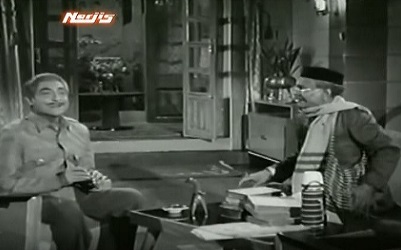
Major Chandrakant (Ashok Kumar) is a blind, widowed ex-officer of the Indian National Army. He now lives in Ooty. One evening, he receives at his home a friend, the school teacher Dhuni Chand (Kanhaiyyalal). There are more dissimilarities than similarities between the two men: Dhuni Chand is poor, barely managing to make ends meet on his salary and what he makes from the odd tuition, while the major is comfortably off, spending his time writing his memoirs.

Major Sahib receives DhunI Chand

Continue reading

Kohraa (1964)

I feel that, no matter how high an opinion one may have of oneself, it is risky business to attempt to remake a classic. If (for example) Alfred Hitchcock made a film, don’t attempt to remake it—especially if you plan on tinkering with the way the story plays out. Biren Nag (who had already made the pretty good suspense thriller Bees Saal Baad) tried his hand at remaking Hitchcock’s atmospheric Rebecca here, and while he got some things right, the end result is not quite as memorable as Rebecca was.

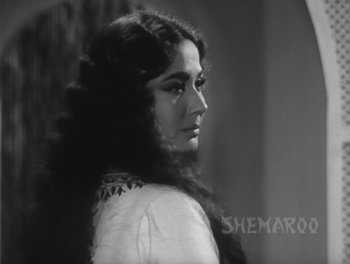
Waheeda Rehman in Kohraa

Continue reading

Gumnaam (1965)

For anybody who’s been following my idea of ‘linked posts’ – each post connected to the one before, and to the one after – this probably comes as no surprise. And Then There Were None was based on Agatha Christie’s highly popular novel and play; Gumnaam is, in turn, an adaptation of And Then There Were None. Not a completely faithful adaptation, but a vastly entertaining one, as you’ll see if you scroll through the comments on my And Then There Were None post: most of my readers, even if they’ve not seen the Hollywood film, have had something to say about Gumnaam.

Continue reading

Madhumati (1958)

A Johnny Walker film, but one that’s known for a lot else besides.

I always associate Bimal Roy with the Do Bigha Zameen or Parakh sort of film: deeply rooted in reality, both harshly real and heart-warmingly real. Stories about people like us, people with problems and joys like ours. His films are socially relevant ones that discuss issues like untouchability and corruption, poverty, alcoholism and the plight of those who aren’t economically or socially powerful enough to stand up for themselves.

Madhumati is the glaring exception, the extremely surprising entry in Bimal Roy’s filmography: a film that’s chockfull of everything one doesn’t expect of Bimal Roy. Reincarnation, spooks, multiple roles, atmospheric storms: one could almost think Ramsay Brothers. Thankfully, no; because Madhumati, though in a completely different genre than Bimal Roy classics like Sujata, Bandini, Do Bigha Zameen or Devdas, still bears the mark of a master craftsman. And it’s good entertainment value.

Continue reading

Akashdeep (1965)

Once upon a time, there was a writer.

No: it wasn’t Dharmendra, and it certainly wasn’t Nanda (old Hindi cinema, at least, doesn’t seem to believe women capable of writing anything more complex than a love letter, if that).
This writer was someone quite different, and one day (I’m guessing) decided that it was time to show the world what he was capable of. So, with a producer and a director, the writer went into action, and what resulted was Akashdeep. Looking at the film, I’m assuming this was somewhat of a collaborative effort. A “how about this?” and a “don’t you think it would be a good idea—?” sort of film.

Continue reading

Sujata (1959)

Another film from one of my favourite directors, and with two of my favourite stars as well. Like many of Bimal Roy’s other productions—Parakh, Usne Kaha Tha, Bandini, Kabuliwala, Do Bigha ZameenSujata is about people like you and me, not outright villains (I like to think I’m not one!!), but not saints either (yes, well, I have to admit I’m not one of those, either). People who’re shades of grey, not black and white. And, like most of Bimal Roy’s other films, this one too focuses on the underdog: in this case, an ‘untouchable’ girl.

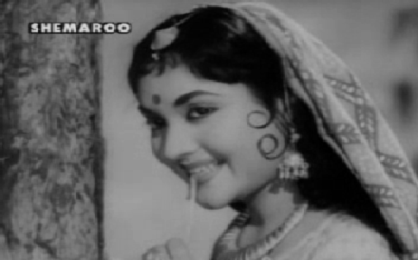
Nutan and Sunil Dutt in Sujata

Continue reading