Sadhu aur Shaitan (1968)

Cinema looking at itself is not an uncommon feature; there have been several notable films, both in India (Kaagaz ke Phool, Sone ki Chidiya) as well as abroad (Cinema Paradiso, 8½, The Bad and the Beautiful, etc), which are about cinema and film-making. But this film, relatively obscure, really should be part of the annals, simply because of its sheer devotion to Hindi cinema. Not because it’s about film-making, not because there is even (as in Solvaan Saal), a single scene on the sets of a film. But because it celebrates Hindi cinema in so many ways, on so many levels.

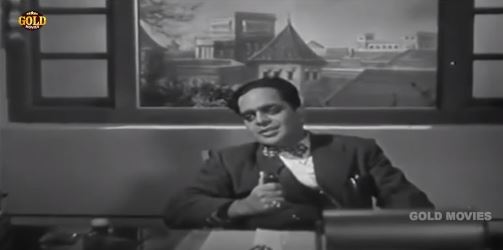
Sadhu aur Shaitan begins by introducing us to the eponymous ‘sadhu’ of the story: Sadhuram (Om Prakash), a widower who lives with his two children Ganesh (Master Shahid) and Munni (Baby Fauzia), and the maid Ramdeyi (Dulari) who looks after home and the children. Sadhuram is a somewhat excessively ‘good and righteous’ man, the living image of piety (all a little over the top as far as I’m concerned, but at least he isn’t stuffy about his righteousness).

Continue reading

Chandralekha (1948)

When I did my post on double roles in Hindi cinema, someone mentioned Ranjan as having done a double role in Chandralekha, the 1948 film which was made both in Tamil as well as in Hindi, and was a big hit. Some years ago, I would have probably filed that bit of information away and not acted on it. Ever since I saw Ranjan in Nishaan, however (and liked him), I have been open to the idea of watching other films starring this dashing actor (who, by the way, was a trained pilot as well). Besides, I remembered that Chandralekha was supposed to be a pretty big film: good production value, opulent sets and so on. Why not see it, I thought.

(By the way, Ranjan does not have a double role in this film).

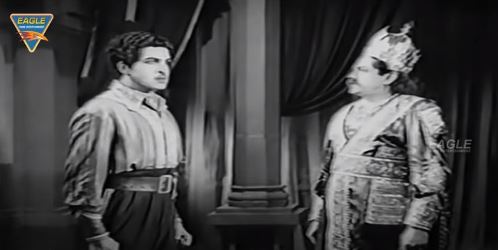
The story is set in a kingdom ruled by a king with two sons. The elder son, the crown prince, is Veer Singh (MK Radha): a ‘good man’, a devoted son and an upright, just would-be ruler. The younger son, Shashank (Ranjan) is the complete opposite of Veer Singh: ambitious, greedy, demanding the throne for himself. The king keeps trying to put him off, to defy him when Shashank tries to bully him, but nothing works. Finally, the king is obliged to banish Shashank.

Continue reading

New Book! Lockdown Lunches: The World On a Plate

Those of you who’ve been following this blog for some years may know that I am passionately fond of food. For a while, I reviewed restaurants here, along with all the films I review. One year, I did an entire ‘food film’ project, where I watched many, many food films from across the world and cooked up dishes to accompany them. I devoted the month of October 2018 to food in films.

Yes, I find food just about as interesting as cinema. More, at times.

So this was bound to happen: a book on food. My first non-fiction book, part memoir, part an exploration of food history from around the world, part cookbook.

Continue reading

Book Review: Manek Premchand’s ‘Majrooh Sultanpuri: The Poet for All Reasons’

Three years ago, celebrating lyricist Majrooh Sultanpuri’s birth centenary on my blog, I wrote that it was a tough ask to select just ten songs from the more than two thousand that he wrote in the course of a film career that spanned a whopping five decades.

For a blog post, restricted (admittedly by its writer) to just ten songs, that can be a challenge; but it is also a challenge for a full-length book to do justice to a colossus of the size and stature of Majrooh. It’s not even as if, when discussing Majrooh, one could get away with just talking about the songs he wrote for Hindi cinema: to be able to portray, with any veracity, not just the poetry of Majrooh but also his personality, the man he was, the work he did, how he thought—all of this requires a lot of research, a lot of organization and careful planning.

Manek Premchand’s Majrooh Sultanpuri: The Poet for All Reasons (Blue Pencil Publishers, 2021) is an ambitious project, an attempt to capture, within the pages of a book, the life and career of one of Hindi cinema music’s greatest personalities.  

Continue reading

Apna Desh (1949)

Happy birthday, Manmohan Krishna.

Today is the birth centenary of one of Hindi cinema’s best-known and most-loved character actors, the very versatile Manmohan Krishna of the beetling brows and the prominently curved lips, who could assay pretty much any kind of role film makers cared to throw his way. Usually slotted as the avuncular older gentleman—the now blind former taxi driver of Dil Tera Deewaana, the philosophical mendicant of Railway Platform, the saintly Abdul Rasheed of Dhool ka Phool, who brings up a foundling to be neither Hindu nor Musalmaan, but a human being—Manmohan Krishna did show, in the rare film where he was given a chance to act a rather less predictable character, that he was perfectly capable of that as well. He could be the evil Lalu Ustad in Sadhna; the wolf in sheep’s clothing in Bees Saal Baad, and the imperious daddy, disapproving of forbidden love, in many films.

Continue reading

Lata Mangeshkar: Ten Solos, Ten Composers – Part 2

When Lata Mangeshkar passed away earlier this month, I wrote a tribute post in which I listed ten songs, all solos, that Lata had sung for ten different composers. Naturally—given Lata’s record number of songs—there were many, many songs and many composers that didn’t get covered in the list. Blog readers helpfully suggested other great songs that could have been part of the list, or which they especially liked; some wondered why I had not listed this song or that. Or why so-and-so composer had not been included.

Even when I had been compiling that post, I’d been thinking, there really ought to be a sequel to this. A post, at least, to include some of the other great music directors for whom Lata sang some exceptional songs. As well as the music directors who may not have been very famous, but who were nevertheless very talented.

Continue reading

Thana Theke Aschi (1965)

When I reviewed An Inspector Calls a couple of weeks back, blog reader AS, in a comment, mentioned that a Bengali version of the film (or rather of the play by JB Priestly, on which it was based) was also made, starring Uttam Kumar: Thana Theke Aschi. This was a film that had been recommended to me earlier as well, so I had it bookmarked; but I hadn’t known it was a version of An Inspector Calls.

Now, fresh from my viewing of (and gushing over) An Inspector Calls, I decided I had to watch Thana Theke Aschi while the story was still fresh in my mind.

The story begins with a brief glimpse of a faceless woman, lying dead on the floor of a dingy little hut, an empty bottle of carbolic acid near her hand. The corpse is found by another woman, who starts to scream.

The scene then shifts to the home of the wealthy Chandramadhav Sen (Kamal Mitra), where an engagement party is in full swing. Mr Sen’s daughter Sheila (Anjana Bhowmick) has just gotten betrothed to Amiya (?), the son of one of Mr Sen’s business associates. It’s a grand party, and once it’s over, Amiya stays on, chatting with the Sens.

Continue reading

In Memoriam: Lata Mangeshkar – My Favourite Solos with Ten Composers

The ‘Nightingale of India’ is no more. Lata Mangeshkar, aged 92, passed away on February 6.

What can be said about Lata that has not already been said? That she was a singer par excellence, that there was never quite anyone else like her? That the sheer volume of her work, in so many languages, across so many years, coupled with the quality of her work, sets her apart from not just her contemporaries, but also those that have followed? That there is unlikely to ever be any other singer (at least female singer) who will be able to match Lata Mangeshkar?

I will not repeat what others, including bloggers like Anu and AK have already so beautifully expressed by way of tribute; let it suffice that for me, too, Lata’s voice was an intrinsic part of growing up, of life itself.

Continue reading

An Inspector Calls (1954)

…at the home of the wealthy and respectable Birling family, just as they finish dinner.

The Birlings have been dining with a guest: Gerald Croft (Brian Worth) has just got engaged to the daughter of the house, Sheila Birling (Eileen Moore). Gerald has got her a wonderful ring, and there’s been much love and affection and congratulations being showered all around.

Continue reading

Nastik (1954)

A hundred years ago, on January 27, 1922, in Golconda (Hyderabad) was born Hamid Ali Khan, known to thousands of Hindi film viewers (and, even thousands more who have perhaps never watched any of his films) as Ajit. The man of ‘saara shahar mujhe loin ke naam se jaanta hai’. The iconic villain, suave and eerily soft-spoken though at the same time very oily and dangerous, of films like Zanjeer, Yaadon ki Baaraat, and Kalicharan. The baas of Raabert and Lilly (who was constantly being told not to be silly).

But long before he became the stuff of really bad jokes, before he attained the stature of one of Hindi cinema’s greatest onscreen villains, Ajit was a hero. Coming to Bombay in the face of parental opposition (having first sold his college books to finance the trip), Ajit had to struggle a lot to find work in the cinema industry. He began as an extra, and worked in several films until being noticed by the Gujarati-Hindi director Nanabhai Bhatt (Mahesh Bhatt’s father) who not only gave him the screen name Ajit, but also launched him in a leading role. Across the 50s and 60s, Ajit acted in a slew of films, both as leading man (Nastik, Dholak, Baradari, Marine Drive, Tower House, Opera House, etc) as well as in major supporting roles (of special note here are Naya Daur and Mughal-e-Azam, in both of which he appeared alongside Dilip Kumar).

Continue reading