Talaash (1969)

There are a bunch of films that I’ve read a plot synopsis of, found it interesting, thought I’d try and watch it—and then taken a look at the cast, only to discover it starred someone I didn’t like. It’s happened time and again; with Talaash, having discovered that the film starred Rajendra Kumar, I decided to put the film on the back burner, even though the synopsis sounded interesting.

Then, reading Anirudha Bhattacharjee and Balaji Vittal’s SD Burman: The Prince Musician, and seeing the list of songs (some of them truly lovely ones), I thought I may be able to sit through the film. Perhaps the rest of the cast, the interesting story, and the good music, would compensate for Rajendra Kumar.

Talaash begins with the graduation of Raj Kumar ‘Raju’ (Rajendra Kumar), who is being congratulated by all his classmates for having once again come first in the class. Raju goes off to meet his friend Lachhu (OP Ralhan, who also directed this film, which was produced by Rajendra Kumar). Lachhu has, after seven tries, finally managed to graduate too. They congratulate each other, and talk briefly of their futures. Lachhu will be roped in to work at his wealthy father’s cloth shop; Raju doesn’t know what he’ll do, but he’s certain: the wealth of his family will only be doubled. Yes, he’s not known want, ever, and he will continue to enjoy all that wealth, now through his own hard work.

Continue reading

Rani Rupmati (1959)

Considering this is a period film—a ‘raja-rani’ film, so to say—and it has some great music, I’ve not made much of an effort to watch it. I don’t mind Nirupa Roy in leading lady roles (she could look really pretty, and as long as she wasn’t playing the self-sacrificing and long suffering Sati Savitri, she was fine). But Bharat Bhushan isn’t my cup of tea. Along with Pradeep Kumar and Biswajeet, he is one of those actors whom I invariably see lip syncing to great songs, and wish the songs had been picturized on someone else.

But I finally decided it was high time I watched Rani Rupmati.

The story begins by introducing us to the town of Mandavgarh (now better known as Mandu), part of the kingdom of Malwa. Malwa is ruled by Pathans: its Sultan is Shujat Khan, whose elder son, Baazid Khan ‘Baaz Bahadur’ (Bharat Bhushan) seems to be an effeminate, music-loving hedonist who spends all his time doing riyaaz with his ustad.

Continue reading

The Guide (1965)

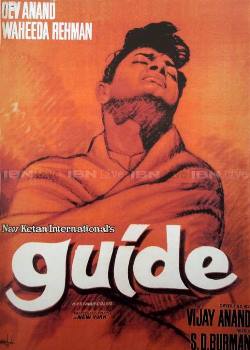
In 1960, RK Narayan won the Sahitya Akademi Award for his novel, The Guide, published in 1958. The story is of a small town tourist guide who has an affair with the lonely wife of an archaeologist, an affair that has a lasting impact on his life.

Of course, anybody who knows anything about Hindi cinema would recognize the plot (and the name) immediately: this, after all, was (minus the ‘The’) the name of one of Hindi cinema’s most popular films ever made. The Dev Anand-Waheeda Rehman starrer Guide, directed by Vijay Anand, won an impressive seven Filmfare Awards (and that excluding what should definitely have been an award, for SD Burman’s brilliant score for the film).

Continue reading

Vachan (1955)

I started my first draft of this post by writing that “I watch some films because of the people who made them”. Then it struck me that that, almost invariably, is the only reason I do watch a film. After all, everybody—the director, the music director, the lyricist, and of course the cast (besides the many hundreds of other, often unnamed, people) who work on a film are those who made them. Sometimes, it’s the cast that appeals to me: give me people like Shammi Kapoor, Dev Anand, Sadhana, Waheeda Rehman—oh, and many more—and I will happily begin watching any film they’re in (whether or not that experience will end up being as rewarding a one I’d hoped for is another matter). Sometimes, it’s just the name of a well-loved and much-respected director—Bimal Roy, Hrishikesh Mukherjee, Vijay Anand among them—that’s enough.

Sometimes, it’s the music. Sometimes, it’s just one song.

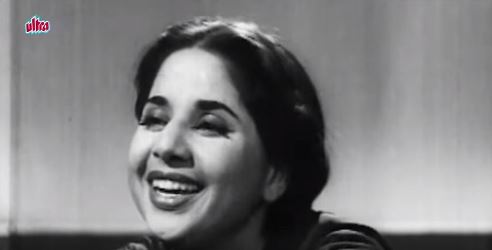
In this case, it was just one song. I was singing Chanda mama door ke to the LO the other day, and I thought: that’s a nice song, and Geeta Bali looks so pretty; I wonder what the film’s like.

Continue reading

Songs in the Snow: Ten of my favourites

Some weeks back, a friend who follows my (occasional) travel writing approached me with a question: where was the place closest to Delhi where one could see snow? Over a weekend? I thought fleetingly of Shimla, of Kasauli, and of Lansdowne—though I’m not certain Lansdowne receives much snow—and eventually had to tell her, regretfully, that it may not be easy to take a weekend trip from Delhi to enjoy the snow.

That brief discussion made me a little nostalgic for the snow. When I was 9 years old, my father (who was in the IPS, and then on deputation to the ITBP) was transferred to Srinagar. We stayed there for the next three years, and in that time, we experienced a lot of snow. Not just during our travels across Ladakh (and through mountain passes like Zoji la, Chang la, and Khardung la, all of them surrounded by snow even in summer), but even while living in Srinagar.

And, one thing I realized was that while snow may look very pretty (when it’s fresh, that is: old snow, with soot piling up on it, or snow that’s melted, got churned into underlying mud and then refrozen, is not pretty at all), it’s tough to live with. It piles up. On driveways and paths, choking them. On roofs, where it slowly slides down until it hangs, in great piles, along the eaves until it suddenly slides down and falls in one great solid slab that can be potentially fatal, if you happen to be standing under it. It collects on electricity and telephone wires, turning them into fat white cables (and sometimes snapping them, which means you end up without electricity or a telephone line—though I suppose things must be easier now that everybody has cell phones).

Back then, in the early 1980s, we had yet another problem: when it snowed a lot, there was also the added danger of water freezing in the water pipes—and because ice expands, that could make the pipes burst; so the local water department of the Srinagar municipality would shut down the water supply. On more than one occasion, we ended up scooping snow from our lawn and boiling it to obtain water (not a pleasant experience—a lot of snow yields comparatively little water, and it takes ages to melt, especially when the ambient temperature is below 0).

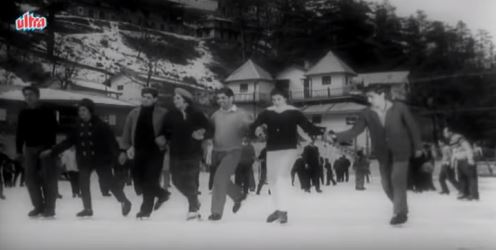
Ah, well. This is a song list, so let’s get down to the songs. Ten songs, from pre-1970s Hindi cinema, which features snow. Very few songs, as far as I could tell, are shot completely in the snow, so I’ve given myself some leeway: the song should feature some amount of snow; it need not necessarily be all against a backdrop of snow. And the snow, even if it’s not real (I recall an interview with Manoj Kumar where he talked of drifting soap flakes getting in his mouth while filming a ‘snow scene’ in Hariyali aur Raasta), should at least not look patently fake.

Continue reading

Tamasha (1952)

When you are as devoted to the pursuit of old Hindi cinema as I am—and you assiduously discuss old cinema with other like-minded souls—you keep getting recommendations. Some recommendations I take with a certain amount of leeway automatically assigned, since I know that the recommender has his or her own biases that are likely to be reflected in the film in question. Others I tend to blindly follow, because over time, I’ve realized that these are people who pretty much share my own ideas of what comprises watchable cinema.

One of these is Anu, who blogs at Conversations over Chai. We have our differences (Raj Kapoor is one), but by and large, Anu and I tend to agree about cinema. So when Anu, chatting with me during my trip in August to meet her, recommended Tamasha, I immediately made a note of it. After all, Dev Anand, Meena Kumari, Ashok Kumar, Kishore Kumar—and a comedy? That certainly sounded like something I wanted to watch.

Continue reading

I Wake up Screaming (1941)

Happy New Year!

… and, what better way to start off the year than with a celebration of a life? A life that was marked both by success and by failure; by happiness and—sadly—by despair so extreme that it drove the person to suicide. Carole Landis (1919-1948), popularly dubbed ‘The Ping Girl’ and ‘The Chest’, who made her breakthrough in One Million BC (1940), though she had debuted in the very popular A Star is Born (1937).

Continue reading

The Holly and the Ivy (1952)

I get the impression, every time I happen to read anything related to Hollywood around Christmastime (or, as the politically correct term these days seems to be, ‘the holidays’), that there’s a plethora of Christmas-themed films churned out every year. From comedies to romances to lots of themes that you wouldn’t think really fitted with what is, at its heart, a religious festival, there’s no dearth of Christmas films.

I’ve seen lots of them too, from heart-warming stories about the essence of Christmas to frothy fluff that uses tropes like strategically hung mistletoe and families coming home for Christmas.

Continue reading

Ten of my favourite Bharat Vyas songs

When it comes to Hindi film music, most people—even the committed aficionados—tend to focus on the music directors and the singers. Lyricists are often relegated to the back seat. People can recognize a singer’s voice; they can often remember who composed the song: but who, really, pays a lot of attention to who wrote the song in the first place? Who created the words which make the song what it is?

It has been a while since I did a post on a lyricist (I’ve done song lists for Sahir Ludhianvi and Shailendra on this blog), so before this year ends, one post to honour a lyricist. Bharat Vyas, often credited as Pandit Bharat Vyas, who was born in Churu, Rajasthan, sometime in 1918. Conflicting reports about his birth date appear online: several versions point to December 18th, others cite January 6th. Since I discovered only last month (thanks to fellow blogger Anup, who found out from old Hindi cinema’s walking encyclopedia, Arun Kumar Deshmukh) that the correct date is actually January 6th, this tribute is belated by almost a year. But I figured that at least I got the year right, so while today may not be the birth centenary of Bharat Vyas, 2018 is the year of his birth.

Continue reading

Songs ‘sung’ by people with disabilities: my favourites

Today is International Day of Persons with Disabilities. Since 1992, this day has been promoted by the United Nations in an effort to promote the rights and well-being of people with disabilities, and to increase awareness ‘of the situation of persons with disabilities in every aspect of political, social, economic and cultural life’.

I must confess that as a child, while I didn’t ever laugh at anybody who was disabled, I rarely felt anything other than pity for them. I wanted to help, but always felt awkward. I wondered what disabled people would do if they didn’t have family members to help them out. I used to think that to be disabled meant that you basically sat about and waited for people to do most things for you.

Thankfully, I’ve grown up and now know better.  I acknowledge that there are different types of disabilities, from the completely crippling to the type that can, at first glance, go unnoticed. I acknowledge that a physical disability can have absolutely nothing to do with the mental or other abilities of a person (think Stephen Hawking). I deeply and truly appreciate Indian corporates like Lemon Tree Hotels, Pantaloons and Costa Coffee, at all of whose stores or properties I have been served by people with disabilities. I wish for a world that is more accepting of the abilities of those with disabilities.

That said, how about a post on Hindi film songs lip-synced by characters with disabilities? Blog reader John suggested this idea way back in February this year, and I was immediately drawn to it. Partly because I did want to observe this particular day on my blog, and partly because Hindi cinema has some superb songs ‘sung’ by people with disabilities. Hindi cinema, especially back in the 50s and 60s, may have used disability—especially blindness—in a convenient way to complicate the lives of already-suffering characters (and restoring their sight/other ability even more conveniently), but at least nearly all of them got a chance to sing. Mournful songs at times, philosophical ones at others, but songs, all right.

Continue reading