Muslim socials are among the genres I can never have too much of. Back in their heyday, they had some of the best music around (remember Chaudhvin ka Chaand? Barsaat ki Raat? Mere Mehboob? The inimitable Pakeezah?) There was the chance to savour the mellifluous sound of Urdu; to peek into a social structure and lifestyles that often went otherwise unexplored in cinema; and to see women in shararas and men in achkans [the latter, like military uniforms, equipped with some inexplicable means of making even Bharat Bhushan and Rajendra Kumar look good].
Category Archives: Dusted Off

Intequam (1969)
When Anu listed her favourite Sadhna films, I remarked that another Sadhna film I like—though it’s from later in the actress’s career—is Intequam. Based on Vendetta, a Marie Corelli novel (the only film adaptation of a Corelli work that’s in colour), Intequam is a story of vengeance. Though it features a Sadhna whose gorgeousness had begun to suffer because of her medical problems, she’s still interesting—and the central character in this film.

Songs of romantic love – in ten moods
Ah, well, the Valentine’s Day bandwagon and all that.
Seriously, I’ve blogged through five Valentine’s Days, and steered clear of the temptation to post something even vaguely romantic (largely because my idea of what constitutes ‘romantic’ is more often than not at odds with what old Hindi cinema, or even a lot of Hollywood, thought of as romantic). This year, however, I’ve decided to throw in the towel. Romance is in the air. And Hindi cinema, as any Hindi film buff will know, has always loved romance (especially in the 50s and 60s, when any self-respecting film had at least one romance in it, if not more).
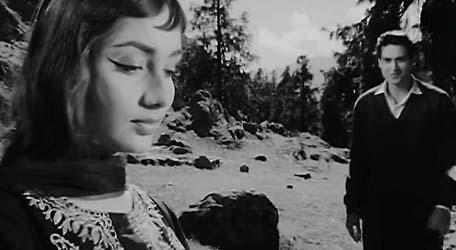
But, since I’m a bit of a non-conformist, I’m doing this with a twist: not necessarily a serenade to a loved one, and not necessarily two lovers billing and cooing to each other. Instead, romantic love in its different forms and shapes and tones and hues. All of these songs are about romantic love (not maternal/fraternal/patriotic/devotional or other forms of the sentiment), and they’re all from pre-70s films that I’ve seen. And they’re each in a distinct mood that shows some aspect of romantic love. Enjoy!
Topkapi (1964)
RIP, Maximilian Schell.
Of the cinema personalities who have passed on recently and to whom I’ve posted tributes on this blog, nearly all have been people I’ve watched in at least a few films each. People (like Eleanor Parker, who for years I knew only as the Baroness from The Sound of Music) whom I may not initially have been utterly enamoured of, but whom I’ve grown to like and admire after having watched them in numerous roles. Joan Fontaine, Peter O’Toole, Suchitra Sen…
The Austrian-born Maximilian Schell (December 8, 1930-February 1, 2014) is the exception, because this is one actor whom I’ve seen—before I watched Topkapi—in only one role: as the earnest young lawyer in Judgment at Nuremberg. Just one performance (an Oscar-winning one), mind you, and that was enough to make me a Max Schell fan. Enough of a fan to mourn his passing.

The Egyptian (1954)
…and it’s a historical, again!
Frequent visitors to this blog would probably by now have realised that I have a weakness for history and historical films. Give me a sword and sandals epic, a Mughal extravaganza, or just about any film set in the ancient, medieval, or even early modern world, and I’m happy. Even happier when it’s a somewhat unusual setting. And more when the film maker has spent two years researching the film.
The Egyptian is set in the Egypt of 3,300 years ago. The main story plays out as a flashback, the memories of old Sinuhe (Edmund Purdom), who looks back on his life.

An Evening in Paris (1967)
…and a day or two in Beirut (plus an afternoon in the Lebanese countryside, masquerading as provincial France). A couple of days in Switzerland, and a grey afternoon at the Niagara Falls. Lots of Paris, of course, from the Eiffel Tower and the Champs Elysées, to the bateau mouche and pretty little cafés.
And Sharmila Tagore. And Shammi Kapoor. And pretty mad masala.
What with reading about Amar Akbar Anthony (and thinking over the lost-and-found trope), I ended up thinking, too, about An Evening in Paris, which is a good enough example of the genre. In this one, Sharmila Tagore is the one who plays the character(s) who’re lost: twin sisters, separated as children, thanks to a villain. They grow up unaware of each other’s existence, and in classic Hindi film style—ranging from Anhonee to Sharmeelee—with one sister good and the other bad, or at least not-so-good.

There you are!: The ‘lost and found’ trope in Hindi cinema
I suppose I should have dedicated this blog post to fellow blogger Anu Warrier, since the uncanny coincidences that dog our two respective lives and blogs seem straight out of a Hindi masala flick. There is also the fact that Anu and I got slightly acquainted with each other online years ago, then lost touch—until ‘meeting’ again on a film blog a couple of years ago, and realising that yes, this was the same person.
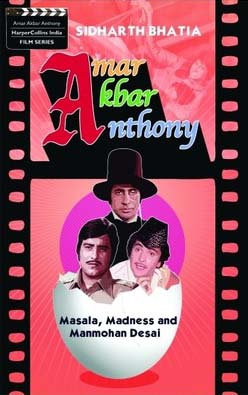
But no, this post is dedicated not to Anu, but to Sidharth Bhatia, whose delightful book Amar Akbar Anthony: Masala, Madness and Manmohan Desai, I’ve been reading. Here, by the way, is my review of Sidharth’s book—if you like Amar Akbar Anthony (and I, despite my love for 50s and 60s cinema, have to admit that I do, wholeheartedly), do get hold of Sidharth’s book. It’s a very satisfying read.
Ten of my favourite filmi wedding songs
It’s wedding season in Delhi (has been, in fact, for the past couple of months). Almost every night, there’s a large shamiana at our local municipal park. There are traffic jams because of huge baaraats, all the women laden with jewellery and tinsel. We see white mares (or, in some cases, a pair of mares pulling a flower-bedecked ‘chariot’) trotting along on roads. We hear a lot of music—or what passes for music.
In fact, every time I hear the sort of music that’s played at many Delhi weddings, I’m tempted to go up to whoever’s acting the DJ, and ask them to play some good shaadi songs.
Since I can’t actually do that, I decided to create my own list: ten Hindi film songs that are directly related to weddings. (Which is why Ab ke baras bhej bhaiyya ko baabul or Laali-laali doliya mein laali re dulhaniya don’t qualify; the words relate to a wedding, but the context is completely different).
Ten wedding songs, therefore, from pre-70s films that I’ve seen. Enjoy!

Christmas in Connecticut (1945)

Aka Indiscretion, which doesn’t sound quite so Christmassy (in fact, it sounds rather more like a Hitchcock film) but describes this one better. Because this film, while it is about an eventful Christmas in Connecticut, is more about an indiscreet little bunch of lies, and the amount of hot water they land their perpetrators in.

In Memoriam: Eleanor Parker (June 26, 1922- December 9, 2013)
On my laptop, I have a bunch of wallpapers of some of my favourite actors and actresses. Every now and then, depending upon whose films I’ve been watching—and therefore, who’s my current favourite—the wallpaper changes (right now, in anticipation of The Hobbit: The Desolation of Smaug, it’s Richard Armitage). For a short time, the wallpaper had been one of Eleanor Parker.