
A couple of months back, amidst a discussion on one of my posts, fellow writer (and fellow Sahir Ludhianvi fan) Karthika Nair and I got involved—as we are apt to do—in talking about Sunil Dutt (who, coincidentally, has appeared in a number of songs written by Sahir). I realized then that I’d never compiled a list of my favourite Sunil Dutt songs. This, despite the fact that he is one of my favourite actors.
Category Archives: Dusted Off

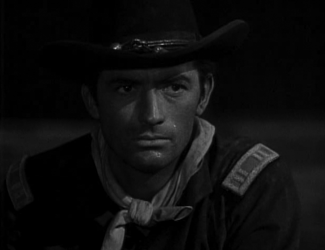
Only the Valiant (1951)
Someone once told me “I don’t watch Westerns and war movies. Too much blood and gore, too little character development, and no message to take home. Nothing but guts and glory.”
True, if (and this is a very big, very emphatic if) the only war films or Westerns you’ve ever seen are the straightforward action types (and even among those, old films tend to be far less gory than their newer counterparts—modern Westerns and war films like The Thin Red Line, Saving Private Ryan, True Grit, etc are, on the whole, far more graphic than their predecessors). But there’s nothing to stop a film—irrespective of genre—from also being well-written, from having good characterisation and character development, and from being something more than a battle of “let’s see who’s braver”. Some of the best films—in fact, even the films that I’ve found affirming virtues like humanity, peace, equality, and so on—I’ve seen have been war films or Westerns: Paths of Glory, La Grande Guerra, The Searchers…
My point being, there are films out there that may seem, at first glance, deceptively run-of-the-mill genre film. Then, at closer inspection, they turn out to be something more.
Book Review: Meghnad Desai’s ‘Pakeezah: An Ode to a Bygone World’
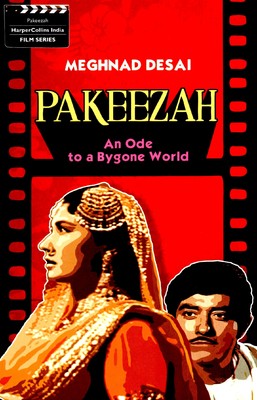
When I posted my review of Pakeezah last week, I mentioned that I’d be posting something further about Pakeezah. This is it, and the reason why I rewatched Pakeezah in the first place: I wanted to see, once again, the nuances of the film, before I got around to reading Meghnad Desai’s Pakeezah: An Ode to a Bygone World (Harper Collins; 2013; ISBN: 978-93-5029-369-0; 152 pages; Rs 250).
Pakeezah (1972)
Whenever people ask me what my movie blog is about, I say pre-70s cinema. Pre-70s, yes, but with a few (very few) exceptions, and those are films released in the very early 70s, but with a distinctly 60s feel to them. Pakeezah is the example I invariably give: a film released in 1972, but with an aura that’s recognisably of an earlier period about it, whether it’s in the fashions, the actors, or the overall look of the film.
Since I generally steer clear of reviewing very well-known films, the format of this review is going to be slightly different from my usual film review. I’ll begin with a much briefer synopsis than usual, then go on to discussing—in far greater detail than I normally do—what I liked about the film, what I didn’t like, and sundry other musings regarding Pakeezah.

Dhool ka Phool (1959)
Yash Chopra’s debut as a director, Dhool ka Phool is unusual in a lot of ways.
Leela Chitnis, for instance, is not a coughing-her-guts out (or basket-making) pathetic old mum.
The hero and heroine travel by train—and that too in trains that go over bridges—without the train falling into the river or crashing and the protagonist losing their memory in the process. Or being given up for dead.
And two people in love in the first half-hour of the film end up moving on in life and not loving each other till the end of time.
On the flip side, it does have a long-lost mother feeling an inexplicable affection towards a strange boy, who for no reason that he can fathom, instinctively calls her “Ma!” It does have a thunderstorm at the end of a love song, with the expected consequences [read: raging hormones, libido and “Humein aisi galti nahin karni chaahiye thhi”]. And it does have Manmohan Krishna being the goodie-two-shoes who stands up for what is right and righteous.

Ten of my favourite ‘classic poem’ songs
Several weeks back, a two-day festival called Dilli ka Apna Utsav was organised in Delhi. As part of the festivities was a heritage walk led by my sister, Swapna Liddle. This walk took us to buildings and landmarks associated with the poetry spawned in Delhi: famous venues for mushairas (like the Ghaziuddin Madarsa and the Haveli Razi-un-Nissa Begum), or places which were once residences, even if only briefly, of famous poets (Ahaat Kaale Sahib, Zeenat Mahal, Ghalib’s Haveli).
What connection does all of this have to Hindi cinema? Just that it got me thinking of the links between Hindi film songs and classic poets. I can’t think of too many classic poets (except Mirza Ghalib and Meera Bai) who have been made the central characters of Hindi films, but the works of famous poets crop up every now and then in Hindi film songs. Sometimes in their entirety, and very well-known, too (as in most of the songs of the Bharat Bhushan-starrer Mirza Ghalib).

Jis Desh Mein Ganga Behti Hai (1960)
In one pivotal scene in Jis Desh Mein Ganga Behti Hai, Kammo (Padmini), the daughter of a dacoit chief tells her naïve beloved that they, the dacoits, are not to be scorned or derided, because they wield guns to make things equal between the rich and the poor. They take from the rich and give to the poor, because the poor have always been preyed upon by the rich.
“Kammoji, tum log chochilist ho?” asks Raju (Raj Kapoor), wide-eyed. Because chochilists, as he informs Kammo, also work to make things ‘barobar’ between the rich and the poor. And when he is reassured that yes, that is the philosophy of the dacoits, Raju decides there and then that he will no longer think of dacoits as evil people.

Alexander’s Ragtime Band (1938)
The other day, scrolling through previous posts, I realised I hadn’t reviewed any Hollywood films for a while (to be honest, I’ve not even watched many Hollywood films over the past couple of months). I also realised that it’s been ages since I watched any films starring Tyrone Power, one of my favourite Hollywood actors. Time to amend that, I decided. So I got out a Power film I hadn’t watched before. An Irving Berlin production, replete with good songs and plenty of Ty candy.

Ten of my favourite Nanda songs
This wasn’t the post I’d planned for this week on Dusted Off. I’d been thinking, instead, of reviewing a Hollywood film—one which I happened to be watching when I received the news that Nanda had passed away on the morning of March 25. I changed my mind about writing a review; instead, I had to do a tribute to Nanda. Not just because I share my birthday with her, but because I think of her as an actress who deserves to be more highly regarded than she usually is.
Ten of my favourite wind songs
The other day, with a storm in full force, I could hear the crash and rumble of thunder, the pitter-patter of raindrops (and, as it grew more stormy, huge splashes of water against the windows)—and the wind, gusting and whooshing all around. It struck me then that nature, even when it’s not living nature—not birds and animals, but water and wind and clouds—makes its own music.
Wind, in my opinion, wins when it comes to ‘natural music’. From the soft swoosh of the breeze blowing through the leaves of a tree, to the howling, gooseflesh-inducing gusts that can be well mistaken for a banshee: the wind has a life all its own. Appropriate, then, that at least two types of musical instruments—wind chimes and Aeolian harps—are played by the wind.
And the wind, of course, has long been an important motif in Hindi film songs. There have been songs addressed to the wind, songs about the wind. Here are ten of my favourites, in no particular order. The only restrictions I’ve imposed on myself are:
(a) As always, the song should be from a film I’ve seen, from before the 1970s
And (b) the song should have a word synonymous with wind (hawa, saba, pawan, etc) in the first line of the song.


