Andha Naal (1954)

Last week, chatting with a group of friends (equally mad about old cinema) on Facebook, I was stumped by a quiz question posted by one of them. Which was the first Indian language feature film to be made without any songs? Most of us who attempted to answer that question could only think of Hindi films, and the earliest Hindi non-songs film we came up with was Kanoon (1960). That wasn’t the answer—the correct answer was the Tamil film Andha Naal (That Day), made six years before Kanoon, and (like Kanoon) blending suspense—in the form of a murder mystery—with weighty issues about society and politics.

[Edited to add: According to blog reader and blogger AK, of Songs of Yore, the correct answer to that question is actually the 1937 Wadia Movietone film Naujawan].

Andha Naal, the first Indian language film with no songs Continue reading

Coping with the summer, Mughal style

There aren’t any records of how high summer temperatures rose during Shahjahan’s day—either in Dilli or across the rest of the northern plains—but one can safely assume that they probably wouldn’t have been much different from today’s broiling heat. So how did the Mughals survive the summer?

For the Emperor, his court, and the very wealthy, the solution was to leave the plains and spend the summer in the cool green Kashmir Valley.

A view of the mountains and lakes in Kashmir.

A view of the mountains and lakes in Kashmir.

Continue reading

Bahurani (1963)

Inspirations to watch (and review) films come to me from all over. Friends and relatives are occasionally badgered to suggest genres; blog readers’ requests and recommendations (some of them, alas, long-pending) are taken into consideration. And, sometimes, I get inspired by the most outlandish of things. For instance, this film—which I first watched years ago, on TV—jumped to the top of my to-watch list because one day, while washing up in my kitchen, I was reminded of Mala Sinha.

[And no, not because I happened to be scrubbing a colander].

Mala Sinha in and as the Bahurani Continue reading

Kalpana (1960)

Though I’d heard of this film – and loved one of its songs (As-salaam-aaleikum babu) – I’d not been too keen on watching it. Firstly, Ashok Kumar is not really my idea of a dashing leading man. Secondly, I’m not a great one for the Travancore Sisters. At the risk of being labelled an iconoclast, I’m going to admit that dance is not generally a big thing for me – I’m awful at any sort of dancing myself, and I don’t have much of an eye for watching it, either. Plus, there’s the fact that both Padmini and Ragini have horrid Hindi accents, which means that when they’re playing Hindi-speaking characters, they are not exactly very believable.

Then Richard reviewed Kalpana, and I got to know a bit more about the film. And then, to add to it all, Tom Daniel praised it too. So, I ended up watching Kalpana. It turned out to be – surprise, surprise – much more engrossing than I’d expected it to be.

Ashok Kumar and Padmini in Kalpana

Continue reading

The stones that make the Taj

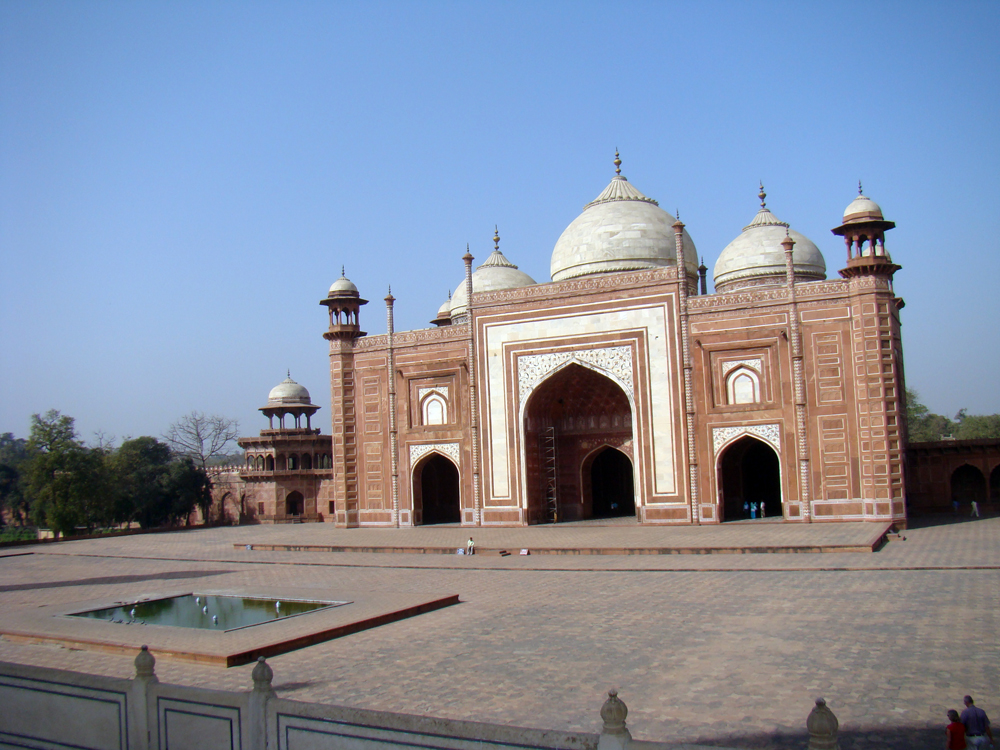
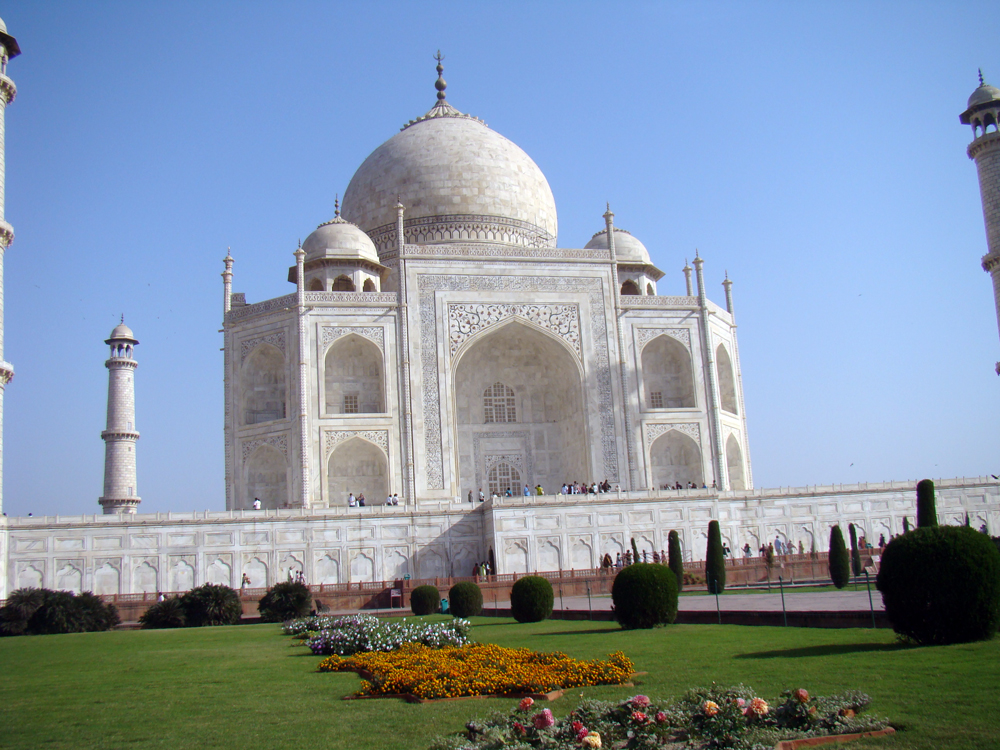
Show anyone a photo of the Taj Mahal complex, and chances are, they’ll immediately recognise it—and even be able to say that while the mausoleum (the ‘rauza’) is made of white marble, most of the subsidiary buildings are made of sandstone. The Jilau Khaana, for example, where visitors would dismount before entering through the Darwaaza-e-Rauza. Or the mosque and its mirror building, the Mehmaan Khaana.
A view of the mosque at the Taj Mahal

A view of the mosque at the Taj Mahal

Wrong on both counts. The rauza is not made of white marble, and the other buildings are not of sandstone. In fact, all the buildings in the complex are made of brick; the marble (‘sang-e-marmar’) and the sandstone (‘sang-e-Gwaliari’ is the name for grey or yellow; ‘sang-e-surkh’ is the name for the red) are only the cladding, which forms the attractive outer face of the buildings.
And that’s not all. Approximately forty different types of semi-precious and precious stones were used in the decoration of the buildings.

Accounts of the construction of the Taj Mahal complex refer to the sources from where material was procured. The most abundant—the white marble and the sandstone—came from close at hand: the red sandstone from Fatehpur Sikri and the white marble from Makrana (in Rajasthan).
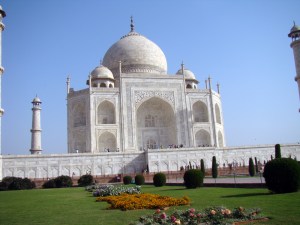
The rauza at the Taj Mahal

The rauza at the Taj Mahal

The more rare stones were brought from some very far-flung areas: malachite from Russia, jade from Kashgar in China, turquoise from Tibet. From as far west as the Nile Valley came cat’s eyes (also known as ‘lahsunia’); from the east, in Burma, came yellow amber. Lapis-lazuli were brought from Afghanistan, rubies from Sri Lanka. Other stones—orange-red cornelian, jasper, grass-green chrysolite, and deep blue (or green) heliotrope—were also procured.

[Note: You can click the illustration below to see a larger version].

Sources of some stones for the Taj

Sources of some stones for the Taj

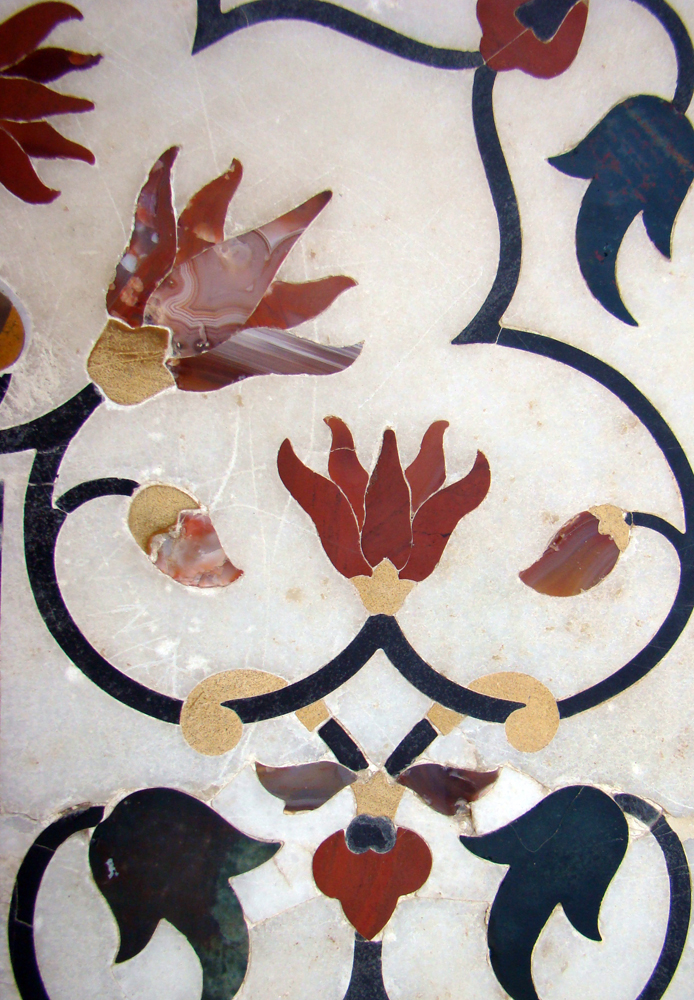
These stones were used in the pietra dura inlay (known in Hindustani as ‘parchinkari’) that decorates many of the buildings, most notably the mausoleum itself. To create a panel of parchinkari, a master artist would begin by drawing the pattern, in henna, on the surface of the marble. This pattern would then be carefully gouged out by the parchinkar, and the empty spaces thus created filled with very finely cut slices of the coloured stones. Variations in colour and pattern within the stone were used to create stunning effects of light and shade.
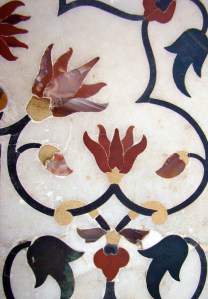
Parchinkari detail at the rauza, Taj Mahal

Parchinkari detail at the rauza, Taj Mahal

Engraved in Stone contains more fascinating information about how this parchinkari was done, so if you haven’t bought your copy yet, do so—there are some mouthwatering deals on at Flipkart, BookAdda, Landmark, etc! If you live outside India, you can order the Muzaffar Jang series on Amazon, Abebooks, and Infibeam, among others.

Plein Soleil (1960)

I’ve spent the past month—and more—focussing solely on Indian cinema. Time for a change, I thought.
This, therefore. Director René Clément’s Plein Soleil (literally, ‘Full Sun’, but known as Purple Noon) is a French adaptation of Patricia Highsmith’s The Talented Mr Ripley, and was the first major film of Alain Delon, who really does dominate the film. In more ways than one.

Alain Delon in Plein Soleil

Continue reading

Mai Baap (1957)

Today is the 100th birth anniversary of one of my favourite Hindi film actors, the extremely talented, very versatile Balraj Sahni. Born on May 1, 1913 (an interesting coincidence, considering he went on to become the first president of the leftist All India Youth Federation), Balraj Sahni became a prominent writer—first in English, later in Punjabi—and, of course, a brilliant, much-respected actor, with a dignity and screen presence that made him stand apart in films as different as Do Bigha Zameen, Waqt, Kabuliwaala, Haqeeqat, Anuradha, and Sone ki Chidiya.

Balraj Sahni in Anuradha

Continue reading

Shamshad Begum: A Tribute

When I began April 2013 on my blog, I’d promised this month would be dedicated to celebrating 100 years of Indian cinema—not merely Hindi cinema, as I tend to do, but regional language cinema as well. Apart from a review of the first full-length Indian feature film (Raja Harischandra) and a post on 100 years of Hindi film music (and how could I not post that, in a month commemorating Indian cinema’s centenary)?—I have tried to stick to my promise.

But, the day I was posting Songs for all times, I received a sad piece of news: that Shamshad Begum had died, just a little over a week after her 94th birthday. I did fit in a small tribute to Shamshad Begum in that post, but I had to say a fonder farewell, with a longer post showcasing this singer’s wonderful, very distinctive voice.

Shamshad Begum

Continue reading

Songs for all times: Celebrating 100 years of Hindi film music

Late last year, an editor from ForbesLife India wrote to me, telling me they’d be doing special ‘100 years of Indian cinema’ editions this year. Would I be interested in contributing an article? That was a no-brainer (or so it seemed), but when I got over my initial excitement and began to think, I realised that:
(a) I know virtually nothing about Indian cinema in general. Hindi cinema, yes; other Indian cinema, almost negligible.
(b) It was too vast a canvas. What would I write?

Much thought later, I offered to write about something I know something about: Hindi film music. What follows is a version of the article that appeared in the April-June 2013 issue of ForbesLife India. Do buy yourself a copy to read the final article—and to read some more interesting writing on a century of Indian cinema.

Jaan-pehchaan ho, from Gumnaam

Continue reading

Chaowa-Pawa (1959)

Serendipity: noun. plural: serendipities. The faculty of making fortunate discoveries by accident; the occurrence of such a discovery. Coined by Horace Walpole in 1754, based on a fairy tale called The Three Princes of Serendib (‘Serendib’ being present-day Sri Lanka)—the three princes in question often making such lucky discoveries.

And what does this have to do with Chaowa-Pawa (‘To Want and To Have’)? Simply that, while I had set about watching this film because I really, really like the lead pair—Uttam Kumar and Suchitra Sen—I realized, within the first half hour of the film, that it was a remake of one of my favourite old Hindi films, Chori-Chori (which, as many of you would know, was a remake of It Happened One Night). Serendipity? Absolutely.

Uttam Kumar and Suchitra Sen in Chaowa-Pawa

Continue reading