[This is a version of an article I wrote for the June 2013 issue of National Geographic Traveller India]. It is a sunny summer day, and my husband and I are in Strasbourg’s Palais Rohan. After the Nôtre Dame Cathedral, … Continue reading
[This is a version of an article I wrote for the June 2013 issue of National Geographic Traveller India]. It is a sunny summer day, and my husband and I are in Strasbourg’s Palais Rohan. After the Nôtre Dame Cathedral, … Continue reading
It is May 31, 1944. In London, the plans for D-Day have been finalized. The Allied invasion of Europe—and, hopefully, the subsequent collapse of the Axis—cannot be far. Things are looking bright. Perhaps a bit too bright? Perhaps the Allied top brass have been a trifle too complacent. Perhaps they’ve not realized exactly how far the Germans will go to find out more about the plans for the invasion.
A week or so ago, a cousin of mine who thrives on films about World War II, sent me a list of all the WWII films and documentaries he owns. He asked me to add to the list. With some caveats. He (like me) doesn’t like gory and gruesome films; he prefers films about missions, espionage, and adventures à la Where Eagles Dare. And he prefers films from the 60s, when colour and better special effects made films more realistic than they’d been in the 40s and 50s.
A couple of weeks ago, I was contacted by Nina Hilger, who works with Dzintars Cers of the Canadian Broadcasting Corporation. Nina said she’d read my list of ten favourite monsoon songs, had been inspired to rent the films in which those songs featured—and wanted to do a radio show on the monsoon in India. Would I be willing to do an interview? Of course, I was very happy to do so—and had an extremely enjoyable hour chatting with Nina and Dzintars, telling them about why I chose those songs, and what the monsoon means to us here in India (both the good and the bad—from hot chai and pakoras, to waterlogging and floods. This was, happily, before disaster struck in Uttarakhand).
It also inspired me to try my hand at another tribute to rain in Hindi cinema. A list of ten rain-related scenes (from pre-70s Hindi films) that I find utterly memorable. These may be memorable for different reasons, both good and bad, but what sets them apart for me is that they’ve stuck in my mind over the years.
Look what I found!
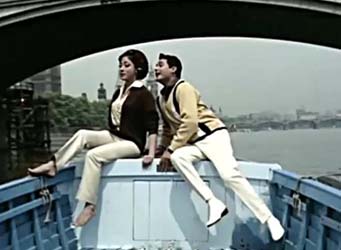
[To make that clearer to those not in the know: I am a die-hard Shammi Kapoor fan, especially of the Shammi Kapoor between 1957 and 1966. I have watched most of his films from that period, and to find one I haven’t seen is cause for rejoicing. Even if it turns out to be a dud. Therefore the euphoria].
I first came across a mention of College Girl while watching a video of Halke-halke chalo saanwre (from Taangewaali, also starring Shammi). Besides the music (which I loved), I thought the song looked great too, and was eager to try and get hold of Taangewaali—until someone told me that a neat job of mixing had been done here: the audio was of the Taangewaali song, but the video was from College Girl. College Girl went up on my list of films to search for—and I discovered it last week on Youtube.
On a stormy night, a Viking longship battles the elements. Waves sweep over, tossing the ship; rocks loom. The men aboard the ship yell in fear and try to hold on to the masts, to each other—to anything—in an effort to stop from being sucked in by the water or dashed against the rocks. But the inevitable happens.
“And so, by the storm’s fury, he lost all that he loved most in this world: his ship, and his shipmates. But he was washed ashore, alone, the only survivor. Then the monks found him and took him to their monastery, where they tenderly nursed him, never asking his name, or his country. And, gradually, he grew stronger…”
…Or to a painting, a photograph, a piece of music, or just about anything created. Even a dish.
I am not often tempted to write essays, and even this one isn’t going to be an extremely analytical one. Rather, a response to something that happened online last week.
To set the scene, a little bit of background. If you see my Twitter profile, I call myself (among other things) a foodie. I enjoy experimenting with food, I like eating out, and I am generally interested in food—what goes into it, its history, and so on. So, when an ex-boss invited me to a Facebook foodie group about a year back, I joined happily. I participate only occasionally, but I do keep an eye on what’s happening. People post recipes, discuss restaurants and food stores, talk about issues related to food, and so on.
Happy birthday, Shyama!
Today is the 78th birthday of one of my favourite actresses, the gorgeous Shyama. Born in Lahore on June 7, 1935, Shyama debuted at the tender age of 9, when she appeared onscreen as one of the chorus in the Zeenat (1945) qawwali , Aahein na bhareen shiqve na kiye. In a career that spanned 40 years and close to 150 films, Shyama played everything—from the shrew to the vamp, the tomboy to the domestic goddess. And she invariably shone, quite literally. Shyama’s sparkling eyes and bright, 1000-watt smile could light up the screen like few other actresses were capable of doing.
If you are one of the increasing number of people who prefer a digital book to a hard copy, here’s a great offer. The Muzaffar Jang E-Omnibus, consisting of the three Muzaffar Jang books (The Englishman’s Cameo, The Eighth Guest … Continue reading
Last week, chatting with a group of friends (equally mad about old cinema) on Facebook, I was stumped by a quiz question posted by one of them. Which was the first Indian language feature film to be made without any songs? Most of us who attempted to answer that question could only think of Hindi films, and the earliest Hindi non-songs film we came up with was Kanoon (1960). That wasn’t the answer—the correct answer was the Tamil film Andha Naal (That Day), made six years before Kanoon, and (like Kanoon) blending suspense—in the form of a murder mystery—with weighty issues about society and politics.
[Edited to add: According to blog reader and blogger AK, of Songs of Yore, the correct answer to that question is actually the 1937 Wadia Movietone film Naujawan].
There aren’t any records of how high summer temperatures rose during Shahjahan’s day—either in Dilli or across the rest of the northern plains—but one can safely assume that they probably wouldn’t have been much different from today’s broiling heat. So how did the Mughals survive the summer?
For the Emperor, his court, and the very wealthy, the solution was to leave the plains and spend the summer in the cool green Kashmir Valley.