Songs for all times: Celebrating 100 years of Hindi film music

Late last year, an editor from ForbesLife India wrote to me, telling me they’d be doing special ‘100 years of Indian cinema’ editions this year. Would I be interested in contributing an article? That was a no-brainer (or so it seemed), but when I got over my initial excitement and began to think, I realised that:
(a) I know virtually nothing about Indian cinema in general. Hindi cinema, yes; other Indian cinema, almost negligible.
(b) It was too vast a canvas. What would I write?

Much thought later, I offered to write about something I know something about: Hindi film music. What follows is a version of the article that appeared in the April-June 2013 issue of ForbesLife India. Do buy yourself a copy to read the final article—and to read some more interesting writing on a century of Indian cinema.

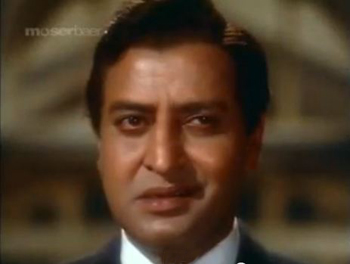
Jaan-pehchaan ho, from Gumnaam

Continue reading

Chaowa-Pawa (1959)

Serendipity: noun. plural: serendipities. The faculty of making fortunate discoveries by accident; the occurrence of such a discovery. Coined by Horace Walpole in 1754, based on a fairy tale called The Three Princes of Serendib (‘Serendib’ being present-day Sri Lanka)—the three princes in question often making such lucky discoveries.

And what does this have to do with Chaowa-Pawa (‘To Want and To Have’)? Simply that, while I had set about watching this film because I really, really like the lead pair—Uttam Kumar and Suchitra Sen—I realized, within the first half hour of the film, that it was a remake of one of my favourite old Hindi films, Chori-Chori (which, as many of you would know, was a remake of It Happened One Night). Serendipity? Absolutely.

Uttam Kumar and Suchitra Sen in Chaowa-Pawa

Continue reading

Pathala Bhairavi (1951)

When I’d decided to dedicate this month to regional Indian cinema, I’d also decided that I wouldn’t restrict myself to only the grim, stark ‘real’ films that win awards (Chemmeen, as you will see over the next few films, was an exception rather than the norm). After all, it’s not only the films which win awards that are remembered and loved. There are also films that may not be award-winning material, but are enjoyable and prove to be hugely popular.

Pathala Bhairavi—originally in Telugu, also dubbed in Hindi and Tamil—was one of these.  Although the research I’ve done doesn’t seem to indicate any awards won, this film was a superhit, which ran to packed houses for weeks on end. It was also the only South Indian film to be selected for screening at the first International Film Festival in Bombay in 1952. And—this was what made me want to see it—it was a fantasy film, one of my favourite genres.

The cave of Pathala Bhairavi

Continue reading

Chemmeen (1965)

When I first began searching the Net to find landmark regional films to review for this special ‘100 years of Indian cinema’ celebration, Chemmeen was one name that cropped up again and again. It sounded impressive. This was one of the first Malayalam films to be made in colour; more importantly, in won the President’s Gold Medal for Best Feature Film at the National Film Awards in 1965. It was screened at both the Cannes and the Chicago Film Festivals, and was greeted with much critical acclaim (not to mention commercial success)—it was even released, dubbed, in Hindi as Chemmeen Lehren, and in English as The Anger of the Sea.

All it needed was for me to discover that the music director of this film was an old favourite (Salil Choudhary) and that Manna Dey sang in it, and my mind was made up: I had to watch Chemmeen.

Madhu and Sheela in Chemmeen

Continue reading

Raja Harischandra (1913)

April 2013 has a special significance: this month marks 100 years of Indian cinema. The country’s first indigenously produced full-length feature film, Raja Harischandra, made by the legendary Dhundiraj Govind ‘Dadasaheb’ Phalke, was shown to a select audience at Bombay’s Olympia Theatre, on 21st April, 1913.
(Note: There is some controversy about this; some film historians believe that Shree Pundalik, 1912, was the first full-length feature film).

But. Celebrating the centennial of Raja Harischandra seemed good enough reason to dedicate this month to Indian cinema. Not just Hindi cinema, as I have been prone to do, but Indian regional cinema. I am painfully aware that the only regional language cinema I’ve reviewed so far has been Bengali, so this is a good place to make a start. April 2013 on Dusted Off is going to be when I set about exploring more of cinema from across the country.

I thought it appropriate to begin with Raja Harischandra itself.

Dhundiraj Govind 'Dadasaheb' Phalke

Continue reading

Mughal charbaghs: some trivia, some basics

The most common form of the Mughal garden is the ‘charbagh’, so named because it consisted of a four-sided garden, with two streams of water running perpendicular to each other. Supposedly a representation of Paradise, this garden concept was originally Persian and made its way to India with Babar, when he began to rule in Agra.

The Nishat Bagh, in Srinagar, laid out in 1632 by Asaf Khan, the brother of the Empress Noorjahan.

Continue reading

Mirza Sahiban (1947)

If you’ve read Greta’s latest blog post, you’ll know there are some recent and  utterly mouthwatering additions to the Edu Productions page—including this film, Noorjehan’s last to be made in India. Greta, on the Edu Productions page, mentions that source is a mediocre quality tape supplied by Muz.” Well, no longer. Tom’s cleaned it up beautifully, and Pacifist has subtitled the film. The result is something I’m grateful for. And that, coming from someone who’s not a fan of tragic romances, is a lot.

Noorjehan and Trilok Kapoor in Mirza Sahiban

Continue reading

The Paradine Case (1947)

This is one of the few Hitchcock films I didn’t see in my younger years. And, considering that Hitchcock is one of my favourite directors, and Gregory Peck one of my favourite actors, that is odd indeed. Perhaps I should put it down to the fact that The Paradine Case is not one of Hitch’s best-known works; in fact, he more or less washed his hands off it. And Peck, too, seems to have not really liked it.

Gregory Peck in The Paradine Case

Continue reading

Sharmeelee (1971)

Happy 75th birthday, Shashi Kapoor!

Yes, the youngest of the three Kapoor brothers was born on March 18, 1938, in Kolkata. He is one of my favourite actors, and one of the very few whom I like also in his 70s avatar—that charm didn’t desert him with time. But. To return to the time period this blog specializes in: looking through the films I’ve reviewed till now, I realized there are only a handful of Shashi Kapoor films here. Prem Patra (another favourite), Pyaar Kiye Jaa, Pyaar ka Mausam, The Householder, Benazir.

So, this calls for another review, another Shashi Kapoor favourite of mine. Sharmeelee, which, though it was released in 1971, has enough of the feel of the 60s—in fashions, music, crew and cast involved—for me to include it in my list. Most of all, it has Shashi Kapoor at his absolutely irresistible best.

Shashi Kapoor in Sharmeelee

Continue reading