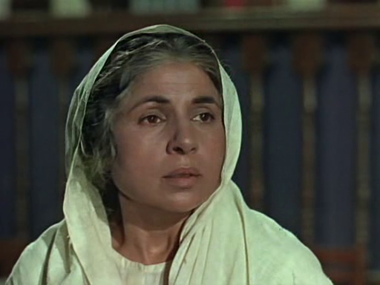
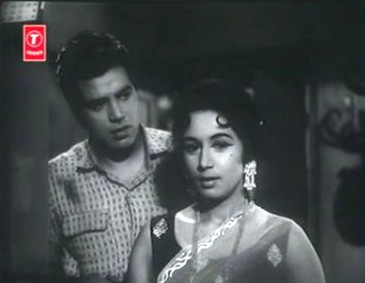
By some strange oversight, despite the fact that Waqt is one of my favourite masala films, I’ve never reviewed it on this blog. And I’m wishing I didn’t have to end up writing about it on such a sad occasion—because Achla Sachdev, the actress who played the self-sacrificing, long-suffering mother and wife in this film, passed away on April 30, 2012.
Tag Archives: Achla Sachdev
Azaad (1955)
After all the unhappiness over the past week or so – first Ravi’s death, and then Joy Mukherji’s – you’d think the last film I’d want to see would be one that starred the ultimate tragedy couple: Dilip Kumar and Meena Kumari.
But, thanks to Anu, who assured me that Azaad was loads of fun, I decided I should try watching this one. And yes, Anu: I loved it. Loved Meena Kumari’s pretty peppiness. Loved Dilip Kumar at his swashbuckling, handsome, thoroughly attractive self. Loved the smoke rings (almost perfect circles) that Pran blew. Loved Sai and Subbulaxmi’s awesome dancing. Loved C Ramachandra’s fantastic music.
Mere Sanam (1965)
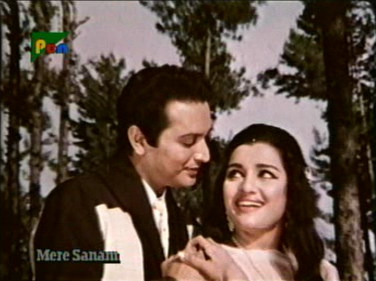
Nasir Hussain may have made his Tumsa Nahin Dekha story into four separate – and equally successful – films, but did that induce others to be original? On the contrary. Narinder Bedi, at least, probably seemed to think that what worked for Nasir Hussain might well work for him. Therefore, Mere Sanam, which has a storyline similar in many ways to Tumsa Nahin Dekha. (Both films also have fantastic music by OP Nayyar, by the way).
Rajkumar (1964)
My blog has featured Shammi Kapoor now and then – with reviews of some of his films, in my list of classic Hindi cinema’s handsomest men (which he topped, by a very long margin), and in various lists of songs.
Yesterday morning, when I woke up and logged on to the Internet, the first news headline I saw was that Shammi Kapoor had passed away. I have never been so affected by the passing away of one of the many stars of the past who have died in the recent past… but the news of Shammi Kapoor’s death brought tears to my eyes. I have a lump in my throat even as I type this.
I had not really intended to write this review now. I am in the midst of a blog project in which each post links to the previous and the next posts in some way or the other. But I could not ignore the passing of my favourite actor. I would never forgive myself for that. So, while this post does have a connection to the last (Humayun was a ‘raja-rani’ – ‘king-and-queen’ – film; so is Rajkumar), it is, first and foremost, a tribute to the brightest, most joyous and most entertaining star of the 60s. A sun that will never set.
Jahanara (1964)
Hindi cinema’s fascination for the Mughals is – well, fascinating. Even before independence, we were busy churning out semi-historicals such as Humayun (1945) and Shahjehan (1946); then, in the 50s and 60s, there followed a spate of rather more big-budget extravaganzas, complete with big names, vast armies, glittering palaces and superb music: Mughal-e-Azam, Taj Mahal and Anarkali (Note: As a character, Anarkali seemed to be especially popular. Besides the Bina Rai-Pradeep Kumar version, there were Tamil, Telugu and Malayalam versions of her story; even a Pakistani version starring Noor Jehan. And that list neither includes the two versions made in 1928, nor a 1935 film starring Ruby Myers. Note that Mughal-e-Azam is also about Anarkali).
Shagoon (1964)
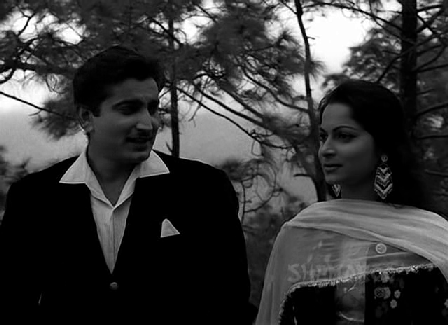
Dare I repeat myself by admitting that one of the reasons I wanted to see this film was the music? Shagoon (which I think should have been spelt Shagun) combines Sahir Ludhianvi’s lyrics with Khayyam’s music, to stunning effect. But my other reasons for watching this film were equally valid. It stars the matchless Waheeda Rehman in the only film where she co-starred with Kamaljit, later to be her husband. What chemistry there must be here, I thought. Plus the film featured some of the most dependable character actors of Hindi cinema: Nasir Hussain, Achla Sachdev, Pratima Devi, Chand Usmani. This one had to be worth seeing, I thought.
Humraaz (1967)
I watched two old Hindi films last week, both with a love triangle—of sorts—as a central plot element. The first film, Saheli (Pradeep Kumar-Kalpana-Vijaya Choudhary) was an indifferent, predictable, forgettable flick which crescendoed into high melodrama. This one, a rewatch, makes for more satisfying reviewing, since the story is more interesting, the cast is better—barring one glaring and painful exception—and the music is out of this world. Humraaz is a BR Films production and a fine example of the high entertainment value that characterises BR Chopra’s best films. Total paisa vasool.
Khozhdenie Za Tri Moray (aka Pardesi) (1957)
Frequent readers of this blog have probably realised I have a soft spot for ‘real life’ stories: Gladys Aylward, Dr Kotnis, Changez Khan, Shahjahan: I’m game. Of course, I don’t always end up with films that bear any resemblance to the life of the person in question, but there’s no harm in trying.
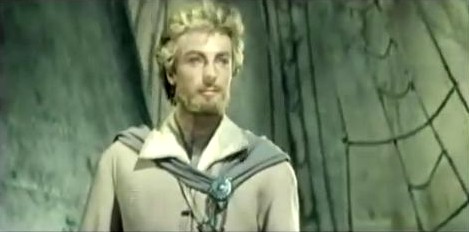
So, another. Afanasy Nikitin was a horse trader from Tver in Russia, who came to India in the late 15th century, having started off from Tver in 1466. His travels took him down the Volga River, through Persia, and then via dhow to India. He is believed to have disembarked in present-day Maharashtra; over the years that followed, he travelled through a large part of peninsular India, including Bidar and Vijaynagar. He died in 1472 in Smolensk, on his way home; his travelogue of India, however, endures: entitled Khozhdenie Za Tri Moray (‘The Journey Beyond Three Seas’), it describes in detail all that Nikitin saw of what was to him a wild, exotic land like nothing he knew.
Gyaarah Hazaar Ladkiyaan (1962)
What is a writer without readers? What is a blogger without people who stop by to read, comment, suggest, recommend, and encourage?
So, in gratitude to everybody who’s been visiting this blog over the months: this month on Dusted Off is dedicated to you. All through September 2010, the posts here will be connected in some way or the other to the readers of Dusted Off. The film reviews will be of films that have been recommended, given, or otherwise suggested by readers; and the lists—those ‘top tens’ I’m so fond of—will be of requests made by readers.
To begin with, this film. When I posted a review of Bhai Bahen a while back, it sparked off a discussion on N Dutta’s music—and reader Ash mentioned Gyaarah Hazaar Ladkiyaan, for which too the score had been composed by Dutta. After we’d indulged in much speculation about the film’s plot (what an intriguing title, right?!), another reader, Shalini, was kind enough to say that she had a copy, and was even more kind enough to share it. Therefore…
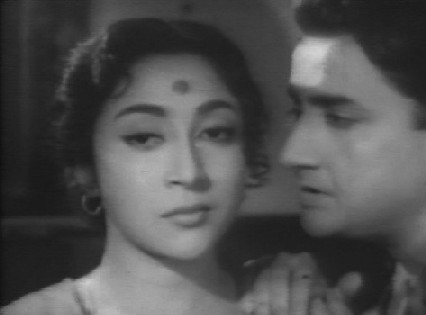
Akashdeep (1965)
Once upon a time, there was a writer.
No: it wasn’t Dharmendra, and it certainly wasn’t Nanda (old Hindi cinema, at least, doesn’t seem to believe women capable of writing anything more complex than a love letter, if that).
This writer was someone quite different, and one day (I’m guessing) decided that it was time to show the world what he was capable of. So, with a producer and a director, the writer went into action, and what resulted was Akashdeep. Looking at the film, I’m assuming this was somewhat of a collaborative effort. A “how about this?” and a “don’t you think it would be a good idea—?” sort of film.